

- Small budget PR wins by building a linkable asset — original data, one clear headline finding, and a specific journalist beat — using low-cost sources like surveys, internal analytics, or repackaged public data
- Best-performing formats are surveys, stats roundups, simple tools, and annual benchmark reports, since original data consistently beats plain content
- A strong pitch leads with the finding (not the company), stays short, and includes methodology — and earned coverage compounds over months as new writers pick it up
- Track more than just backlinks: referring domains, unlinked brand mentions, traffic, and journalist response rate, since AI search increasingly relies on mentions as much as clickable links, and earned links outperform paid ones long term
Big agencies win accolades for six-figure campaigns that reach millions. None of those tactics will actually boost your search rank, business growth or backlinks. A small group with a great question, a short survey and a targeted email list quietly receives coverage in key industry magazines. It’s not a coincidence. This is a repeatable system. A good digital PR campaign doesn’t require a big budget or a viral moment to make an impact. It requires original information, a clear conclusion, and outreach that takes the time of a journalist.
1. Budget Size Is Not A Direct Indicator Of PR Results
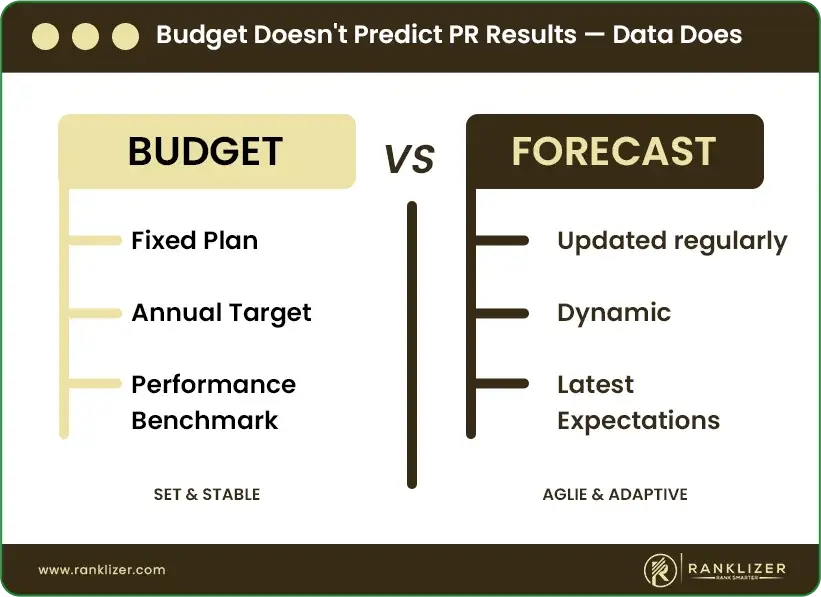
One of the most expensive myths in marketing is that spending more will yield better PR results. In reality, a more budget friendly PR plan that is based on actual data is more likely to outperform expensive PR plans that focus on style over substance.
Journalists don’t ask the cost of a campaign. They wonder if the story provides their readers with something useful. A recent survey finding that addresses a question a specific audience is already asking will always outperform a shiny content piece that says nothing new. Reach and distribution are determined by budget. It is not a criterion for deciding whether a story is worth telling.
Lean campaigns tend to win for the following reasons:
- Specific data trumps general noise; targeted results are delivered to targeted journalists.
- Small surveys yield statistics that can be cited in publications.
- There is no substitute for original findings; journalists can’t just link elsewhere.
- Low cost earned media coverage builds over months with no continued investment.
The most successful businesses in terms of regular PR backlinks are not the ones with the deepest pockets. They are the ones who see PR as a system of specificity and data, not of spectacle.
2. How To Make Your PR Asset Linkable
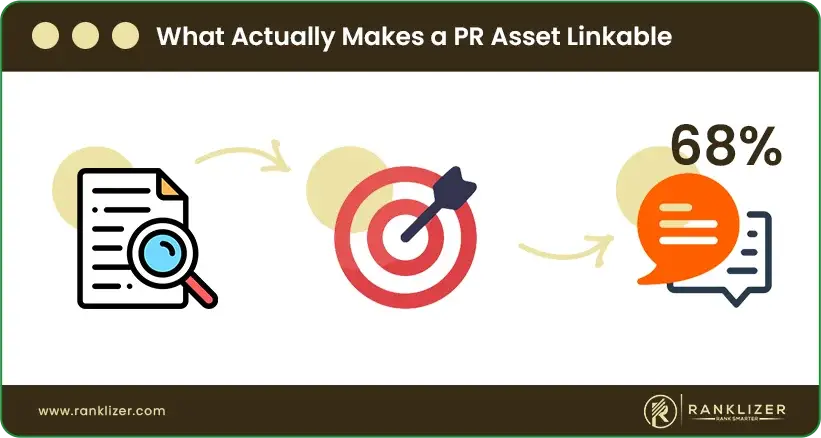
A linkable asset is a term that is always used in SEO and PR. But few people attempt to explain what makes one piece of content link worthy and another not. It all depends on substitution. A journalist connects to something when no other source gives him the same information. If the data, finding, or resource is available elsewhere, there is not a strong reason to link to that particular source.
The core of the original data is the key. Even a small internal survey or public record study is something new a corporation creates when it releases it.
Relevance to a specific beat also matters. The following statistic is relevant to journalists reporting on the gig economy: a stat about gig pay volatility means little to a journalist covering something else entirely.
A headline finding that travels. Each strong linkable asset is based on one number or one insight that can be contained in one sentence. A statement such as “68% of small business owners have never pitched a journalist” is specific, surprising and immediately useful. Every pitch, every follow up and every placement the campaign receives is anchored by that one line.
3. The Real Building Blocks Of A Data Driven PR Campaign
A data driven PR campaign doesn’t start with a content calendar or a media list. It begins with a hypothesis, a particular query that a certain audience of journalists would want answered. The hypothesis should be clear and specific enough to be of interest regardless of the outcome of the answer. The question “What are small business attitudes toward marketing?” is not a hypothesis. The question is: “What percentage of small business owners have cut back their content budget over the past year?” The difference is specificity. Specific questions yield specific findings, and specific findings are cited.
The three elements all campaigns require:
- A clear hypothesis that is related to a question that journalists in a particular vertical are asking.
- A small but honest dataset: 100 to 300 responses is sufficient if the sample is appropriate for the claim.
- One headline discovery that is a single memorable sentence.
- A methodology note that describes the sample size and data collection.
The data doesn’t have to be enormous. It has to be honest, relevant and specific enough to be of use to a journalist on deadline.
4. Low Cost Data Sources That Yield Citable Results
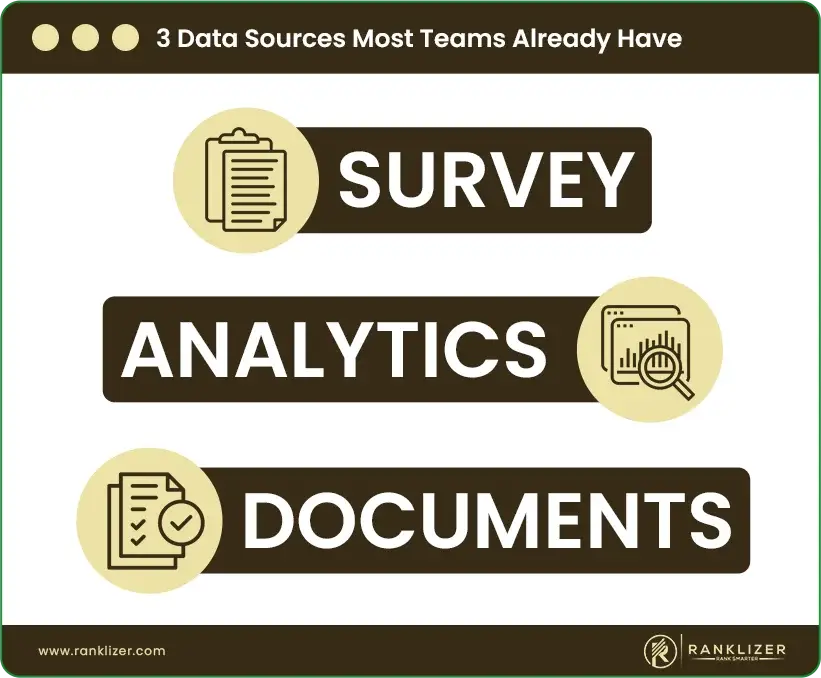
The biggest problem that small teams have with an original research campaign is the belief that original data is expensive to produce. In fact, there is data in most businesses that is worth packaging. The challenge is identifying it and articulating it in a way that a journalist not in the organization can use.
Customer and Audience Surveys. Within a week, publishable findings can be obtained from a small number of people (a few hundred) using a short survey sent to an existing email list. Google Forms and other free tools allow for easy distribution. The important thing is to ask specific questions that are related to a hypothesis, rather than general satisfaction questions that yield general results. A 10 question survey with 150 responses in a niche industry is more useful to a journalist than a 1,000 person survey with no interesting questions.
Internal Analytics and Platform Data. Data that is aggregated and anonymized from a business’ own platform or operations can be a very citable source. Industry level usage trends, behavior patterns or performance benchmarks provide data that journalists can’t find anywhere else. This is one of the most underutilized data driven PR sources for small businesses.
Public Data Repackaged. There is a vast amount of raw data in government databases, academic studies, and public records that very few people have translated into a readable story. Compiling and contextualizing that data, connecting dots that no one has connected before, is a true linkable asset with no primary research costs.
5. Budget Friendly Campaign Formats
It doesn’t take a lot of money to create a great PR strategy. There are some of the most effective digital PR formats for small businesses that require little more than time and attention. The format should be the same as the data. A set of statistics is best suited as a roundup or press release. A trend analysis is best suited for a short report. One surprising number is best used as a single pitch. One of the most frequent causes of solid research not getting coverage is the wrong format of the data.
Formats that provide excellent link building strategy results with little or no budget:
- Statistics roundups: Gather public statistics and add original context to a reference resource.
- Small surveys: 100 to 300 targeted responses in a niche yield highly citable findings.
- Simple tools: Passive links are earned for a free tool that answers a common industry question, such as a simple calculator.
- Expert reaction pieces: Quickly analyze a new, significant report and get a citation.
- Repackaged public data: New analysis of government or academic data that no one else has done.
- Annual benchmark reports: Repeating a survey each year establishes credibility and provides journalists with a story to report on.
These types don’t need to be viral or costly. Each one has clarity, a target audience, and a dedication to produce something valuable, not something that looks amazing.
6. Campaign Format Comparison: Cost vs. Link Potential
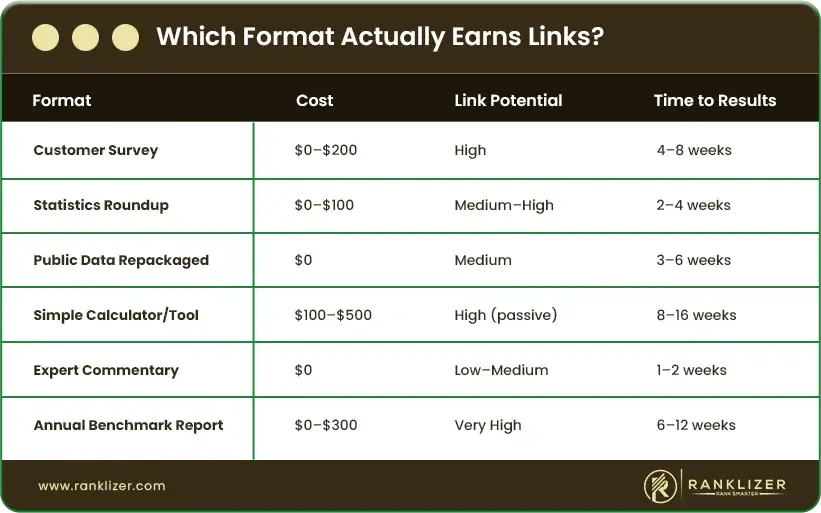
The format of a small budget campaign is dependent on the resources available, the timeframe and the type of data the business already has. But let’s look at some formats in four important dimensions to help teams make that decision clearly. The table below shows the estimated cost of the format, along with the potential time to first results.
| Format | Cost | Link Potential | Time To First Results |
| Customer Survey | $0 to $200 | High | 4 to 8 weeks |
| Statistics Roundup | $0 to $100 | Medium to High | 2 to 4 weeks |
| Public Data Repackaged | $0 | Medium | 3 to 6 weeks |
| Simple Calculator/Tool | $100 to $500 | High (passive) | 8 to 16 weeks |
| Expert Commentary | $0 | Low to Medium | 1 to 2 weeks |
| Annual Benchmark Report | $0 to $300 | Very High | 6 to 12 weeks |
Content only formats are consistently outperformed by original data formats on link potential. The time invested is real, but the effects are cumulative and continue long after the initial outreach cycle is over, which paid placements can’t do at the same cost.
7. Creating A Journalist Outreach List That Generates Responses
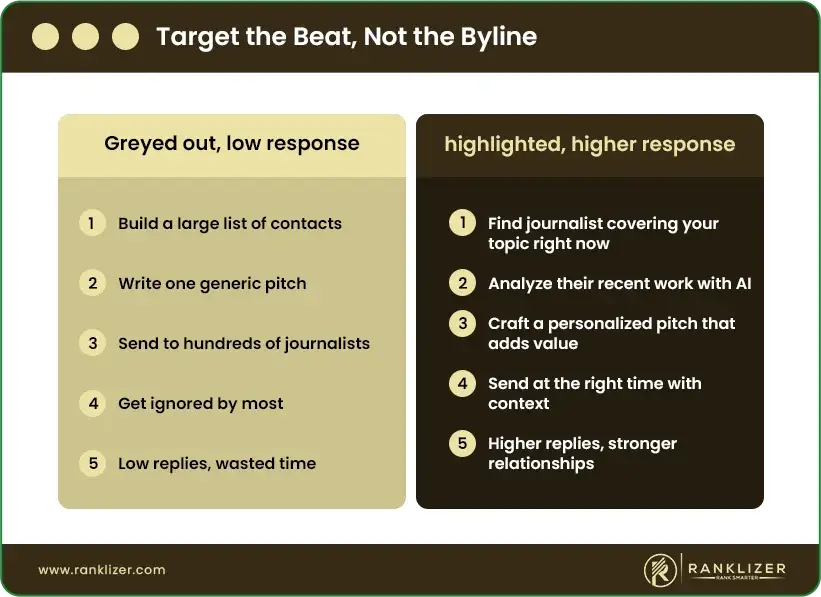
One of the most consistent methods of wasting time in PR is mass outreach. It’s tempting to send the same pitch to 500 journalists. It rarely yields any results.
Target by beat, not by publication. A small business finance reporter at a large publication is a much more likely source for relevant data than the general business editor of that publication. Journalist outreach is effective when it’s not only about the brand name of the publication, but also matching the finding to the beat.
Ensure that the list is kept up to date. Journalists switch jobs more frequently than you think. If the media list was correct six months ago, it may have 20% wrong contacts today. Sending pitches to outdated contacts is a sign of carelessness and a loss of the best opportunities in the campaign.
8. Writing A PR Pitch That Gets Read And Acted On
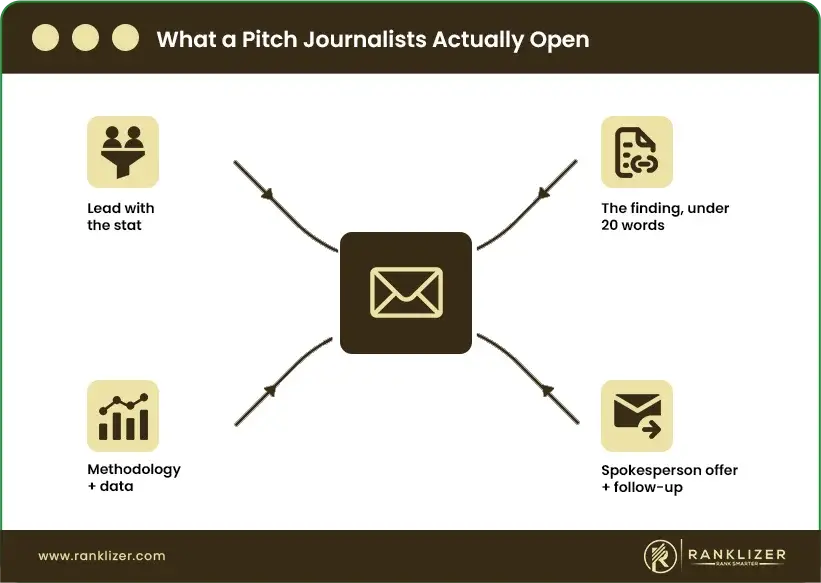
The problem with small budget PR pitches is not that they’re lacking in substance, but how they’re presented. Journalists get bombarded with pitches throughout the day. The subject line and first two sentences need to be compelling for journalists to read on. A PR pitch that journalists will answer starts with the finding, not the company. This is not only more considerate of the journalist’s time, it also makes their job easier by giving them the information they need up front.
The components of a pitch that will get a response:
- The subject line should contain a specific stat or finding, not a company name or a general topic label.
- Opening sentence: the main discovery, clearly expressed in less than 20 words.
- Body: methodology note, supporting data points and link to full asset.
- Offer: a spokesperson for remark, or raw data for independent use.
- Length: 150 words or less; may offer more on request.
- Follow up: send one email 5 to 7 days later.
9. How Earned Media Coverage Compounds Over Time
Original research earned media coverage is different from most other content distribution methods. A well cited statistic from a small survey can be found in dozens of publications over months and years, as new writers find it and cite it in new stories.
Once you have a strong finding to build a digital PR campaign around, you can continue to get links long after the initial outreach cycle. This compounding effect alters the math for small teams that are investing a small amount of resources into earned media. If a campaign gets eight placements in the first month, it can get another dozen placements in the next three months as secondary publications pick up the story, with no extra funding.
10. What A Small Budget PR Campaign Actually Achieves
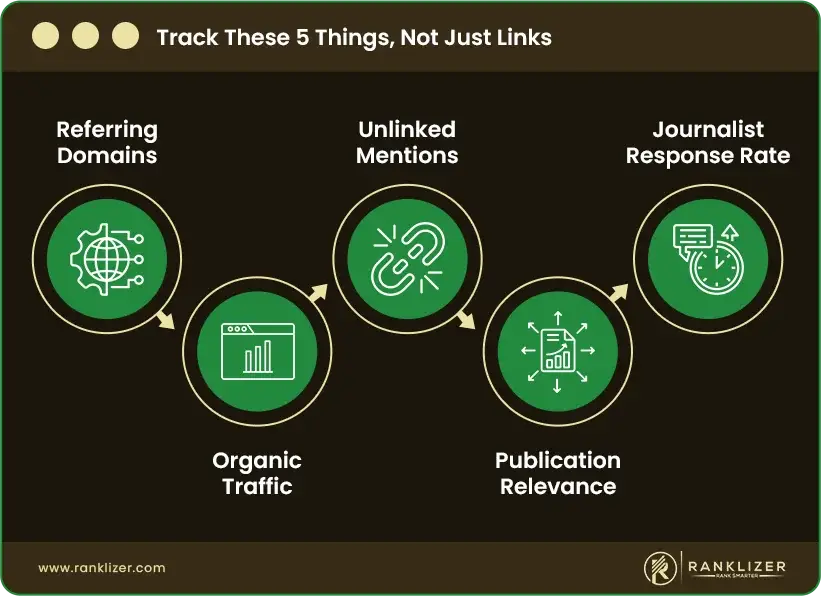
When it comes to measuring the impact of a minimal budget PR plan, it’s not all about the number of links. Volume is not as important as quality, relevance, and context. Most small teams underestimate their campaigns’ actual results because they only measure direct backlinks.
After each campaign, these are the metrics that should be monitored:
- New referring domains that were added to the site.
- Organic traffic the asset page receives in the first four to eight weeks after it is published.
- Brand mentions in the same article that are not linked to the brand name.
- The domain authority and relevance of the publications that reported the finding.
- Keyword ranking fluctuations for terms closely related to the campaign topic.
- Journalist response rate.
Here it is important to have realistic expectations. A first campaign from a lean team could get 5 to 15 placements. This is a worthwhile outcome. The purpose is not to replicate an agency case study, but to create a process that can be repeated and improved with every iteration.
11. The Power Of AI Search For Brand Mentions
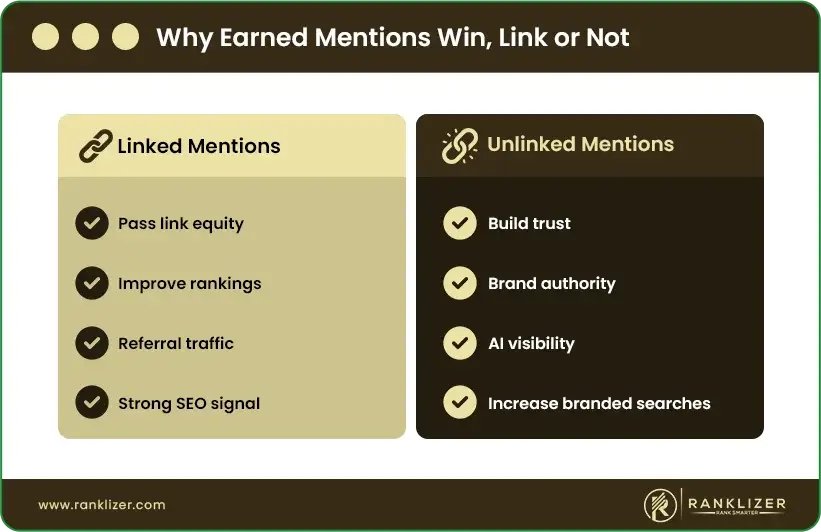
The primary focus of most digital PR strategy 2026 conversations is backlinks. Focusing only on backlinks is becoming incomplete. AI powered search algorithms are relying on brand mentions for journalistic citations, even without a clickable link, a shift documented by Google Search Central.
Why unlinked mentions still deliver value: even if a placement doesn’t contain a clickable link, it can still provide measurable value for brand mentions SEO. The mere mention of the term conveys relevance and authority to search systems that are becoming more entity and relationship aware than anchor text and URL dependent.
What this means for campaign planning: if you’re a small team with a lean PR program, the brand mentions SEO opportunity translates to a mention in a publication that doesn’t link out, and that mention still counts.
12. Timing Outreach For Better Response Rates
One of the most frequent errors made in journalist outreach is sending a pitch at the wrong time. Editors have news cycles and reporters have editorial calendars. A finding on hiring trends is more likely to be picked up in January than August. A report on online shopping behavior is better received before the holiday season than after.
The following are outreach timing principles that have proven to be effective in enhancing response rates over and over again:
- The highest open rates are seen Tuesday to Thursday, 9am to 11am in the journalist’s time zone.
- Avoid Monday mornings, as journalists are catching up on the week’s backlog.
- Avoid Friday afternoons, as journalists tend to finish stories, not start them.
- If possible, link the pitch to a news event occurring in the industry at the time.
Timing is not a substitute for pitch quality or data strength. However, a well written pitch sent at the right time and to the right person will be received at a measurably higher rate than the same pitch sent without any thought to when it is sent.
13. Earned Links vs. Paid Links: What The Data Actually Shows
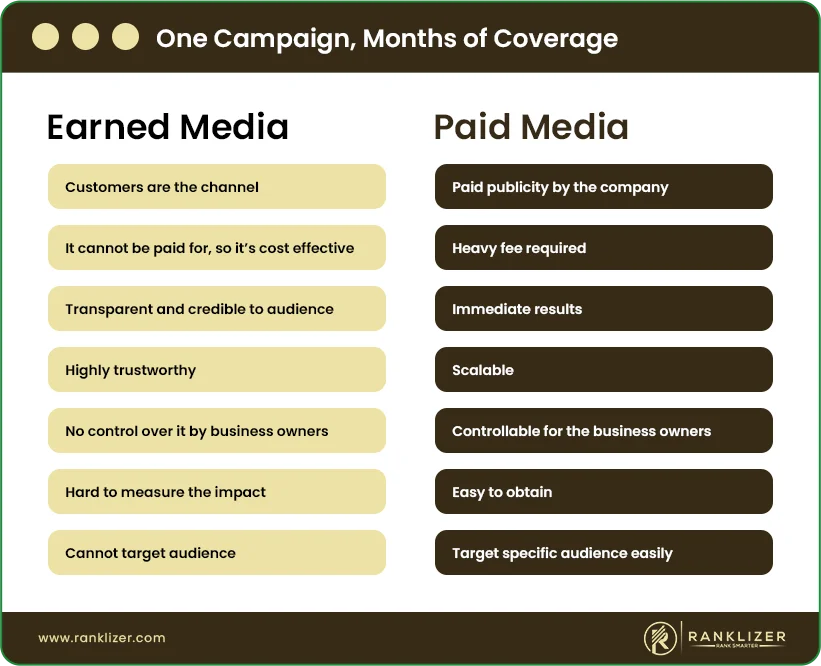
There is no debate for teams that have been running paid and earned links for a significant period. Paid placements provide links in a timely fashion. A journalist who decides to link to a discovery because it’s actually helpful to their readers is telling a very different message than a journalist who is paid to link to a discovery. The ability of search systems to differentiate between these two categories has become more sophisticated, and the value difference between them is growing larger every year.
While it’s not just a matter of principle, it’s also a matter of the numbers when it comes to the long term SEO and brand authority results a small business can expect for a limited investment in digital PR link building. The initial effort required to create a real dataset is real. That investment always pays off better in the long run than paid link strategies do at similar cost.
14. Running A Survey Campaign From Start To Finish
There is no research budget needed for a survey campaign SEO strategy. What is needed is a clearly defined question, an accurate methodology, an adequate sample for the claim made, and results presented in such a way that journalists can make use of them in that beat.
The process of a small team conducting a survey campaign step by step:
- State a hypothesis that is connected with a question that a specific group of journalists would be interested in.
- Create 8 to 12 questions to build toward a compelling headline finding.
- Emphasize the best finding and develop the pitch around it.
- Prepare a press release summary including the headline stat, supporting data and methodology note.
- Time the outreach carefully, avoiding Monday mornings and Friday afternoons, as covered in section 12.
- Send a tight pitch to a targeted list of journalists covering the relevant beat, then follow up once.
The Only Campaign That Fails Is The One Without A Start
When small teams are not getting PR coverage, there’s a pattern that emerges. They know how it works. They all believe that original data yields better results than generic content. They understand that a targeted journalist outreach list works better than a mass blast. The digital PR strategy 2026 playbook for small businesses is not difficult. Choose a question that is worth answering. Gather information from an existing audience. Construct one solid discovery. Last but not least, deliver a short and punchy pitch to 20 journalists who cover the beat. This is the entire system.