

TL;DR Summary
- Digital advertising means paid ads online (search, social, display, CTV, retail media, audio) that you can track and measure.
- Ads are bought through automated auctions, with DSPs buying and SSPs selling through real-time bidding, and search ads rank on bid plus Quality Score.
- You pay by CPC, CPM, CPA or CPV, and judge success by conversion rate, CPA and ROAS, not clicks.
- Small businesses should set a goal, pick channels, install tracking, test small, then scale what works.
Digital advertising now makes up the biggest share of global advertising spend, but what happens between committing a budget and seeing a profit remains opaque to many businesses.
This guide covers what digital advertising is, how it works, which channels fit which goals, and how to evaluate its effectiveness.
What Is Digital Advertising?
Digital advertising refers to the paid placement of messages in media accessible over the internet, including search engines, social platforms, websites, apps, streaming services, and online marketplaces.
What sets it apart from traditional advertising is that you can measure how a targeted audience responds with a high degree of accuracy. A billboard, for example, cannot tell you who has seen it. A digital ad can report who has seen it and what they did immediately afterwards (or weeks later, if it prompted a purchase).
Digital advertising is one component of a larger marketing effort. Marketing is an umbrella term that covers advertising, media relations, owned and paid social media, and other promotional activities, whereas advertising is concerned specifically with paid placements.
Digital Advertising versus Digital Marketing
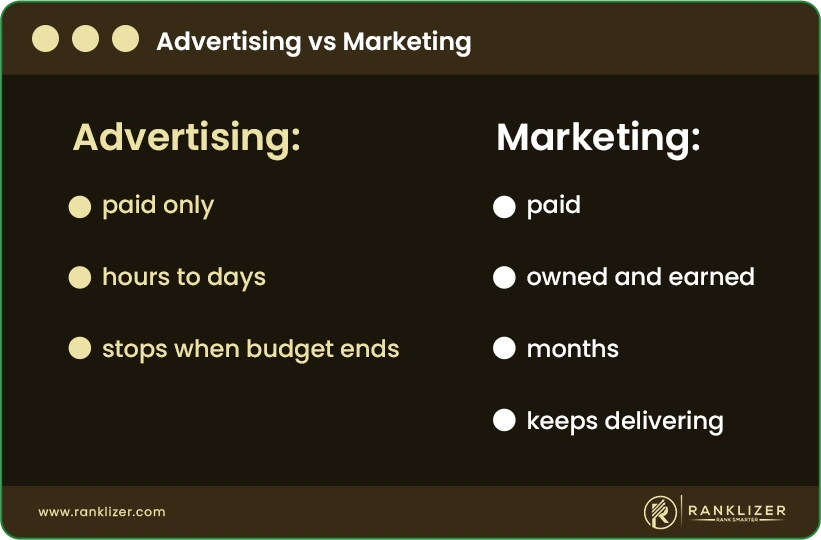
In short, marketing is concerned with both building and distributing value, while advertising is the act of paying for attention.
Digital Advertising vs Traditional Advertising
Traditional media sells estimated reach (a half-page ad in The New York Times costs X per thousand people reached), whereas digital media typically sells individual impressions in real time.
This gives advertisers the three core benefits of digital advertising: precision, measurement, and flexibility.
How Does Digital Advertising Work?
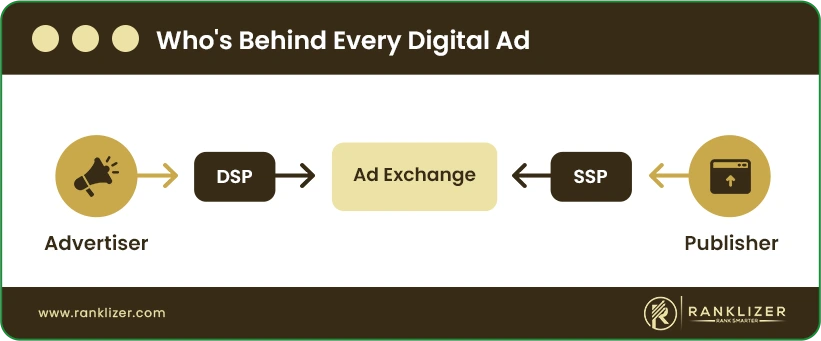
Behind every digital ad is a complex system of intermediaries and an auction process that determines which advertiser gets which impression. Here is a breakdown of the key players.
Key Players in the Digital Advertising Ecosystem
| Players | Description |
| Advertisers | Businesses that buy impressions to meet a marketing objective. |
| Publishers | Websites, apps, and streaming services that sell ad inventory. |
| Walled gardens | Closed ecosystems (Google, Meta, Amazon, TikTok) that own both the audience and the buying platform. |
| Intermediaries | Ad exchanges, DSPs, and SSPs (see below). |
A small number of these walled gardens, led by Google and Meta, capture a disproportionate share of total ad spend. Their influence extends to how budgets are allocated, what data is shared with advertisers, and how advertising technology evolves.
The Technology Behind Digital Advertising
The open web requires an additional layer of technology to run the auction between advertisers and publishers.
| Components | Description |
| Demand-side platform (DSP) | The advertiser’s buying interface; it evaluates which impressions to buy and at what price. |
| Supply-side platform (SSP) | The publisher’s selling interface; it makes inventory available for purchase. |
| Ad exchange | The auction platform where DSPs and SSPs meet. |
| Ad server | The technology that stores creatives and displays the winning bidder’s creative. |
| Customer data platform (CDP) | A repository for the advertiser’s first-party data, used for segmentation and suppression. |
DSP vs SSP: A DSP works for the buyer and helps advertisers get impressions at the right price. An SSP works for the seller and helps publishers earn the highest price for their inventory.
This automated process is known as programmatic advertising. For display ads, it typically involves real-time bidding (RTB), in which advertisers compete for an available ad slot.
Real-Time Bidding Explained
When a publisher’s page opens in a user’s browser, these steps take place before the ad loads:
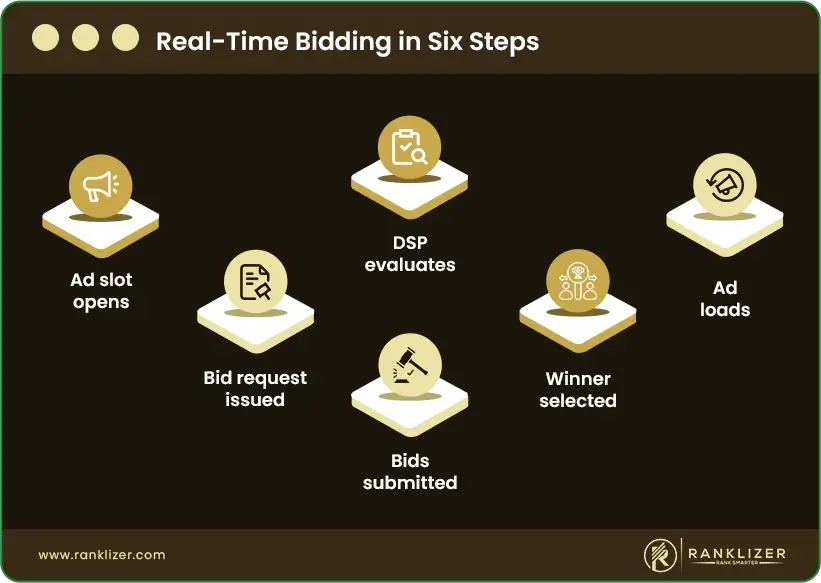
An ad slot opens. When a user navigates to a page, the publisher’s ad server identifies open slots and passes them to the publisher’s SSP.
A bid request is issued. Anonymized data about the impression (the page’s topic, the user’s approximate location, the device they are using, etc.) is sent to ad exchanges.
The DSP evaluates the request. It weighs the user’s characteristics against the advertiser’s target audience and decides whether to bid and at what price.
Bids are submitted. Interested advertisers virtually “raise their hand” to compete for the impression.
A winning bid is selected. The highest bidder wins the auction.
The ad loads. The winning creative is displayed, and the impression is recorded.
How Search Ads Work
Google and other search engines have their own way of ranking ads. Here is what you need to know.
Google’s auction takes into account your maximum CPC bid as well as the Quality Score of your ad and landing page.
What this means in practice:
A relevant ad with a lower maximum bid can beat a higher but less relevant bid.
Strong Quality Scores can reduce your CPC.
Weak Quality Scores can lower your ad position and raise your costs.
In short, relevance is rewarded and irrelevance is penalized.
A Summary of Digital Advertising Channels
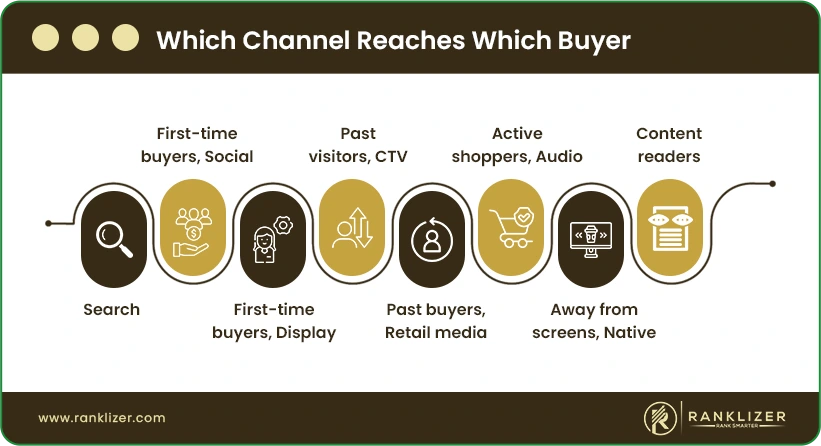
Channels differ in production requirements, but the more important distinction is the stage of the buying journey at which each is most effective. In other words, which type of buyer is most likely to engage with this channel?
Common digital advertising examples include Google search ads, Instagram Reels ads, banner retargeting ads, and sponsored product listings on Amazon.
| Advertising Channel | Most Relevant to |
| Search Advertising | First-time buyers |
| Social Media Advertising | First-time buyers |
| Display/Programmatic Advertising | Past visitors |
| Video/Connected TV Advertising | Past buyers |
| Retail Media | Active shoppers |
| Audio/Podcast Advertising | Audiences away from screens |
| Native Advertising | Readers engaged with content |
Search Advertising and How to Use It
Search ads appear in response to a query. Because of this, they are well suited to reaching first-time buyers.
Why it’s effective:
You are advertising to an engaged, highly motivated buyer who has expressed intent to purchase.
By selecting relevant keywords, or letting Google choose them for you, you can reach a very specific segment of the market.
Social Media Advertising and How to Use It
Social media ads appear in users’ feeds and take many forms, from standard feed placements to short-form video and stories.
Why it’s effective:
It lets you reach first-time buyers who are not yet researching a particular category. Through precise targeting, you can educate them about your offering and its benefits, shortening the decision-making process.
Most social platforms offer detailed targeting based on interests and lookalike audiences.
Display and Programmatic Advertising and How to Use It
Display advertising covers a range of ad formats (banners, rich media, native) that appear across a network of websites and apps.
Why it’s effective:
It helps you reach past visitors and is useful for retargeting and building brand awareness.
Video/Connected TV Advertising and How to Use It
Connected TV advertising is shown on television screens but bought and measured like digital video. Ads appear before or during streamed programs and may be produced by the brand or by a third party.
Why it’s effective:
It helps you reach past buyers or first-time buyers in an environment well suited to explaining your product or service. It has the engagement power of traditional TV with the targeting and measurement of digital ads.
Retail Media Advertising and How to Use It
Retailers such as Amazon, Walmart, and Target sell advertising inventory on their websites and mobile apps.
Why it’s effective:
It helps you reach buyers who are already shopping on the retailer’s website or app. The ads often appear close to the buy button and are a natural extension of the buyer’s journey.
Audio, Podcast, and Native Advertising and How to Use It
Audio advertising is a catch-all term for audio placements (in podcasts or music and radio apps), whereas native advertising is designed to match the look and feel of the content on a publisher’s website.
Why it’s effective:
Audio reaches engaged listeners when they are away from screens, and native ads reach readers without interrupting what they are consuming. Both are well suited to building brand equity.
How Digital Advertising Costs Are Typically Calculated
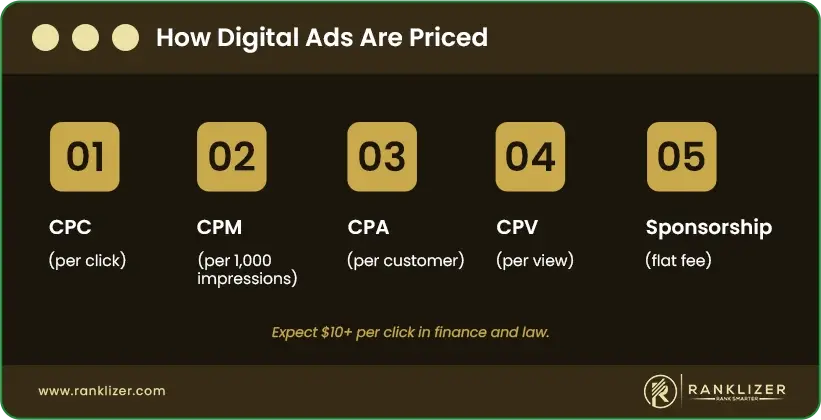
Many variables are at play, and rates depend on your industry, competition on a given channel, and the quality of your ad. In general, though, you should not expect to pay less than $10 per click in highly competitive industries such as finance and law.
| Advertising Metric | Description |
| CPC (Cost per Click) | The cost of a single click. It is the most common pricing model in search advertising. |
| CPM (Cost per Thousand Impressions) | The cost of 1,000 ad impressions. It is common in display, video, and social advertising. |
| CPA (Cost per Acquisition) | The cost of acquiring a customer. It is useful for assessing a campaign’s efficiency but can be misleading if it ignores order value. |
| CPV (Cost per View) | The cost of a video ad view. |
| Sponsorships | A flat fee for a placement. They are common in podcast advertising. |
Evaluating the Profitability of Advertising Spend
Several metrics feed into an overall assessment of how much profit your advertising generates. Here is a snapshot.
| Advertising Metric | Why It Matters |
| Cost per Click | Determines traffic volume. |
| Conversion Rate | Determines profitability. |
| Cost per Acquisition | Measures how much you pay for each customer. |
| ROAS | Measures how much revenue is generated for every dollar spent on advertising. |
What Counts as a “Good” Return Differs by Business
A high-margin product can tolerate much higher acquisition costs than a low-margin product. Always calculate your breakeven ROAS before you commit budget.
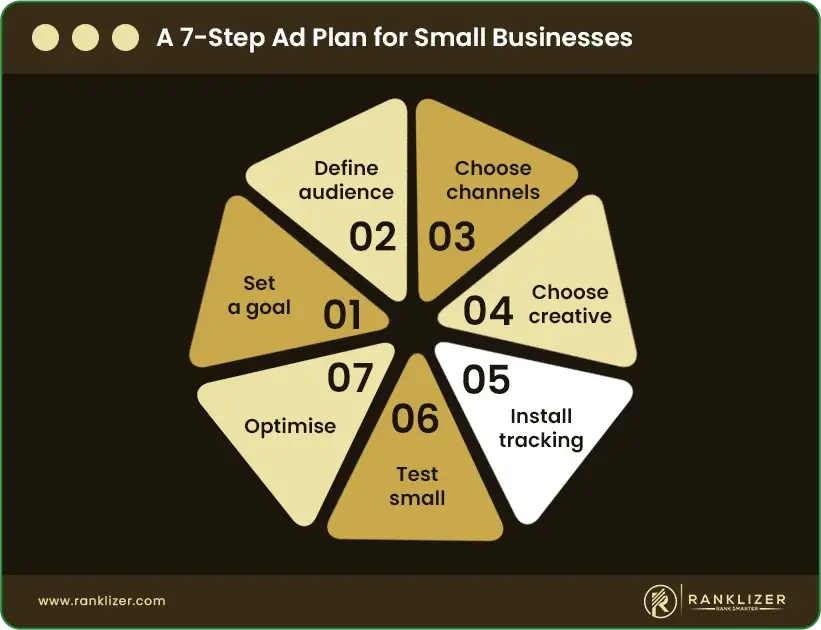
Digital Advertising for Small Businesses: A Step-by-Step Example
Imagine you are a small skincare brand launching for the first time. Here is how you would approach it.
1. Set a goal. As a new company with a limited budget, your goal might be first-time online orders at a target cost per order. Avoid vague goals such as “more awareness.”
2. Define your audience. As a skincare brand, your audience is people interested in clean skincare who are already searching for similar products.
3. Choose the channels that best reach your audience. In this example, the channels might break down like this:
| Advertising Channel | Objective |
| Search Advertising | Acquire first-time buyers |
| Short-Form Social Advertising | Acquire first-time buyers |
| Display Advertising | Re-engage past visitors |
4. Choose your creative for each channel.
- Search advertising: Your creative should reflect the searcher’s intent.
- Social advertising: Use authentic creator content.
- Display advertising: Remind past visitors of your brand and prompt a return visit.
5. Make sure your ad spend is tied to real business outcomes. Install conversion tags and confirm they work correctly before committing significant budget.
6. Allocate your budget and start testing. At this stage, you are not trying to scale; you are trying to find which channels and creatives perform. Run a small budget across channels with a few creative variations per channel.
7. Optimize based on performance. If social advertising looks expensive, don’t cut the budget right away. First check whether people who saw your social ads later searched for your brand and bought.
Key Digital Advertising Metrics
Clicks are a useful indicator of how well your ad appeals to a given audience, but they say little about its overall effectiveness.
| Advertising Metric | Why It Matters |
| Click-Through Rate (CTR) | Measures relevance. |
| Conversion Rate | Measures effectiveness. |
| Cost per Acquisition | Measures efficiency. |
| ROAS | Measures overall impact. |
Last-Click Attribution Is Not the Only Way to Measure Advertising Effectiveness
A customer rarely interacts with just one ad before buying your product or service. Three alternative approaches can give you a more accurate picture.
| Approach | Description |
| Multi-touch attribution | Assigns credit to each touchpoint the user interacted with before converting. Note that each platform’s own reporting tends to give itself disproportionate credit. |
| Incrementality testing | Compares users who saw your ad with a control group that did not, then measures how many additional conversions your spend actually drove. |
| Media mix modelling | Does not track individual users; it analyzes aggregate spend and revenue across channels to estimate each channel’s contribution to revenue. |
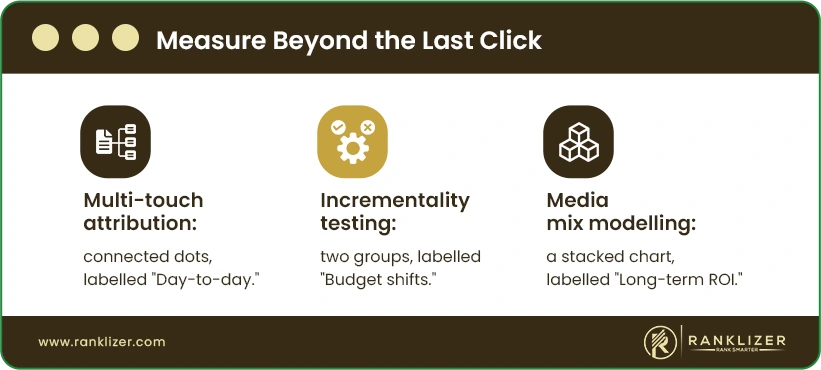
Most experienced advertisers use a combination of all three: multi-touch attribution for day-to-day optimization, incrementality testing to decide how much budget to shift between channels, and media mix modelling to estimate long-term ROI.
Digital Advertising Trends and Challenges
| Challenge | Description |
| Privacy and data loss | Tracking users is increasingly difficult due to Apple’s tracking limits on iPhones, stricter privacy laws, consent requirements, and ad blockers. |
| AI-driven search | Advertisers must adapt their strategies as Google and Meta prioritize AI-generated search results and assistants. |
| Ad fraud and brand safety | Not all impressions come from real users; fraudulent bots can drain budgets. Advertisers must also ensure their brand is not shown next to undesirable content. |
| Walled gardens | Google, Meta, TikTok, and Amazon control most advertising dollars and set the rules of engagement. |
Conclusion
Digital advertising has fundamentally changed how attention is bought and sold by turning it into a measurable commodity. The ecosystem’s complexity can leave everyday advertisers in the dark, but understanding the fundamentals of how it works gives you real insight and leverage.
A successful campaign rests on three principles: reaching the right audiences, delivering messages relevant and valuable enough to prompt action, and measuring everything to identify what drives profitability and growth. Above all, successful advertisers recognize that what sets them apart is not the size of their budget but their ability to get the most value from every dollar spent.