TL;DR Summary
- Niche edits often fail to move rankings not because Google is unpredictable, but because of bad anchor text getting silently devalued
- Devaluation is invisible. No warning, no manual action, the link simply stops passing ranking value while everything looks fine in reporting tools like Ahrefs
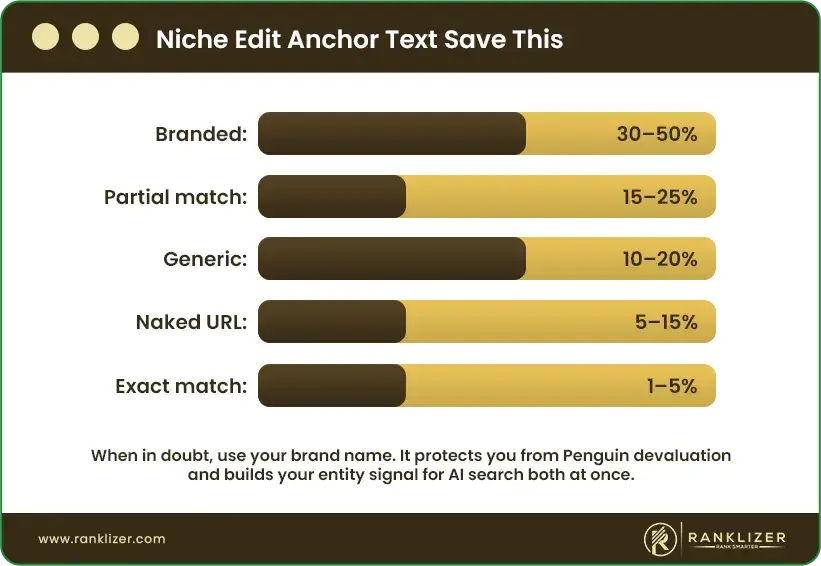
- Recommended anchor text ratio: branded 30 to 50%, partial match 15 to 25%, generic 10 to 20%, naked URL 5 to 15%, and exact match only 1 to 5%
- Fix it by auditing your current anchor distribution, reading the actual paragraph before agreeing to a placement, favoring branded anchors, and treating this as an ongoing habit, not a one-time cleanup
- Bonus angle: branded, contextual anchors also help AI systems like AI Overviews build entity association with your brand, so this same anchor strategy increasingly supports AI search visibility too
A lot of link placements that fit the anchor text are devalued, and here’s why and how you can fix it.
There’s a particular disappointment that’s familiar to anyone who’s paid for a niche edit, and 2-3 weeks later, nothing happens at all.
The invoice clears and the link goes live. The target page is still sitting in the same spot on the rankings as it was before the link went live.
This is often chalked up to “Google is unpredictable.”
It isn’t unpredictable. In most cases, the culprit is sitting in plain sight: the anchor text itself.
Link insertions (also known as niche edits) are supposed to provide a shortcut. You do not need to create a new article and wait for an editor to link to it; you simply place your URL in an article that is already ranking and already has trust.
This works well when the anchor text is used sparingly and naturally. If it isn’t, the link just sits there; you’ve paid the fee, but it does nothing for your rankings.
What “devalued” means
This isn’t a dramatized, site-wide punishment. Google’s own guidance on search spam updates is succinct and to the point:
According to Google Search Central’s spam updates documentation, the more Google’s systems detect and neutralise the impact of manipulative links, the more that ranking boost is simply lost, and it cannot be regained.
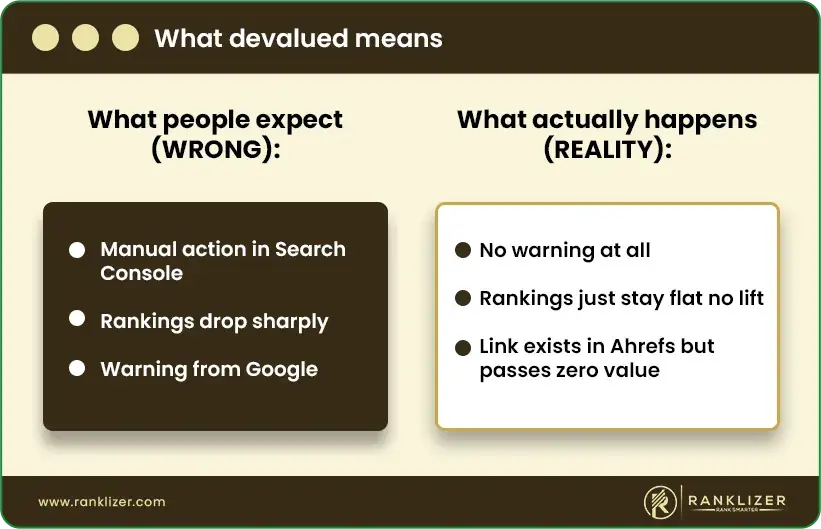
No warning arrives. A manual action notice doesn’t appear in Search Console. The link simply doesn’t count, as if it were never inserted.
This is important because the feedback loop goes unnoticed:
- A ranking will not necessarily drop
- There will be a lack of the lift you are looking for (much more difficult to diagnose)
- Half of those insertions can have no benefit, while the other half can look pretty good in an Ahrefs export
This change was made with Penguin 4.0 (2016), which folded this evaluation directly into Google’s real-time core algorithm instead of applying it as a periodic filter.
Devaluation is no longer done in a periodic sweep; it’s continuous, happening as pages are being crawled and links are found.
Google’s full policy on manipulative links is laid out in its official spam policies for Google Web Search.
That continuous evaluation is exactly why niche edits get caught more often than other link types. Here’s why link insertions are particularly vulnerable:
Why are link insertions particularly vulnerable?
Guest posts are great because you get the freedom that niche editors don’t have: you write the entire page. The anchor is in a paragraph that you wrote and a context that you selected.
A niche edit doesn’t provide any of that. You’re adding a link to a sentence that was already there, in an article that was written for somebody else’s purpose, and generally, a long time before you got your outreach email.
That’s where it all goes wrong. There are two recurring patterns of failure:
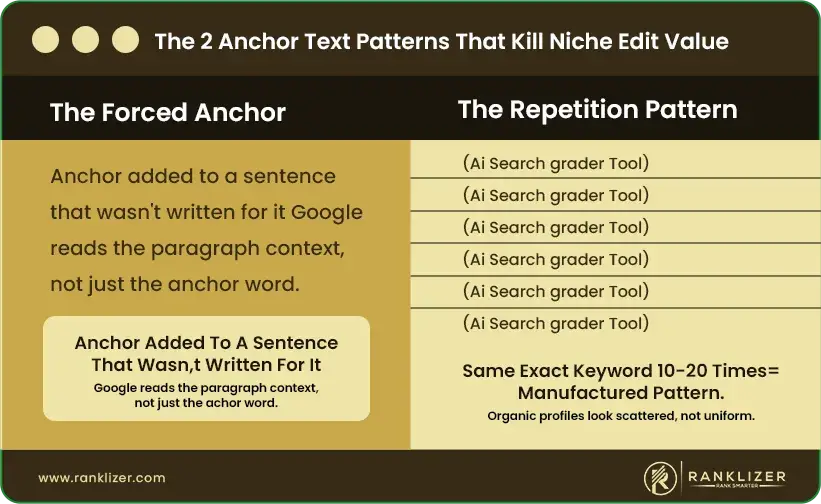
1. The forced anchor
There’s a tendency to push a keyword-heavy term into a sentence that wasn’t designed with it in mind, since the page already has one.
Google is not just looking at anchor text, it is also examining the context of the paragraph that contains the anchor text, the topic of the page that it’s on, and the content of the page it’s linking to.
The anchor appears as an add-on, no matter how relevant the keyword.
2. The repetition pattern
The benefit of having a paid insertion is that you can control the anchor word (unlike earned links, where the publisher controls it), and it can be tempting to use your exact keyword phrase for every instance.
Do that 10 or 20 times over a couple of months and you have your own repetitive pattern link spam that the spam detector will identify.
Real, organic mentions look scattered: your brand name here, “this guide” there, a bare URL occasionally, and your exact keyword only sometimes.
The ratio that will keep your profile safe
Any magic number that promises a single percentage should be taken with a pinch of salt: no single formula applies to every site.
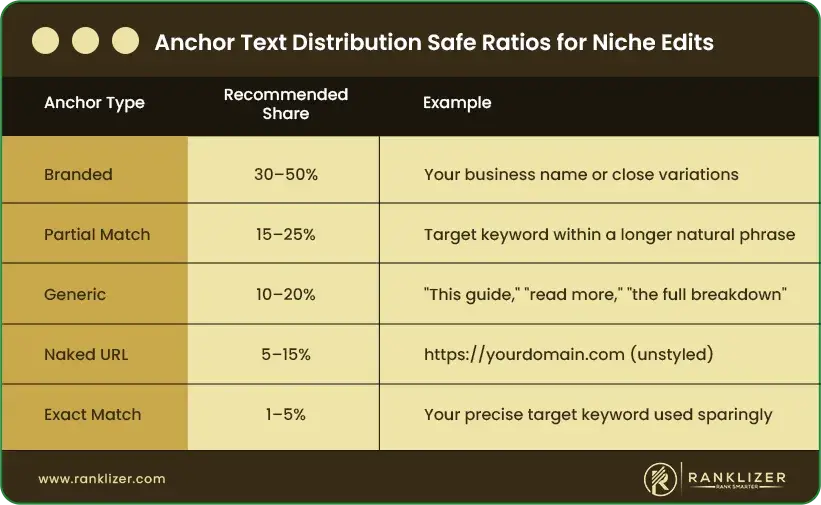
However, independent analyses, including Ahrefs’ large-scale study of anchor text, come up with similar shapes:
| Anchor type | Recommended share | Example |
|---|---|---|
| Branded | 30–50% | The name of your business, or close variations. |
| Partial match | 15–25% | Use target keywords within a longer phrase in a natural way |
| Generic | 10–20% | “This guide,” “read more,” “the full breakdown” |
| Naked URL | 5–15% | The original web address, without styling. |
| Exact match | 1–5% | Your precise target keyword, used sparingly. |
The consistent thread: branded anchors should dominate your profile. Exact-match anchors should stay a small minority; once they climb toward 10–15% of your overall links, the profile starts to look manufactured rather than natural.
One thing buyers tend to overlook is that it’s not just new links that apply; it’s your entire link profile. A few high-quality niche edits are not enough to save a bad backlink profile that’s full of keywords.
It’s often not just about cutting back on the old links, but also deliberately building more branded and generic anchors, as is the case with dilution.
What to do to make it right
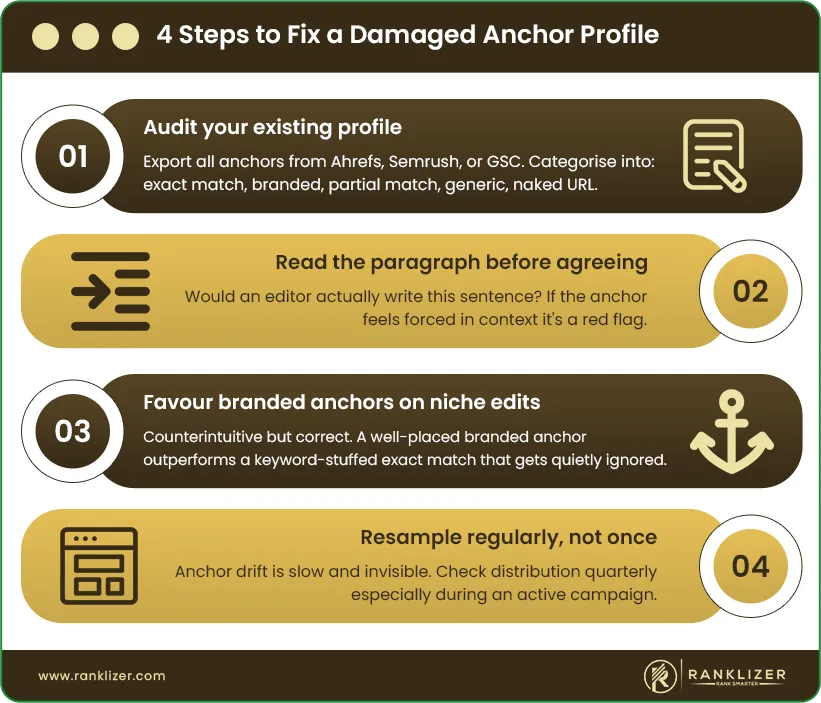
Step 1: Audit what you already have
Export all of your referring domains and anchor text (use Ahrefs, Semrush, or Google Search Console’s free links report).
Put each of them into one of the following categories: exact match, branded, partial match, generic, or naked URL. The majority of site owners are taken aback by how imbalanced their anchor profile turns out to be.
Step 2: Read the paragraph before you agree to anything
Always read the actual paragraph the link will be placed in before you agree to anything. Ask: would an editor actually write this sentence when covering this story? Otherwise, it’s a red flag, even if the keyword is a close match.
Step 3: Favour branded anchors on niche edits
This is contrary to what is instinctive: most buyers want to get the greatest ROI from every dollar invested. Resist it.
A good anchor tag, thoughtfully placed, will outweigh a “keyword-stuffed” anchor tag that will be quietly de-emphasized once the pattern is picked up.
Step 4: Make it a habit, not a one-time fix
Resample your anchor distribution periodically, particularly during a campaign.
Drift occurs slowly: that’s the slightly too-precise anchor you took, and that’s the anchor you took but didn’t think about where it’s going, and six months later, it’s in a completely different direction you didn’t purposefully choose.
Frequently asked questions
What is meant by an anchor text being “devalued” and not penalized?
The link no longer passes ranking value, and it won’t trigger a manual penalty.
What makes link insertions more susceptible to this than guest posts?
You’re appending to a different person’s sentence, and it’s easy to force an ill-fitting, keyword-rich anchor into it. Google is particularly sensitive to this mismatch.
What percentage of anchor text should be an exact match?
Most analyses land between 1–5% of your overall link profile, with the bulk of your remaining links being branded anchors.
Is it possible to optimise an existing anchor profile?
Yes, primarily through dilution. Create more branded, generic, and naked-URL anchors going forward; don’t try to fix individual problematic anchors after the fact.
Does this apply to internal links on my site too?
No. Google has stated that there’s no over-optimisation penalty for internal linking; the same leniency doesn’t apply to keyword-rich external anchors.
Does the anchor text strategy still work in AI search the way it does in Google search?
Increasingly, yes. While an exact-match anchor may contribute a little to this signal, branded, contextual anchors do more to help AI systems correctly identify your brand when the topic comes up.
An angle that many people don’t even know about
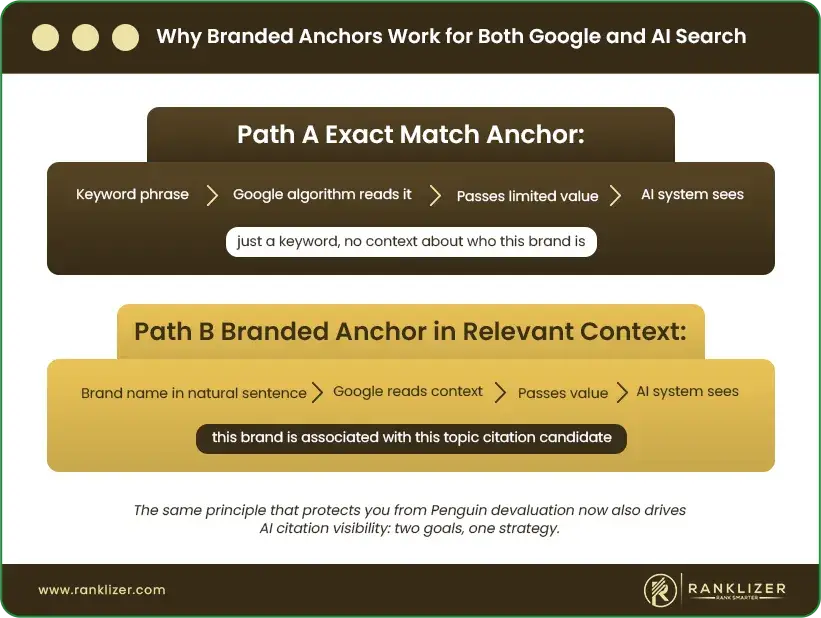
This is where the advice moves beyond rehashed Penguin-era rules of thumb and becomes forward-looking.
Understanding how your brand is built is evolving as AI Overviews and conversational assistants become more and more integral to how people find your brand:
- Large language models score the text around the page semantically, and even more carefully around the context, compared to Google’s ranking algorithm.
- Having a brand anchor within truly relevant content can build entity association between your brand and the topic within an AI system.
- An exact-match anchor is typically just a statement of a keyword, without much elaboration to help the model understand who you are.
Conclusion
When your niche edits are not helping your rankings, look at the anchor texts. Most often, the broken links use forced, keyword-rich anchor text in paragraphs that weren’t written with them in mind.
Simple solutions here. Keep your branded anchor text as the main part of your anchor profile, use exact-match anchor text only occasionally, check each paragraph, and ensure an even distribution of anchors. This will ensure your links are still passing value in Google and will also help any AI search tools in the future to associate your brand with your topic.