TL;DR Summary
- E-E-A-T isn’t a ranking factor or a score. It comes from Google’s quality rater guidelines, and AI search tools reward the same principles when they choose which sources to cite.
- Priority order: trust first, then off-site authority (brand mentions and reviews matter most), then expertise, then experience, with structured data supporting all of them.
- Quick wins (days to weeks): put real author names and bios on your pages, update popular posts, improve your About page, add proof such as case studies, fix technical issues, and audit your brand mentions. Long-term (months): earn mentions and reviews, and keep improving content quality.
- Avoid fake “expert reviewed” badges, publishing lots of thin content, robots.txt rules that block AI crawlers, inconsistent brand details across sites, and AI content nobody has edited. YMYL topics such as health and finance need stricter expert review and better sources.
Type a question about your industry in an AI tool and look at the brands it recommends. If your brand is absent, the reason is rarely keywords. And in most cases, it comes down to trust.
Large language models cannot recommend every brand, so they prioritise information from websites that demonstrate trust, accuracy, and popularity across the web. The same principles comprise the E-E-A-T criteria, and a prioritised E-E-A-T checklist for AI search is your best chance to optimise the way your brand appears in AI search results.
This guide will explain what to do and what to avoid when trying to appear in AI search results and provide an E-E-A-T checklist for SEOs to follow. The short version is this: E-E-A-T stands for Experience, Expertise, Authoritativeness, and Trustworthiness.
It is not a metric and should not be treated as a ranking factor. Instead, E-E-A-T is a set of quality assurance guidelines for Google’s human raters, and AI search tools reward the same principles when selecting pages for their results. When optimising for AI search, focus on trust, then off-site authority, then expertise and experience, and use structured data to enable all of the above.
What E-E-A-T Means for AI Search Optimisation
E-E-A-T comes from Google’s Search Quality Rater Guidelines. These guidelines instruct Google’s human raters on how to evaluate a search result’s quality.
The company updated the document in December 2022 to reflect the addition of the first E — Experience. The update formalised the importance of first-hand experience in the Google Quality Rater Guidelines.
The four letters in E-E-A-T stand for:
- Experience
- Expertise
- Authoritativeness
- Trustworthiness
Google’s raters evaluate each page’s trustworthiness, which encompasses the other three Es. For example, a page may have a credible author, but if the article’s claims lack third-party evidence or the publication’s ownership information is unavailable, the page fails the trustworthiness test.
Why Does E-E-A-T Matter for AI Search?
AI search results are not a list of ten blue links, but their underlying principles are similar. Google has stated that its AI search tools use the same systems as the traditional search engine. Therefore, the same factors that influence organic SERPs influence the selection of sources for AI answers.
Other large language models (LLMs) operate in a similar vein. They will analyse a set of relevant documents and extract the most trustworthy excerpts for their answers. Any information that originates from an untrustworthy source, unnamed and unpublished authors, or lacks third-party validation will be discarded.
In other words, E-E-A-T for AI search is not about catering to an algorithm but designing an information source that minimises the possibility of being rejected by an LLM. Here is how to do it.
E-E-A-T for AI: What to Prioritise First?
Not all aspects of E-E-A-T are equal to AI search. Here are the factors in priority order, with an assessment of their importance and how to leverage them for AI SEO:
| Prioritisation | Signal | Importance for AI Search | Effort |
| First, trust | Inaccurate, vague, or confidently incorrect statements are filtered out by AI search | Low–medium | |
| Then, off-site authority | AI search tools confirm brand mentions via third-party mentions and reviews | High | |
| Next, expertise | The named and credible authors improve the trustworthiness of the content | Low | |
| Followed by experience | First-hand knowledge helps separate between copied and unique content | Medium | |
| And finally, structured data | Enables accurate identification of brand properties and topics covered on the page | Low | |
Off-site mentions and reviews carry the most importance for AI SEO. While first-hand experience is valuable, it is rare for an individual to have encountered every product and service offered by a company, especially at scale.
A brand mention on another website acts as a trust endorsement from a publisher to a business. And according to research conducted by Ahrefs, brand mentions have the strongest correlation with appearing in AI search results of all off-site signals.
The E-E-A-T SEO Checklist
The following EEAT SEO checklist can be used to evaluate individual pages and the website as a whole. Begin with trust, then follow the checklist in priority order.
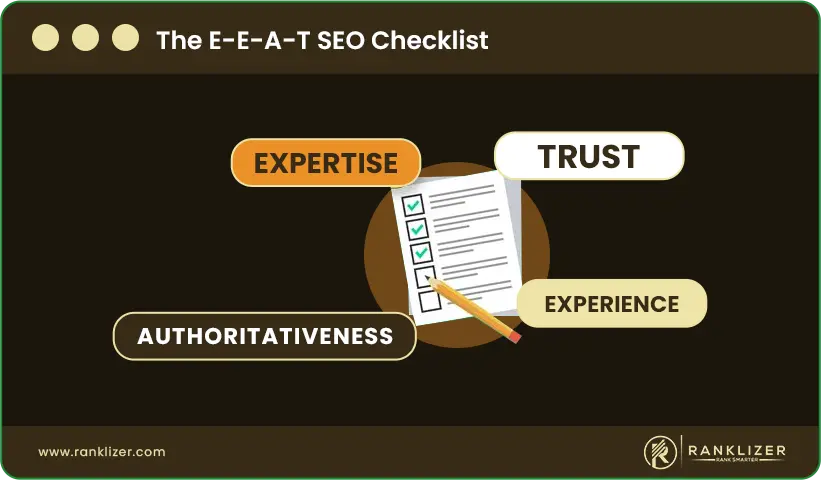
Trust
- Statistics and facts cite credible and first-party sources
- Publish date and/or “last updated” date is available and recent
- About page discloses who owns and operates the website
- Contact page includes a physical address, email, or phone
- Privacy policy, terms of service, and other disclosure pages are available
- The website uses HTTPS and does not have any security-related warnings
- Outdated advice is removed or revised
- Exaggerated claims of results are avoided in favour of specificity
Authoritativeness
- The brand is mentioned on authoritative websites
- Unlinked brand mentions are discovered and linked to, where appropriate
- Reviews on the third-party review platforms are recent and up-to-date
- The brand’s information across directories is consistent
- The company’s staff publishes articles or interviews on external websites
- The website’s content is comprehensive and covers topics in sufficient depth
Expertise
- Articles and other content have named and credible authors
- Author bios list relevant skills and experience
- Author pages contain external links to professional websites
- Sensitive or technical subjects are reviewed by relevant professionals
- Content goes beyond surface-level information
Experience
- Content contains first-hand testing, observation, and research
- Content uses original imagery, screenshots, and data visualisations where possible
- Results are reported with specific consideration to context
- Content contains lessons learned from failures, not just successes
- Content demonstrates a level of knowledge beyond common knowledge
Schema Markup and Structured Data for Answer Engines
Schema markup and structured data allow search engines to better identify the entity (a brand, website, person, etc.) and its attributes. They are not a substitute for quality content, but they can prevent misunderstandings.
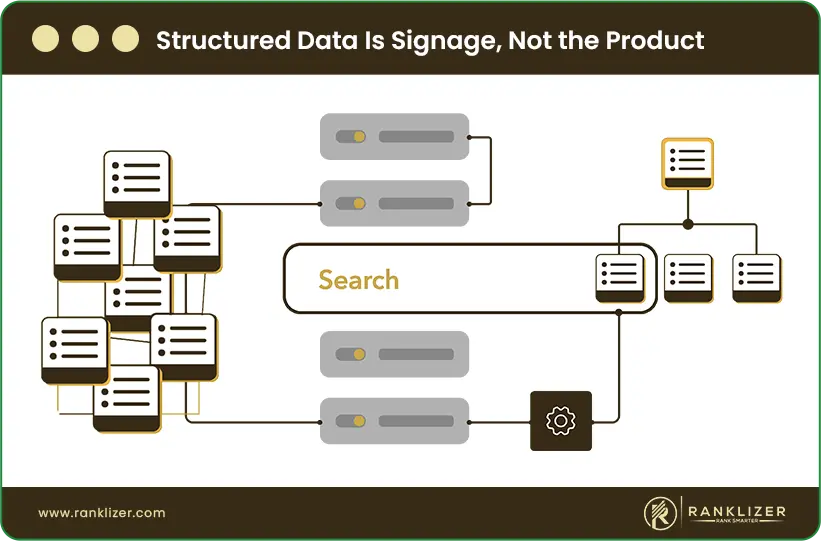
Structured data for answer engines functions like signage in a store. It will not improve the quality of products, but it will help shoppers find them.
The following schema markup types are particularly useful for E-E-A-T and appearing in AI search:
- Organization: brand name, logo, contact information, and social media
- Person: author name, occupation, qualifications, and professional website
- Article or BlogPosting: author, publish date, and update date
- Review and AggregateRating: customer reviews, where applicable
- sameAs: links to relevant content on other websites
Here is an example of a Person schema:
{
“@context”: “https://schema.org”,
“@type”: “Person”,
“name”: “Jane Smith”,
“jobTitle”: “Senior SEO Strategist”,
“sameAs”: [“https://www.linkedin.com/in/janesmith”]
}
An Ahrefs analysis of pages that appear in AI answers showed that schema markup has little to no impact on citations. So, treat structured data as you would page copy: as a tool to build upon quality content, not the foundation of your content strategy.
Five Quick Wins for Improving E-E-A-T
Some improvements take weeks or even months, but here are five quick wins to improve E-E-A-T for AI search right away:
- Replace generic author names. Assign real names to your top twenty pages and update their bios.
- Update your most popular posts. Improve the statistics, citations, and recommendations and update the “last updated” date.
- Enhance your About page. Include your history, staff, qualifications, and notable clients or partnerships.
- Include proof. Add a screenshot, case study, or other proof to your articles, where applicable.
- Conduct a brand mention audit. Search for your brand name and remove any unlinked mentions or outdated information.
Mistakes That Undermine E-E-A-T
Even the best websites fall victim to some common E-E-A-T traps. Here are some examples of E-E-A-T mistakes that undermine your ability to appear in AI search:
- Fake badges. A “reviewed by an expert” badge without a named expert may do more harm than good.
- Quantity over quality. Having more articles diminishes the perceived value of each page.
- Accidental robot.txt restrictions. Ahrefs’ internal research shows that robots.txt file restrictions stop AI search crawlers in their tracks.
- Inconsistent brand information. Differences in pricing, staff information, and other details across directories weaken the perception of trust.
- Unedited AI content. While AI copy may be adequate, it will be discarded by AI search crawlers as untrustworthy.
Raising the Bar for E-E-A-T on YMYL Topics
Google’s guidelines ask raters to apply stricter scrutiny to “Your Money or Your Life” (YMYL) topics. In other words, pages on medical, financial, and other sensitive subjects need to be held to a higher standard.
The same principles apply to AI search. In particular, government websites, medical institutions, and other trustworthy resources have an advantage in YMYL topics.
If your website covers YMYL topics, tighten your E-E-A-T scope according to the following recommendations:
- Assign relevant professionals to pages requiring expert advice and ensure their names are published.
- Cite primary sources such as scholarly articles, government reports, and regulatory guidance.
- Add disclaimers where applicable and disclose when the advice is conditional.
- Update YMYL pages more frequently to ensure there is no outdated information.
In practice, it means stricter requirements for finance and medical websites. On a finance blog, only accountants should edit tax-related articles.
On medical websites, doctors may review pages pertaining to their specialty. Enhanced scrutiny is the best way to improve E-E-A-T for sensitive topics covered on your website.
How to Measure E-E-A-T and Success
Since E-E-A-T is not a metric, evaluating progress is challenging. Focus on the following E-E-A-T SEO metrics:
- AI citations. Begin with a small set of queries (20–30) in a given niche and see how many appear in AI search results.
- Brand mentions. Monitor brand mentions on a regular basis and assess the authority of websites that mention your brand.
- Organic performance. Watch the organic performance of optimised pages.
- Accuracy. Monitor if search engines represent your business accurately.
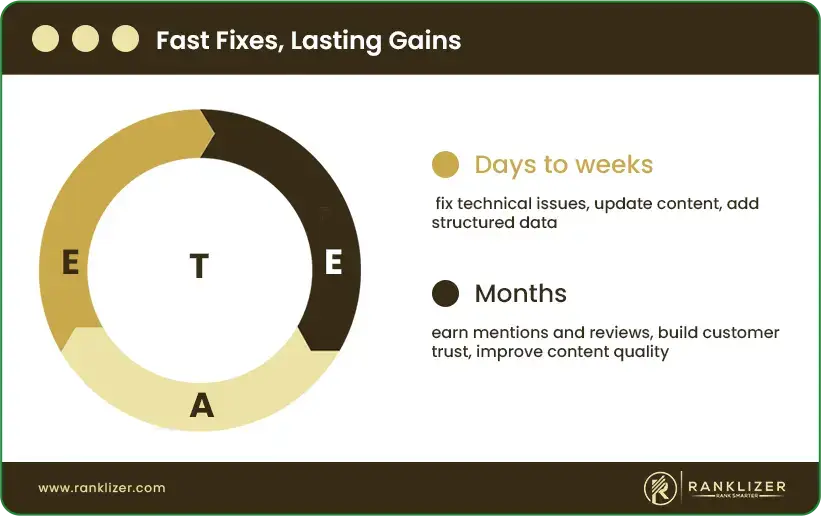
Most technical improvements affect SERPs within a few weeks. Pages that gain authority from third-party mentions typically take longer to show results. With that in mind, here is a breakdown of how long it takes to improve E-E-A-T and why.
Quick Wins for E-E-A-T
Many quick wins for E-E-A-T take only days or weeks. Here are some quick wins to improve E-E-A-T for AI search:
- Fix technical issues. Broken links, incorrect dates, missing pages, and other technical issues affect both organic SERPs and AI search.
- Update old content. Older content benefits from additional research, revised recommendations, and improved content.
- Add structured data. Structured data improves discoverability without requiring significant changes to the page copy itself.
- Enhance trustworthiness. Minor updates such as adding a LinkedIn profile or an “About” page can boost a website’s credibility.
- Conduct brand mention research. A brand mention audit identifies quick wins such as repairing unlinked mentions.
Long-Term Gains for E-E-A-T
Long-term gains for E-E-A-T take months. Here is how to pursue long-term gains for E-E-A-T:
- Earn mentions and reviews. Build relationships with other websites to improve your brand’s reputation and authority.
- Build trust with customers. Encourage customer reviews on relevant review platforms and respond to negative feedback promptly.
- Improve content quality. Regularly update and improve your content to ensure it meets the highest standards.
Appearing in AI search is not about satisfying an algorithm. It is about building trust and demonstrating expertise.
Ahrefs’ research shows that the most frequently mentioned brands and businesses are those that consistently follow E-E-A-T guidelines. By addressing technical issues, updating content, and earning mentions, you will improve your chances of appearing in AI search while also building long-term trust with human visitors.
FAQ
What is an E-E-A-T checklist?
An E-E-A-T checklist is a set of trust, expertise, authoritativeness, and experience criteria used to evaluate the quality of content and web pages.
Is E-E-A-T a ranking factor?
E-E-A-T is not a ranking factor. However, Google’s ranking algorithms reward the same principles that human raters use to evaluate pages’ quality.
What is the best E-E-A-T prioritisation for AI search?
When optimising for AI search, prioritise trust, then off-site mentions, then expertise and experience, and use structured data to support all of the above.
Does schema markup improve E-E-A-T?
Schema markup assists search engines in understanding the entity (brand, product, person) and the content of a web page, but it is not a substitute for quality content.
Does AI content hurt E-E-A-T?
AI content hurts E-E-A-T if it is not edited and vetted by human experts. Otherwise, it has little impact on E-E-A-T or rankings.
How long does it take to improve E-E-A-T?
Technical improvements to content and pages affect SERPs and AI search within weeks. Gaining mentions and improving domain authority typically takes several months.
Final Thoughts
AI search tools behave like careful editors. They want sources they can cite without risk. Treat this E-E-A-T checklist as an ongoing process: fix trust first, earn recognition beyond your own website, put real experts behind your content, and support it all with clean structured data.
Brands that stay consistent with this won’t just rank. They’ll become the names AI tools turn to when people ask who to trust.