
TL;DR Summary
- Niche edits are cheaper and faster (1–2 weeks) but riskier; guest posts cost more and are slower (4–8 weeks) but hold rankings longer.
- Before buying a niche edit, check real traffic, backlinks, update date, and anchor text, not just DR.
- Avoid chasing DR over relevance, bulk buying from one vendor, over-optimized anchors, and one-off link building.
- Mix about 2 niche edits per guest post, and lean on guest posts for new, low-authority sites.
We have link-building campaigns for clients in many industries. This question is asked virtually every time.
If you decide to invest in link building, should you invest in guest posts or niche edits?
Many agencies will respond to that question in the method of service that they are most known for. That’s not the best advice.
Over the years, we have purchased both strategies on a large-scale. We’ve seen outcomes in dozens of campaigns for clients, and this is based on that first-hand experience.
The very short version: niche edits work quickly and at cheap rates. Guest posts are less risky and are more valuable once published.
One does not always prevail. This choice will vary based on a client’s need for speed and tolerance for risk at the moment.
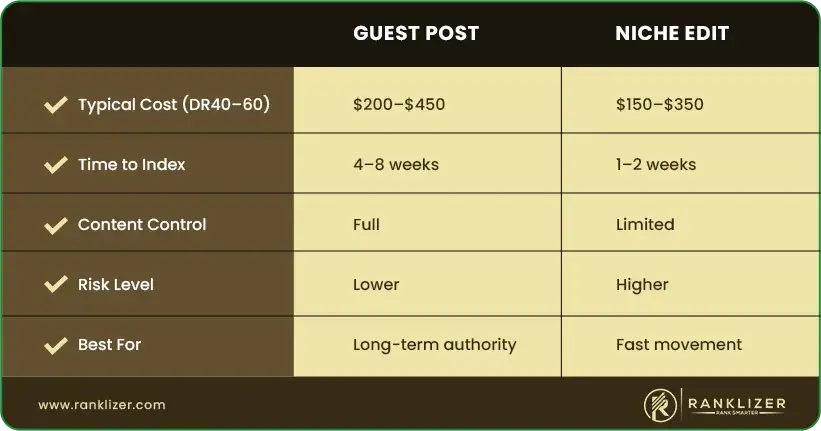
| Comparison | Guest post | Niche edit |
|---|---|---|
| Typical cost (DR 40–60) | $200–$450 | $150–$350 |
| Time to index | 4–8 weeks | 1–2 weeks |
| Control over content | Full | Limited |
| Risk level | Lower | Higher, needs vetting |
| Best for | Long-term authority | Fast movement |
Guest Post
A guest post is a blog post written by someone other than the owner of the website.
A guest post is a brand-new article written for the purpose of getting a backlink. It is published on another site and the link to the client’s site is embedded in the published text.
No existing page is edited. A new page is created from top to bottom.
Control is the benefit here. We choose the topic and mould the surrounding text, and determine the exact placement of the link. The downside of a new URL is that it has no authority.
The link within the text has to be discovered by Google; it has to be crawled, and then Google has to decide that it is safe to trust. It takes time – even if the writing is good.
Then there’s a relationship aspect that is ignored. You can get more placements if you get a guest post from an actual editor, because editors are aware of those who supply them with clean, well-informed work on time.
There is no such thing as that kind of relationship in a niche edit because the interaction there initially begins and ends with one payment.
Niche Edits
A niche edit, also known as a link insertion, is an edit that does not involve any content creation at all.
We don’t create a new article – we find one that already ranks and already gets traffic. We negotiate a link into that piece.
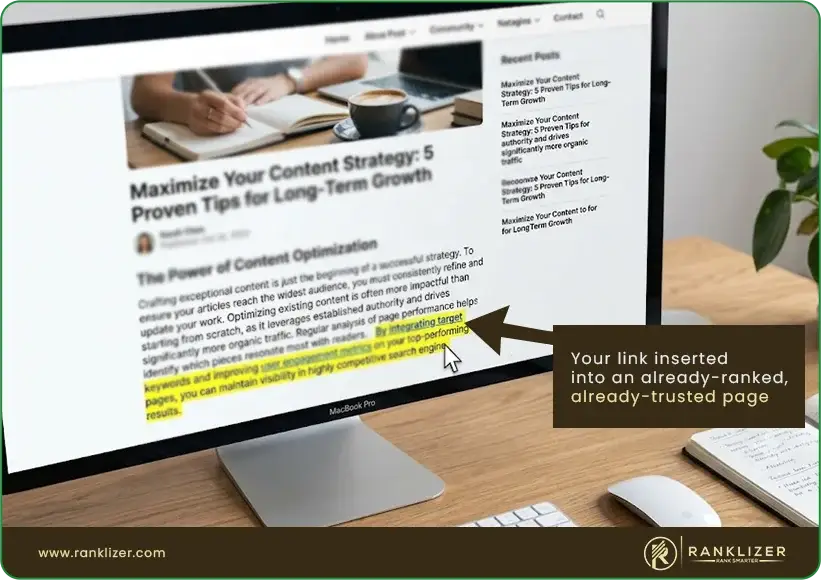
It can begin passing value rapidly because the host page is already indexed and already trusted by Google.
To summarise: This strategy does not create new authority from scratch; it is a strategy based on the authority of already existing pages. Borrowed authority is precisely what it’s all about.
One thing to keep in mind: not all niche edits add an entirely new sentence.
On some pages, such as resource pages or the “best tools” type articles, the publisher may replace its current expired link with the client’s link instead.
The version that is embedded in content that’s already recommending something similar is going to look more natural.
What Each One Actually Costs
The variations in prices are dependent on the value of the authority that is to be targeted, the level of competition in the niche and the level of editing standards that are set by the publisher.
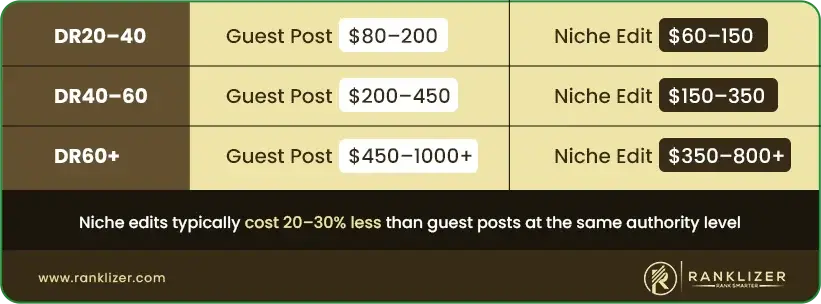
The following is a very approximate estimate from our experience in paying over the last year.
| Tactic | DR 20–40 | DR 40–60 | DR 60+ |
|---|---|---|---|
| Guest post | $80–$200 | $200–$450 | $450–$1,000+ |
| Niche edit | $60–$150 | $150–$350 | $350–$800+ |
Niche edits tend to be between 20% and 30% less than guest posts for the same authority. This is because it is very easy.
The guest post price includes writing, editing, and research in addition to the placement fee. A niche edit bypasses all that.
If they charge the same for both, something is amiss, or the “niche edit” is actually new content masquerading as it.
Some other cost considerations need to be highlighted. In areas like finance, legal, health, and other highly controlled or heavily marketed websites, it will cost more no matter the tactic used, as fewer publishers are willing to accept outside links in these areas than there is demand.
Sites that have a real man or woman reading and approving every request tend to cost more than sites where nearly anything is accepted, but the resulting link is not normally as safe or long-lasting.
These numbers are here as a starting point, not as a fixed rule. Obtain at least 3-4 quotes from vendors in the client’s niche market. These averages are generally lower than what you’ll find on finance, legal, and health websites.
How Fast It Both Moves
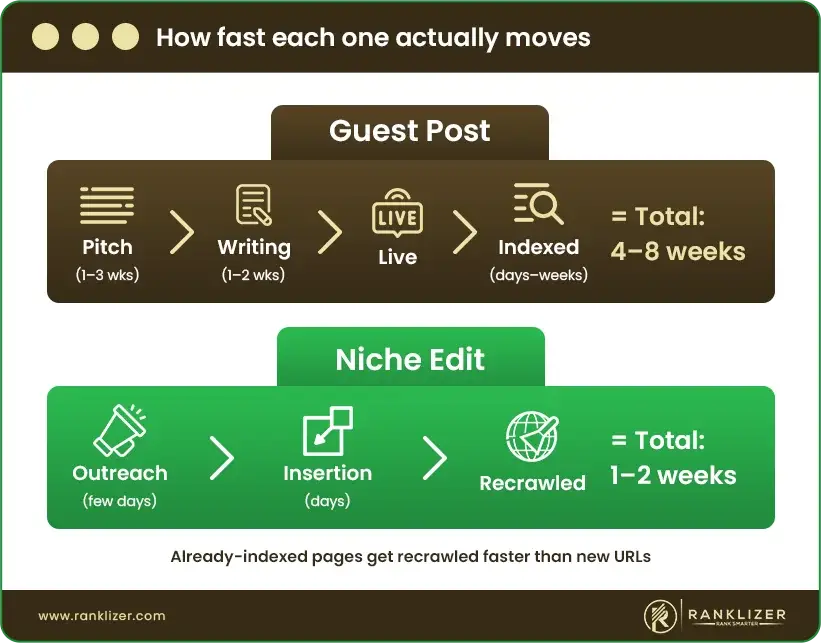
This is where things start to get serious.
Guest Post Timeline
The time for approval and pitching is typically 1-3 weeks. It depends on the editorial queue’s “backed up” status in the publisher. Another 1-2 weeks for writing, revisions, and publication.
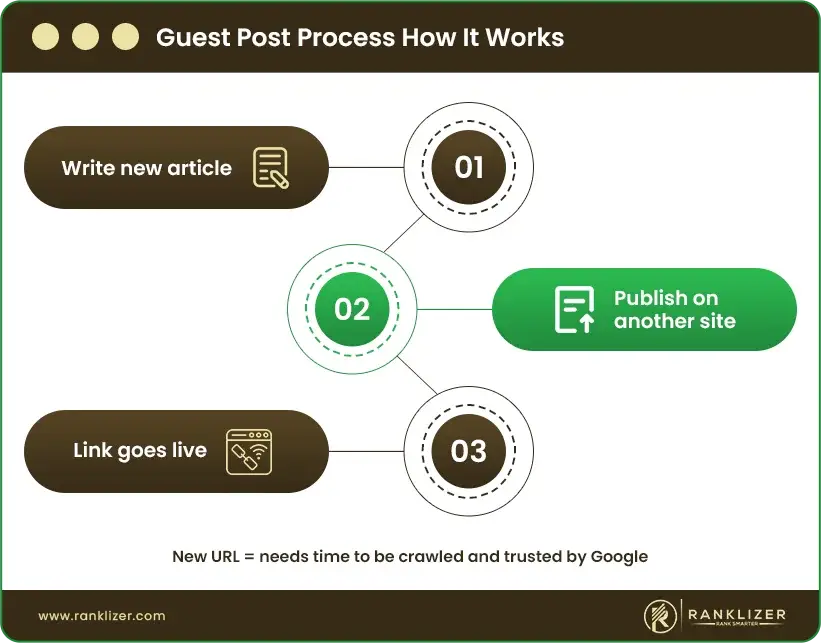
After becoming live, the indexing may take days to a few weeks as a new URL needs to be crawled and assessed.
Not all guest posts get indexed. This happens when the host site doesn’t link to the new article from anywhere else on the domain.
It is more common than you would think that pages with no inbound links to them are not crawled as often.
Processing time: usually 4-8 weeks to be indexed and to benefit rankings.
Niche Edit Timeline
The approval and outreach will take a few days to a week. The insertion will take place within days of approval.
Recrawling and indexing typically also occur within days after that, since editing an already-indexed page will usually cause a new crawl to occur quickly.
Time to fully live link: typically 1-2 weeks following the first outreach message.
Niche edits are better if they are needed quickly, for a seasonal campaign, or if the page is on page 2. That speed advantage is not as important if the client is establishing their authority in the coming year.
Here is something to add to the above. Link speed is more than just the rate at which the link can be displayed. The speed also affects its ability to start affecting rankings immediately after it is indexed.
If you perform a niche edit on a page with heavy organic traffic, a keyword can be moved in days after it has been indexed.
Even if a guest post is indexed, it may still take a few more weeks before its effect on rankings becomes apparent, as Google seems to be more conservative about ranking new pages for a while after they’re initially discovered.
The Risk Side That Needs More Attention
It is not helpful to tell people to avoid link farms if there isn’t any real way to do so. So here’s our actual vetting process!
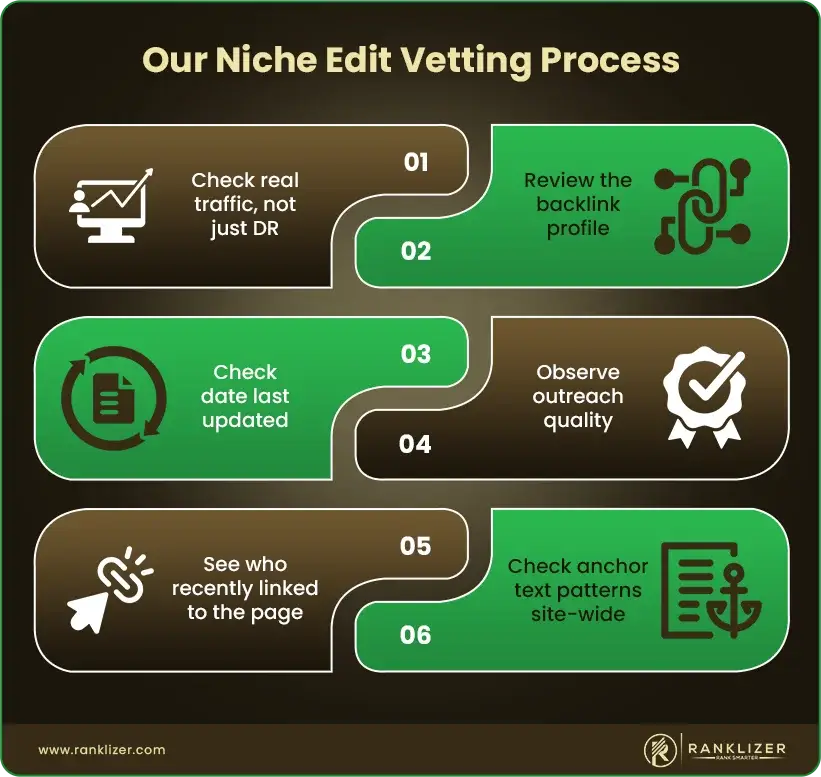
Make sure it’s real traffic, not DR. Having a high Domain Rating does not mean that the site has a great quantity of backlinks, it can be a good profile built years ago that is on a website that isn’t visited anymore.
Go to Ahrefs or Semrush, view the real traffic for the target site and then visit the target site’s specific page, rather than the entire domain.
Review the backlink profile. Paid link networks are indicated by sudden spikes with no apparent cause, some combination of anchor text that seems unrelated, or by sitewide links that are found throughout dozens of pages that have no connection.
Look for the date the page was last updated. If the content remains relevant and hasn’t changed since 2019, then it’s a wonderful opportunity to rank a page that hasn’t been touched for some time.
A page that appears abandoned and only gets handled to add paid links is another.
Observe the outreach discussion. If a publisher offers to publish without asking questions about the product or the link, they are not a true publisher. Websites that have real standards tend to drag a little bit behind.
See who recently linked to that page. If a page is suddenly getting 10 new links that are all to different products, then they are probably being sold on repeat and not curated.
This pattern can be seen quickly by examining the page’s version history, using a tool such as the Wayback Machine.
Look for an anchor text pattern throughout the entire site.
If you have a lot of branded or natural anchor text on a site and then all of a sudden the site has a bunch of exact-match anchors that are commercial, it’s probably not an editorial site and is probably padding the link inventory.
All of these checks take under a few minutes per placement, but most bad placements are due to omitting checks. It will cost a client many more hours of effort to fix the issue if a cheap link damages the client’s trust with Google.
Our Recent Campaign
Our team did a guest post and niche edit at the same time for one of our clients. Specific keywords with a similar level of difficulty and on sites with similar authority.
There was a slight delay of more than 6 weeks between the pitch and the indexed link. During the next month, it reduced the ranked target keyword from #14 to #9.
The niche edit was published in nine days. It took two weeks to rank a similar phrase from rank 11 to rank 8.
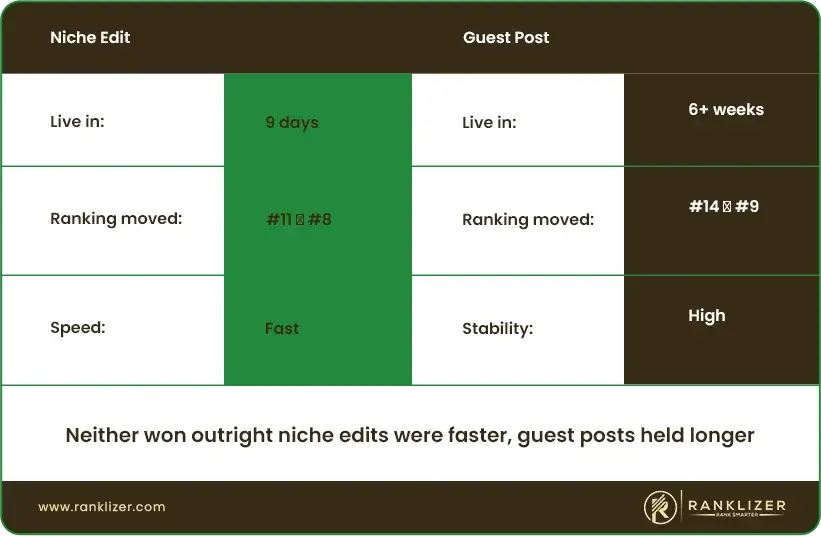
Neither method came out as the clear winner. The niche edit was quicker.
Over the next quarter, the guest post maintained its position much more reliably, and the niche edit’s effect was dampened somewhat by the addition of unrelated content around the niche.
This is one of many examples of this type of comparison we have observed with many more placements. Niche edits are about speed. Guest posts will last for a long time.
Common Mistakes We see Clients Make
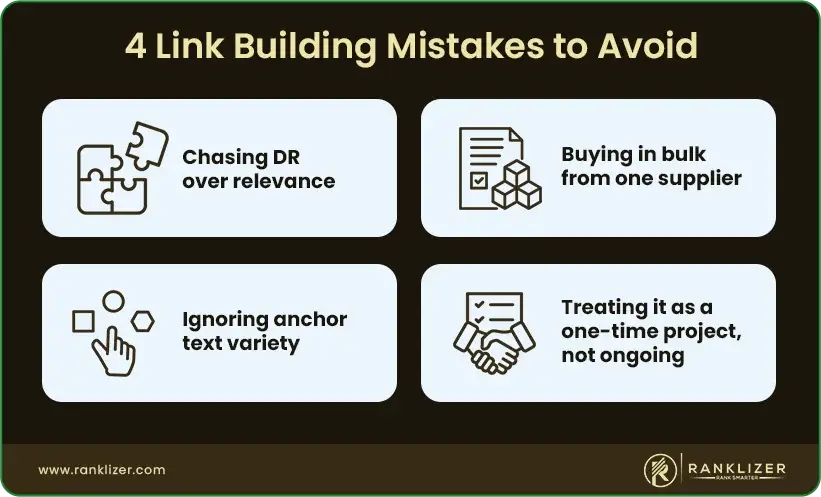
The most common one is to chase DR rather than relevance.
A DR70 site in a completely different niche is less valuable than a DR35 site, which is more relevant to the client’s niche, because relevance is a ranking factor in and of itself, apart from authority.
Another is to purchase in bulk from one supplier.
A variety of placements, across various vendors, various site types and various anchor text patterns will appear much more natural than a batch of links all coming from the same vendor, the same site type, and the same anchor text pattern from the same week.
Without anchor text variety, there are issues later.
Brands, naked URLs, and other generic anchor phrases such as “click here” should be added to a client’s links to their profile, though, because it looks more suspicious to Google if an anchor profile is too clean.
This is because people think of it as a single project and not a process that needs to be repeated.
The quick and high links tend to stall out and even fall back again after being caught by the competition, while the steady and gradual approach will keep results steady and keep climbing.
Frequently Asked Questions
Which will be safer – guest posting or niche edits?
Guest posting is more secure, in general. The context and content of the link are constructed from scratch rather than inherited.
Niche edits can be just as safe if you are on a page that has a strong, high ranking. However, they will require more time and careful research because the page isn’t one that you own.
What is the price of a niche edit in 2026?
The price range is roughly $60 on low authority sites to $800 or more on high authority sites, and is typically 20-30% less than a similar guest post.
How quickly are niche edits indexed?
The vast majority of them are recrawled and indexed in just a few days of their release. The change to an already-indexed page is a fast crawl as opposed to a brand-new page that needs to be discovered.
Is it possible to implement both strategies in the same campaign?
Yes and in most cases, it’s the better approach. Niche edits will provide quicker short-term movement. Guest posts create a more stable, deeper authority that will stand the test of time.
What is the optimal number of links for a campaign?
There is no set number. It is a factor of the competitiveness of the targeted keyword, the existing authority of the site and the level of link building aggressiveness of its competitors.
It can take just a couple of great links for a low-competition keyword, and a couple of months’ worth of links for a competitive commercial keyword.
Can rankings be lost due to a poor niche edit?
Yes, but typically not one, but an ongoing series of poor placements. Google’s spam systems can devalue links or, in serious situations, apply a manual action on a site with heavy reliance on low-quality or obviously manipulated placements.
How We Advise Clients To Decide
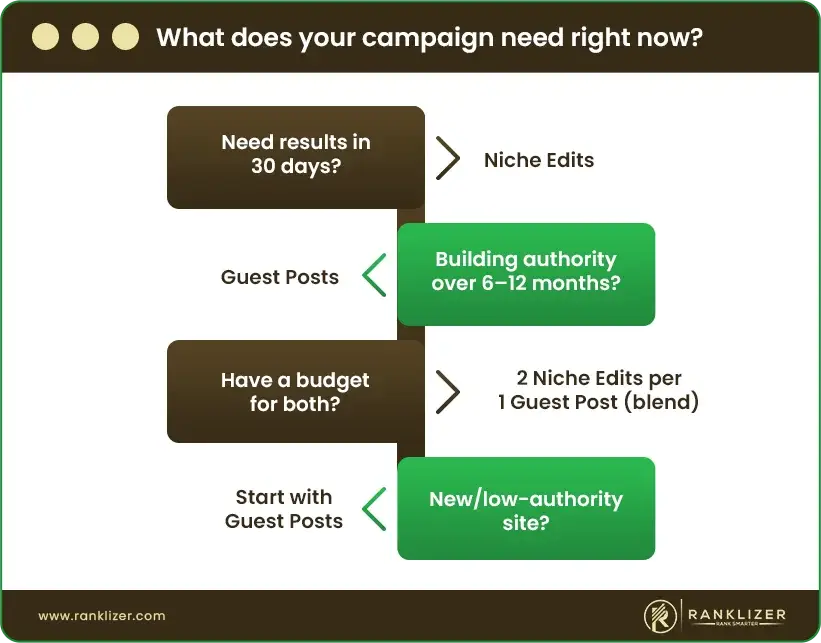
If you need to move within 30 days, niche edits are the way to go. Niche edits work well, particularly when it’s a time-sensitive situation such as a seasonal push or a page just outside page one.
Establishing control in the coming six to 12 months? After the delay from indexing is over, guest posts are a better bet.
Do you have a budget for both? Blend them. Two niche edits per guest post is a good rule of thumb.
That means you can get quicker short-term traffic, yet still get those great deeper links that guest posting provides over time.
New site that has low authority? More value in guest posts early on, as a thin or brand new site will benefit from more variety in content rather than the rapid insertion of links that are outstripping the site’s growth.