

- Walk away if a niche edit site shows 3+ red flags: vague writing, unverifiable author, templated meta descriptions, unrealistic publishing volume for team size
- 2026 risk is higher — publishers are banning AI content, Google catches scaled low-effort patterns, and AI-heavy sites are more likely to get deindexed later
- AI use isn’t the problem, ownership is. A reviewed AI-assisted site is fine; raw AI output isn’t. Traffic, topical focus, indexation, and editorial history still matter first
- Run the 5-minute check before any niche edit placement: read a few articles, search the author, scan meta descriptions, compare volume to team size — and don’t rely on detector scores alone
A link insertion is a link that is inserted into a published article, not a new guest post that is written from scratch. The link is also going to have traffic and search history on the host page, so it should theoretically get some of that authority when it goes live. That’s the pitch, and that’s why the tactic has remained popular for years.
The short answer is: walk away from niche edits if the host site exhibits three or more of these symptoms simultaneously: vague, detail-less writing, unverifiable author, templated meta descriptions on articles, and a publishing volume that is too high for any small team to realistically achieve. One signal alone isn’t disqualifying. Three or more is always the case, no matter how good the traffic or domain rating of the site appears to be.
Why This Matters Now
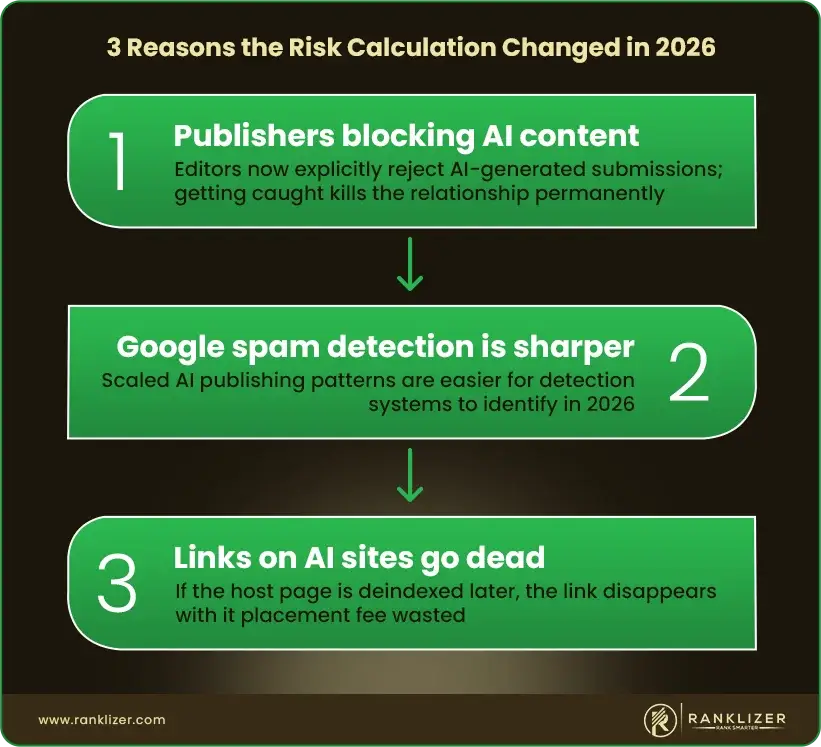
There are three changes to the risk calculation for high-traffic niche edit links in 2026.
Publishers are outright prohibiting AI content. Many editors now make it clear in their guidelines that AI-generated submissions will not be accepted. If you are caught putting a link in an AI-generated article on a website that has a “no links” policy, you will be rejected and will lose the trust of that editor for the future.
Google’s spam systems are more effective at detecting scaled, low-effort content. Google has stated publicly that AI-generated content is not inherently against its guidelines — the issue is content created for the sole purpose of ranking. See Google Search’s guidance about AI-generated content.
But that’s the kind of pattern that scaled AI publishing tends to produce, and it’s not a difficult pattern for a detection system to recognise.
A link on an AI-driven site is weaker than a link on an actual edited site. Later, if the host page is deindexed or stripped down, the link will go with it. The risk isn’t only a wasted placement fee; it’s a placement that looks great now and then doesn’t count for a thing in six months.
All of this does not mean that all AI-powered sites are useless. There are plenty of legitimate publishers who use AI somewhere in their process, whether it’s for research, outlines, or first drafts. The real distinction is ownership; was there a knowledgeable person who shaped, verified and stood behind what was published, or was it raw model output that was published after a quick grammar pass?
The Standard Checks Still Apply
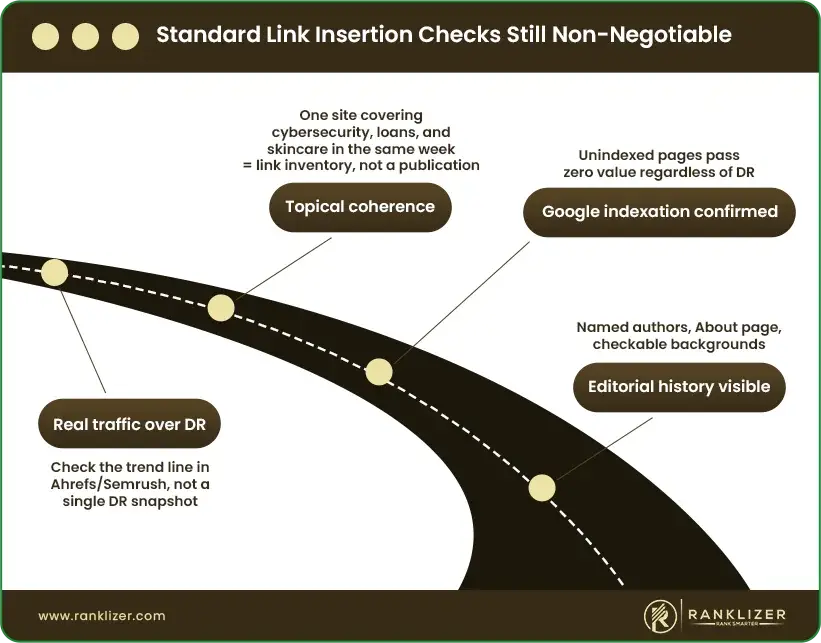
But before diving into AI-specific signals, the basics of niche edits screening remain unchanged and are still paramount.
- Organic traffic is more valuable than just domain rating. A site can have a very high DR from old links and have virtually no traffic today. Look at the trend line, not a single moment in time.
- Topical coherence — a site that publishes about cybersecurity, personal loans, and skincare in the same week is not a publication; it’s inventory. Relevance is a trust signal that Google takes into account.
- If you don’t have your articles indexed by Google, then it doesn’t matter what else is on your site. An unindexed link does not pass any value.
- Editorial history — named authors with a real, checkable background, a visible review process, an About page. None of these is conclusive on its own, but the complete lack of all of them is noteworthy.
What AI Writing Actually Looks Like
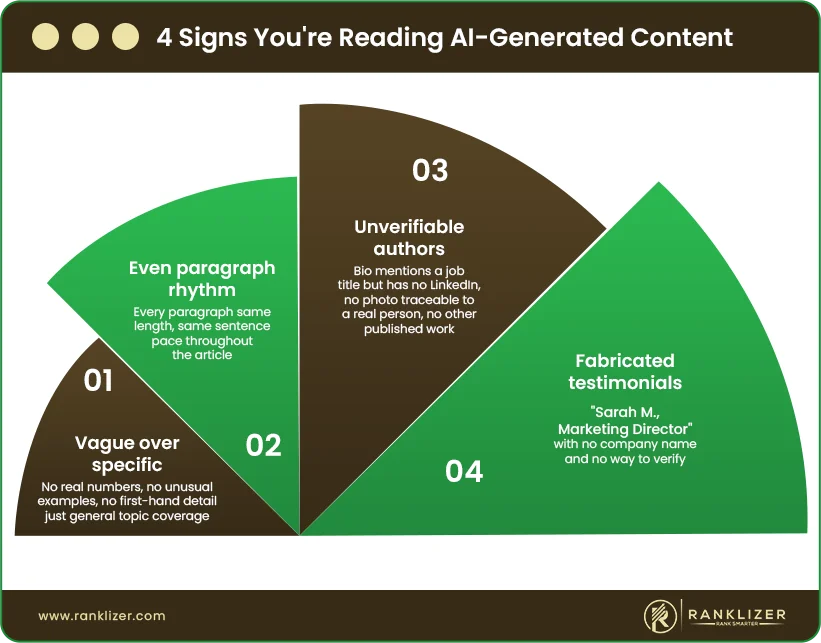
The best way to find an AI site is not a detection tool; it’s reading two or three recent articles carefully. There are four recurring patterns:
- Vague over specific. Writing that is authentic and based on experience contains small particular details, a real number, an unusual example, something that only makes sense if the writer actually did the thing. AI-generated text is often vague and circumspect, avoiding specific details and instead focusing on a general subject.
- Even paragraph rhythm. Human writing is natural; some paragraphs are long, some are two sentences, and sentence length changes with emphasis. AI output is more likely to be consistent and even in pace.
- Unverifiable authors. A bio that mentions a role and a general skill set but lacks a LinkedIn profile, other published work, and a photo that can be traced back to a real person is a red flag on its own. Some sites do not change their fabricated bios between “authors,” even if the names change.
- Fabricated-sounding testimonials. The same quote from “Sarah M., Marketing Director” (no company name, and no way to check if it’s real) is the same, whether or not it was actually AI-generated.
The Five-Minute Check
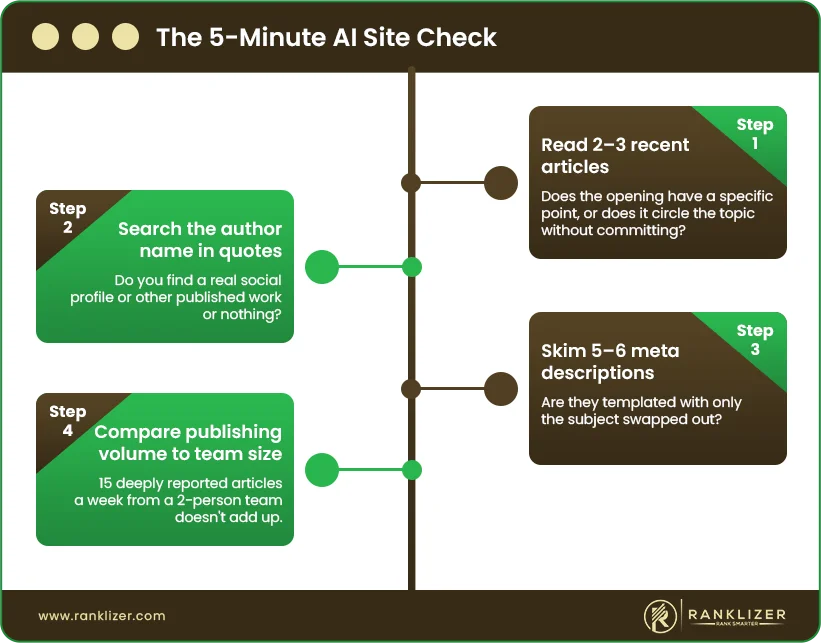
An actual assessment does not have to be an audit. In practice, it looks like this:
- Read the first two paragraphs of two or three recent articles. Do they have a particular message, or are they just going around the subject?
- Search for the author’s name in quotes. Do you get anything real, a social profile, or other published work?
- Look at 5-6 meta descriptions from various articles. Are they based on the same template but with the subject changed?
- Compare publishing volume to team size. Fifteen deeply reported articles a week from a two-person team don’t add up.
Where the Line Actually Falls
It’s not the AI that is the disqualifier; it’s the ownership. A site that is using AI to accelerate research or drafting, then significantly rewriting and checking the output, is not the same as a site that is using AI to generate raw output and then lightly checking the grammar. The surface may be the same. The difference is manifested in specificity, in the possibility of establishing the authorship, and in the structural variation.
A good test is: what happens if a statement in the article is incorrect? On a site that has actual supervision, that’s a mistake that someone would want to be made. If you’re publishing at an AI-assisted scale on a site that doesn’t have any real review, errors are almost guaranteed, and there’s no way to catch them.
A single AI-detection score is not the only determining factor either way. Detectors give false positives for some human writing styles and false negatives for lightly edited AI text. The reading-based signals above should be used as the primary check, and a detector score should be used as one additional data point.
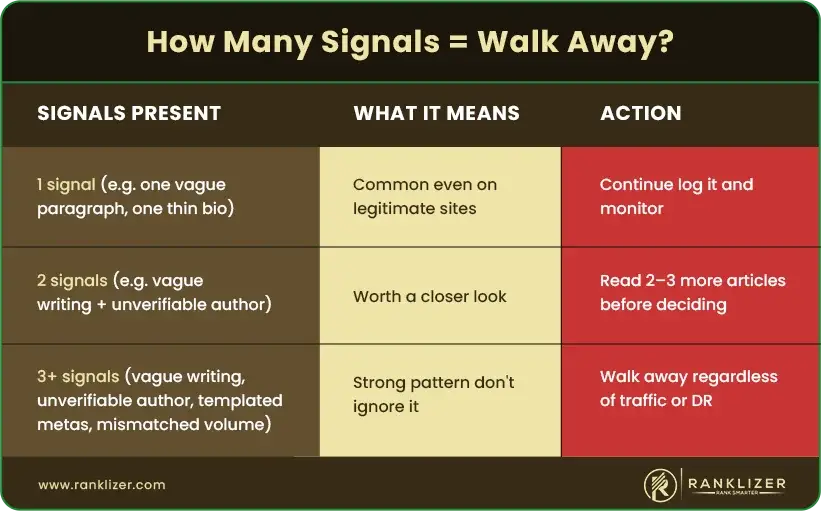
Required signals for a walk-away
| Signals present | The typical meaning of the word. | Recommended action |
|---|---|---|
| 1 signal (e.g. one vague paragraph, one thin bio) | Common even on legitimate sites | Continue, but record it |
| 2 signals (e.g. vague writing + unverifiable author) | Worth a closer look | Read 2-3 more articles before making a decision |
| 3+ signals (vague writing, unverifiable authorship, templated metas, mismatched volume) | Strong pattern | Walk away, regardless of traffic or DR |
Do not consider this a one-time clearance, but a new check each time. In the niche site flipping market, a site that was clean six months ago can turn sour after a change in ownership or a move to cheaper production.
Cost of Placing Niche Edits
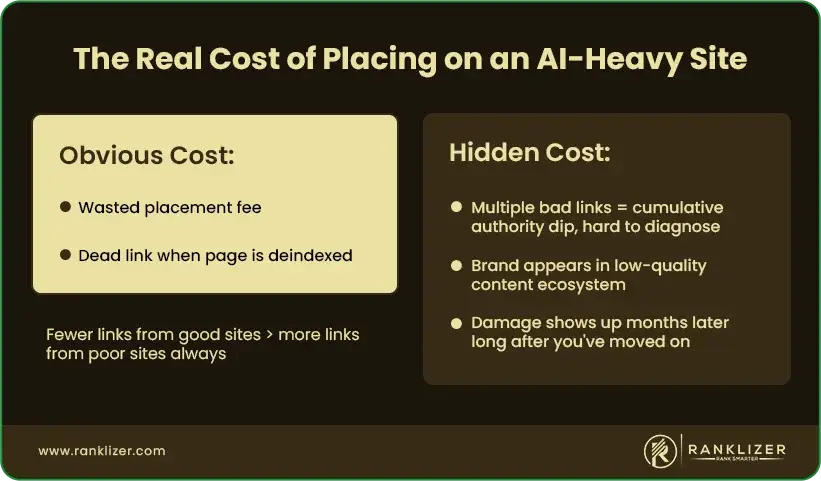
The first thing that comes to mind when thinking about an AI-driven placement that later turns out to be a dud is the obvious loss of a fee and a dead link. The less apparent cost is cumulative. If multiple links in a profile are constructed on the same pattern and are eventually caught in an enforcement wave, they can all be devalued at once, resulting in a wide authority dip that is difficult to identify as a single link.
There’s a reputation thing as well. The credibility of a brand is not only determined by the number of links it has, but also by its presence in the surrounding content ecosystem. A lower number of links from good sites is a stronger signal than a higher number of links from poor sites, even if the number of links is lower.
Frequently Asked Questions
What is link insertion?
A link insertion, also known as a niche edit, is a link that is placed into an existing article that is already published and indexed, not a new article written from scratch. The link can also transfer authority more quickly than a brand-new guest post on the same website, as the host page already has traffic and history.
How to identify AI-generated content on a website?
Check for vague, general phrasing, consistent paragraph structure throughout articles, unverifiable author bios, and identical meta descriptions. There is no single sign that is definitive, but three or more signs together are a strong pattern.
Should it be allowed to put a link on a site that uses AI tools?
Yes. Many legitimate publishers use AI for research or initial drafts. The key is that a knowledgeable editor has substantially reviewed, verified, and assumed responsibility for the final product, not whether AI was used at any point.
What is the real risk of linking to an AI-driven site?
In addition to the wasted placement fee, links on sites that are dominated by AI content are more likely to be devalued or lose their host page if the site is later banned by a publisher or targeted by a Google enforcement action, often months after the link was placed.
Can I rely on an AI content detection score alone?
No. Detectors can give false positives on some human writing styles and false negatives on lightly edited AI text. Do not use a detector score as the only criterion; use it as one of the criteria.
How long should vetting a single site take?
Once the pattern is known, it takes about five minutes: read two or three recent articles, look at the author, skim a few meta descriptions, and compare publishing volume to team size.