Two websites publish identical articles on the same keyword topic. One is a catch-all blog that writes about everything from travel to taxes.
The other is a niche resource that has published dozens of related guides on this one subject. The niche site typically ranks higher, despite having fewer backlinks and a younger domain.
This competitive edge is called topical authority. In short, topical authority is Google’s perception of a website’s expertise on a particular topic.
It is earned by thoroughly covering a topic, interlinking related content, and earning mentions from other sites. Topical authority is vital because it helps websites rank for competitive keywords, gain an edge over larger competitors, and resist algorithmic fluctuations.
It also helps websites appear in answer engines, both traditional search engines and new AI search tools.
This guide will explain what topical authority is, how search engines evaluate topical authority, and how to build topical authority for SEO and answer engine optimization (AEO).
What is topical authority?
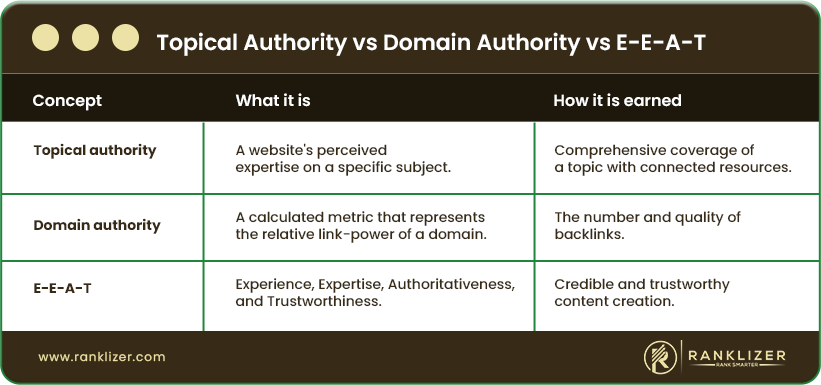
Topical authority is the level of expertise a website is perceived to have on a subject. Unlike domain authority, it is not a single score that can be calculated or manipulated.
Instead it is a combination of factors that contribute to a search engine’s perception of a website’s expertise for a given topic.
While Google does not publish a topical authority metric, its public guidelines reveal that it favors sites that comprehensively cover a topic. Google’s helpful content guidelines note that search engines favor content on a subject that has a clear focus and demonstrates first-hand knowledge and expertise.
Topical authority is the culmination of these factors.
A topical authority analogy
When you need medical advice, you may turn to a general practitioner. However, for specialized care, you may need to see a specialist.
In the same way, search engines differentiate between general sites and specialized sites.
If you search Google for information on email marketing, a general article on email marketing typically ranks lower than a comprehensive guide covering all facets of this topic. This is because Google knows that the guide is a more authoritative resource for this subject.
The three pillars of topical authority: breadth, depth, and connections
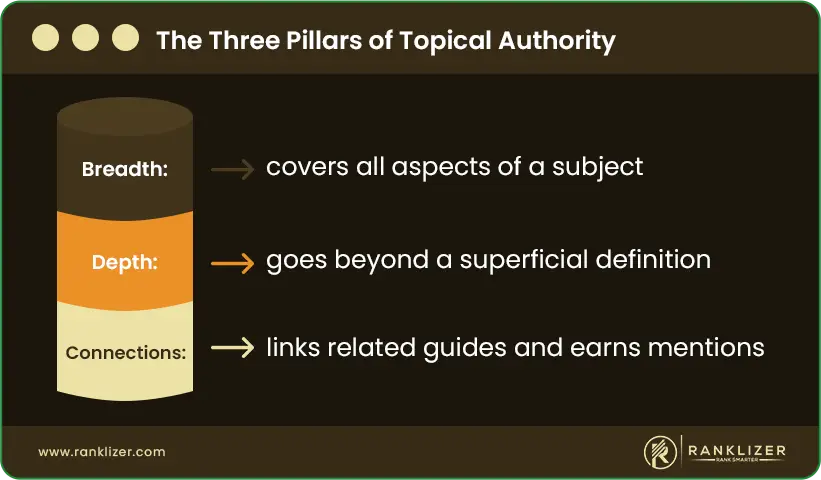
Topical authority revolves around three core principles: breadth, depth, and connections within a subject. Sites that demonstrate a high level of topical authority on a subject will tick all three boxes.
Breadth refers to the extent to which a website covers all aspects of a subject. On-page SEO keywords and guides should target not only first-level questions on a topic but also second-level and deeper questions and topics.
In short, a topical authority guide should address anything and everything you could potentially ask about a topic.
Depth, meanwhile, refers to the degree to which a guide covers the subject matter. A topical authority guide goes beyond a superficial definition and provides additional first-hand knowledge and expert insight on a subject.
Finally, connections ensure that a guide builds upon the information in other related guides. Articles that link back to an overarching pillar post show search engines that a guide is part of a series that more comprehensively covers a topic.
Connections are also established through mentions and citations by other relevant websites.
Topical authority versus domain authority versus E-E-A-T
Domain authority, E-E-A-T, and topical authority are frequently conflated, but topical authority differs from the other two in several key ways.
Why topical authority matters
Building topical authority has several SEO benefits. First and foremost, it can improve rankings for competitive keywords.
Second, it allows smaller sites to compete with bigger domains. Third, it insulates websites from algorithmic changes. Finally, topical authority is vital if you want to appear in answer engines.
Improved rankings for competitive keywords
Google’s algorithm often favors websites that comprehensively cover a topic. Thorough guides typically rank higher than standalone articles as they offer more information.
As such, topical authority guides typically have an easier time ranking for competitive keywords. Moreover, once guides have been published, other relevant content (news posts, blog articles, etc.) will typically rank more easily since it is supported by the pillar content.
In effect, improving the topical authority of a website will typically have a snowball effect on the search engine rankings of related content.
Smaller sites can compete with bigger domains
Big brands typically have an advantage when it comes to publishing content since they can invest in larger-scale content marketing strategies. However, when it comes to topical authority, smaller sites have an equal opportunity to rank.
This is because topical authority revolves around comprehensive coverage of a topic. Size alone doesn’t earn it. Even large sites must cover a topic in depth, which levels the field for focused smaller sites.
In effect, smaller sites can position themselves as bigger authorities on a specific subject.
More stable rankings across algorithm updates
Sites with higher topical authority tend to be more resilient to algorithmic changes. This is because sites with topical authority typically rank well across a range of search intent categories.
As such, they benefit from a broader SEO profile that is less susceptible to updates.
Topical authority and answer engines
Topical authority is even more important for answer engines. For AI-driven search engines, topical authority influences whether a resource will be cited.
Answer engines are more likely to cite resources that are comprehensive and trustworthy. In short, an answer engine will be more likely to cite an article that thoroughly covers the topic as well as any follow-up or related questions.
This means that topical authority guides have a higher chance of being mentioned in answer engines as a resource.
How do search engines evaluate topical authority?
Search engines evaluate topical authority based on how well a website covers a topic in terms of breadth, depth, and connections. No specific metric or algorithmic weight is publicly known, but certain characteristics tend to influence topical authority.
| Coverage | A website’s ability to thoroughly address questions, follow-up questions, and related topics. |
| Focus | How much a website focuses on a certain subject area. |
| Internal linking | How well a website connects related resources internally. |
| Content quality and originality | Whether a website provides original information beyond basic descriptions. |
| Off-site mentions and recognition | Whether other websites mention or cite the content. |
| User engagement | Whether users engage with the content as intended. |
How do you know if you lack topical authority?
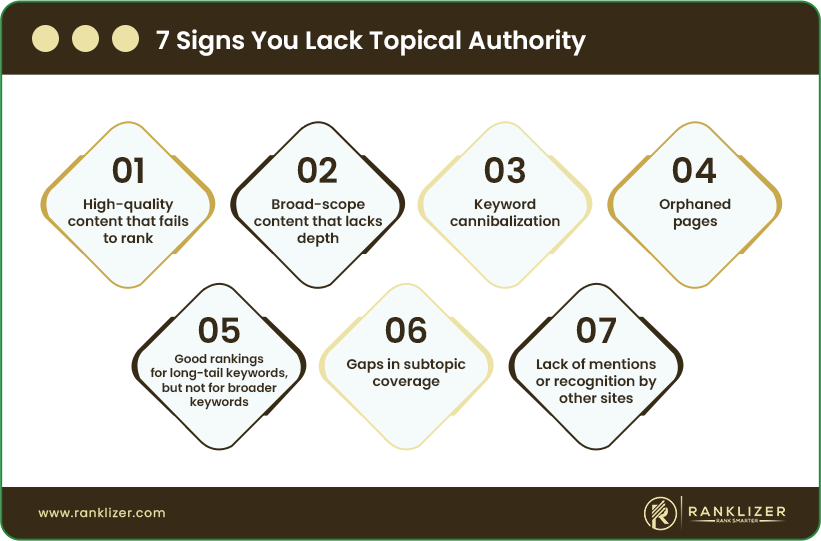
The signs of weak topical authority can be grouped into several broad categories.
Signs of weak topical authority
- High-quality content that fails to rank
- Broad-scope content that lacks depth
- Keyword cannibalization
- Orphaned pages
- Good rankings for long-tail keywords, but not for broader keywords
- Gaps in subtopic coverage
- Lack of mentions or recognition by other sites
How to build topical authority
Building topical authority revolves around several core principles. First, you need to identify the subject areas that you want to cover and build a topical authority map.
Second, you need to create pillar content and topic clusters. Third, you need to connect and interlink related pages. Fourth, you must create original content that goes beyond existing topics.
Fifth, you need to build mentions and recognition from other sites. Finally, you need to regularly update, restructure, or remove your content clusters.
1. Build a topical authority map
A topical authority map refers to a list of subjects and questions you want to cover on your website. First, select the main subjects.
The goal is to be an authority on specific subjects, not to try and cover everything. You can then group relevant questions under each subject.
To do this, analyze what your customers are asking, what questions you get frequently, which questions appear in Google’s “People also ask” results, and what your competitors are covering. You can then create a list of these subjects and questions and group them into related topics.
2. Build pillar pages and topic clusters
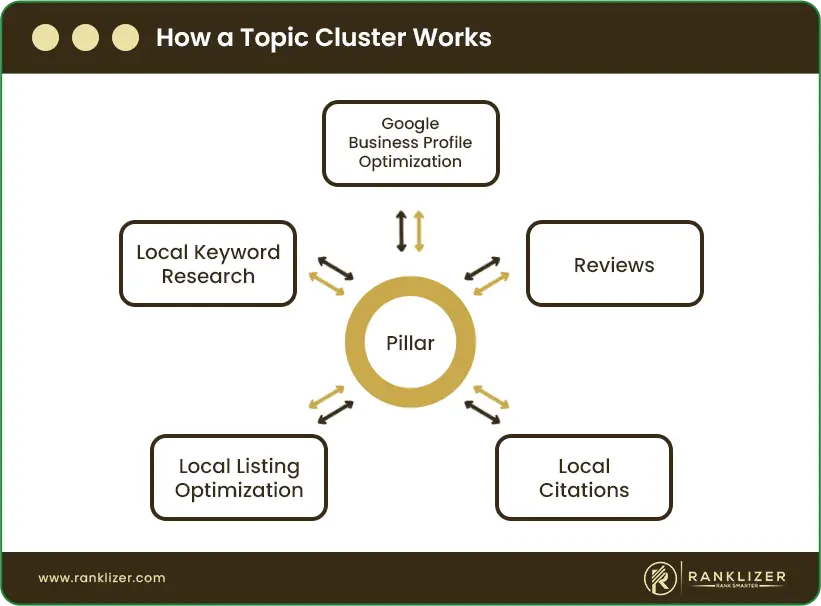
Topic clusters refer to interlinked content that is grouped together around a common topic. A cluster typically involves a main pillar post and several supporting articles or posts.
Pillar posts typically offer a broad overview of a topic, while supporting articles typically cover specific sub-topics in more depth. For example, a pillar post on local SEO will typically be linked to articles on Google Business Profile optimization, local citations, reviews, local keyword research, local listing optimization, and so on.
3. Interlink related resources
Interlinking is one of the most important elements of building out topic clusters for topical authority. It typically involves linking related content together, both internally and externally.
This lets search engines know that the linked pages are connected resources. To interlink your content, link each topic cluster post to the pillar page.
Then, link the pillar post to all related topic cluster posts directly. Finally, you can also interlink similar topic cluster posts together.
Use descriptive anchor text when interlinking to help both search engines and users understand what the linked page is about. Avoid using generic anchor text like ‘this link’.
4. Provide original content and original insights
Beyond simply covering topics in greater depth than competitors, you should strive to provide original content and information on a subject. To do this, go beyond simply rehashing what other posts say and offer additional first-hand knowledge, data, research, examples, or expert opinions.
Original information enhances the perceived topical authority of a post significantly.
5. Build mentions and recognition from other websites
Topical authority is not merely about covering topics more deeply than your competitors. It is also about gaining recognition from other websites as a trustworthy source on a subject.
This often involves digital PR, getting mentioned by other websites, and guest posting on other sites. In short, you need to build mentions and recognition from other websites as an expert on a topic.
6. Update, restructure, or remove content
Time moves on, and new sub-topics and supporting questions emerge. Existing information becomes outdated, irrelevant, or incorrect.
New competitors emerge and update their content. You need to constantly review and update your own content, removing or restructuring weak posts, updating outdated information, and filling content gaps.
How to build a topical authority strategy for AEO
AEO focuses on optimizing content so that it appears as a direct answer to queries in search and answer engines. Optimizing for AEO typically involves building topical authority on specific subjects.
This allows a website to appear as an expert resource in the eyes of search engines and answer engines. As a result, the content is more likely to be cited by answer engines.
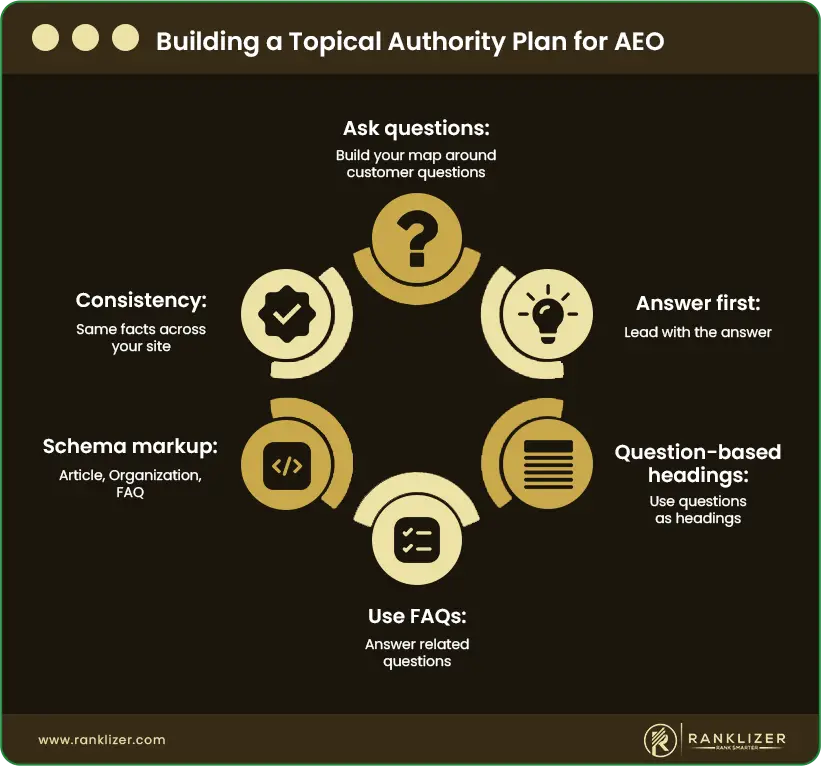
A topical authority strategy for AEO involves similar principles to regular topical authority, but with a few tweaks.
Ask questions
AEO revolves around questions, so it makes sense to build a topical authority map around questions. You should build a topical authority map around the types of questions your customers are asking.
You can structure the questions around themes (topics).
Answer first
With AEO, lead with the answer. That is why it is a good idea to begin each section with a brief answer to the question.
Then expand upon the answer with additional information. This lets answer engines crawl the content and immediately recognize the answer to the question.
Use question-based headings
Where possible, use questions as headings. This helps answer engines find and cite your content.
Use FAQs
Add an FAQ section to your web pages, particularly for the topic cluster posts. This lets you answer additional related questions and gives answer engines more content to crawl and use.
Schema markup
Article schema, Organization schema, and FAQ schema markup help search engines understand your content.
Consistency
Ensure that facts, figures, and information are consistently presented across your website. This includes brand information, definitions, and statements of fact.
Consistency allows search engines to recognize a website as a reliable, trustworthy resource.
Myths about topical authority
There are several myths about topical authority that can lead to confusion and wasted effort.
Myth 1: More articles equal more topical authority
Simply putting out more articles does not necessarily increase topical authority. In fact, publishing low-quality articles can hurt authority.
It is more important to focus on quality than on quantity.
Myth 2: You need hundreds of articles
Some people believe that you need hundreds of articles to build topical authority. This is not the case.
The number of articles needed varies, depending on the scope of the topic. A narrow topic requires fewer articles, while a broad topic will require more.
Myth 3: Backlinks are no longer important
Backlinks still matter. Topical authority works alongside them rather than replacing them.
Myth 4: Topical authority is a metric you can easily measure
Topical authority is not a metric that can be easily calculated. There are some approximations, but topical authority is a holistic combination of different factors that affect rankings.
Myth 5: Once topical authority is achieved it does not require maintenance
Topical authority is not a one-time achievement. It requires constant maintenance to keep the content fresh, relevant, and up to date.
How to measure topical authority
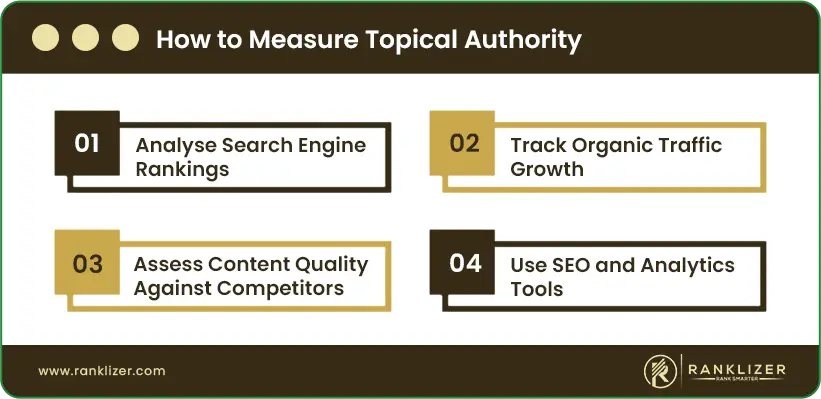
There are several ways to measure topical authority. Since it is not a metric, you have to track various indicators to see if topical authority is improving.
Keywords
Track the number of keywords that your website ranks for, as well as the types of keywords. Over time, you should see an increase in the number of keywords ranked, including competitive keywords.
Ranking distribution
An increase in your ranking distribution indicates that you are ranking for a broader range of keywords, including competitive terms.
Share of voice
Share of voice refers to the amount of visibility your website has compared to your competitors. Ideally, you want to have a consistently increasing share of voice.
Ranking velocity
Ranking velocity refers to how quickly a page climbs the SERPs after publication. The quicker you climb, the more success you are having with topical authority.
Traffic to clusters
After publishing a topic cluster, track traffic to see if it increases and continues to grow.
Mentions and recognition by others
Check whether other websites begin mentioning or citing your content as an authoritative source.
Visibility in AI search engines
Check whether AI search engines begin citing your content.
Topical authority and SEO FAQs
What is topical authority in SEO?
Topical authority in SEO refers to a site’s perceived expertise on a subject.
Is topical authority a ranking factor?
It is not an official ranking factor, but it influences rankings indirectly.
How long does it take to build topical authority?
It typically takes several months of continuous publishing.
How many articles do I need to build topical authority?
It depends on how broad the topic is, but it is usually not hundreds of articles.
Can new websites build topical authority?
Yes, it is often even easier for new websites that focus on one subject.
Does topical authority matter for AI search engines?
Yes, topical authority helps websites appear in answer engines.
How do I build topical authority for large language models?
Build comprehensive pages on a topic, structure the content so it is easily consumed by AI systems, and earn mentions from relevant sites.
Final Thoughts
Topical authority rewards focus. Rather than chasing scattered keywords, it asks you to become the most complete, reliable and useful source on the subjects that matter to your business.
Pick your core topics, map them thoroughly, connect your content with purpose and add insight that others can’t easily copy. Then earn recognition from the sites your audience already trusts. Done consistently, that approach builds rankings that hold their ground, and a brand that both search engines and AI tools recognise as the expert in its field.