

TL;DR Summary
- Editors are now rejecting AI-written guest posts on feel, not detection tools, since the writing is fluent but flat with no real point of view behind it
- Beating a detector isn’t the real goal, since the actual filter is the editor’s attention and their sensitivity to genuine, specific human experience
- 10 practical fixes: open with a real moment, not a generic claim, write your own outline and argument before using AI, break the “rule of three” pattern, add an original data point, vary sentence rhythm, state a real disagreement, cut generic filler sentences, read the piece aloud, run it through a detector yourself as a diagnostic, and make the pitch itself specific and well researched
- Bottom line: the fix isn’t tricking a checker, it’s writing like a specific person with a real point of view, since that’s what AI structurally can’t fake
A SaaS blog editor reads roughly fifty pitches a week. She doesn’t run every word through a detector. She doesn’t need to. By the second paragraph, she already knows.
Most “how to beat AI detection” articles don’t mention this. They consider this a technical issue: outsmart the algorithm, reduce the perplexity score, replace a couple of words that are marked.
However, editors will tell you straight up that detection tools are not the first filter. The actual filter is much easier to do and much more difficult to fake.
What editors are seeing and hearing
When editors turn down AI-generated pitches, they often say they didn’t use a checker. It’s something closer to a feeling. It is written fluently; it is well structured and no one is home.
One editor commenting on this exact transition calls it a particular sensitivity to a flatness, to a kind of AI writing that is grammatically assured, but lacking in experience.
It’s not a matter of picking up the word “delve.” It’s that the piece doesn’t make an argument, but never sounds like it does.
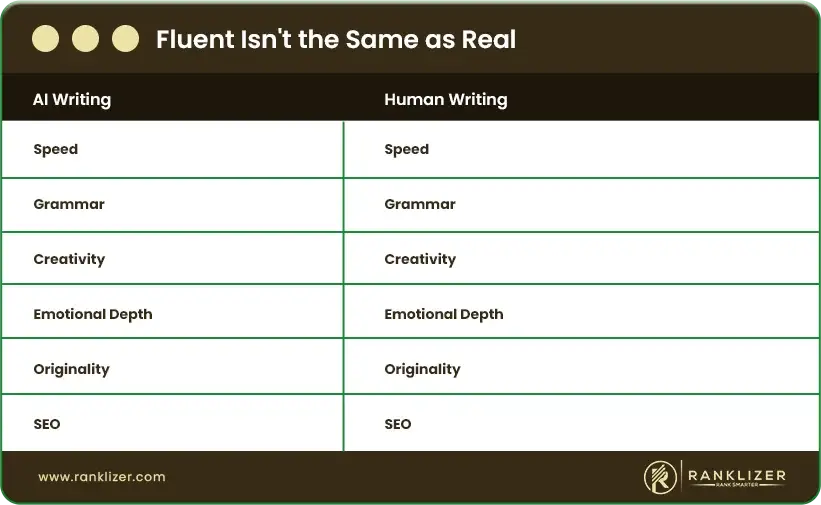
That levelness is evident in familiar locations. One of the easiest red flags editors report is a statement at the top of the submission about how an industry is changing, followed by a neat list of benefits that anyone could have predicted.
There is no software needed to detect that. It’s on autopilot, and a tired human editor sees it.
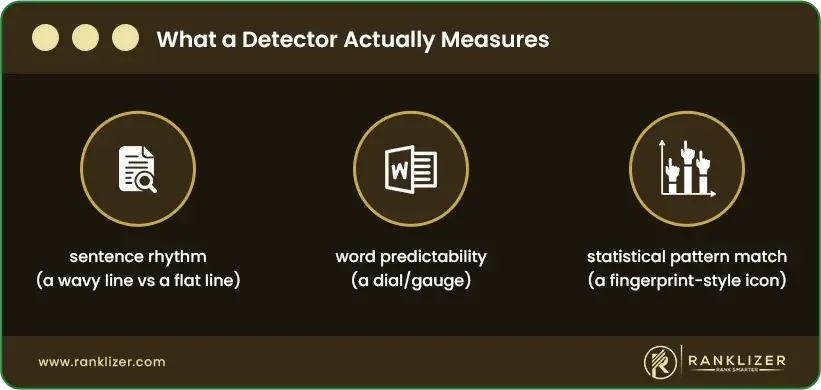
When editors do use a tool, the tool is looking for three things: how predictable each word choice is given a language model, how much a piece varies its sentence rhythm, and whether the writing statistically looks like known AI output.
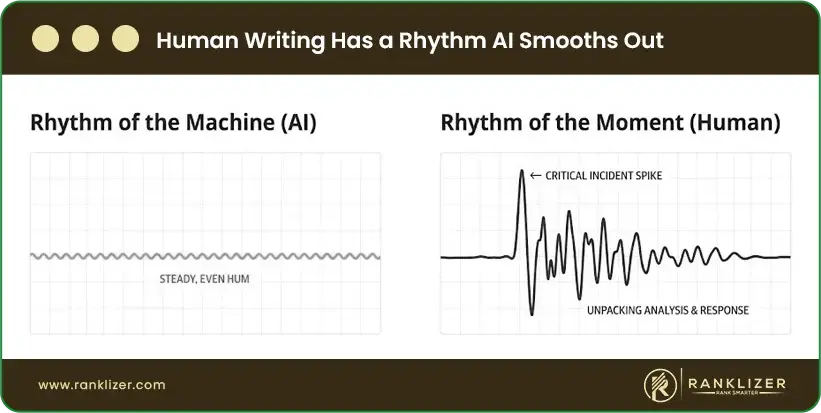
The middle one, rhythm, is worth sitting with. In human writing, the short sentence is followed by the longer sentence that unpacks it.
AI output tends to smooth that variation out to a steady hum. It can be felt before it can be named, and that is why editors see it before writers do.
The stakes are real, and they’re measurable
This isn’t a vibes-based crackdown. One link building agency that monitors its own guest post pipeline made the change to an all-human writing policy back in 2023 and began to test prospective employees using an AI-proctored writing test.
They tightened their editorial review and implemented AI-detection on their own work before submission, and they noticed a tangible decrease in the number of pieces rejected and the number of pieces ghosted or unused.
The second number is more significant than you think. At least you know something when you are rejected. Silence doesn’t.
The general rule among those who make a living out of it is that if an editor has not responded to a few follow-ups, it’s not chaos in the schedule. It’s just that the piece failed to clear the bar and no one wanted to spend any more time explaining why.
This is why it is so important right now, with the broader acceptance-rate data. Cold pitches to a manually screened, quality site land between 5% and 15% while warm outreach to a site with a relationship can land 30% or more.

Each and every pitch you send that’s flavored with AI is not rejected.
It consumes a space in a narrow acceptance window, and more quality publications are including explicit anti-AI policies in their editorial guidelines, instead of it being an unwritten rule.
Why is this good news
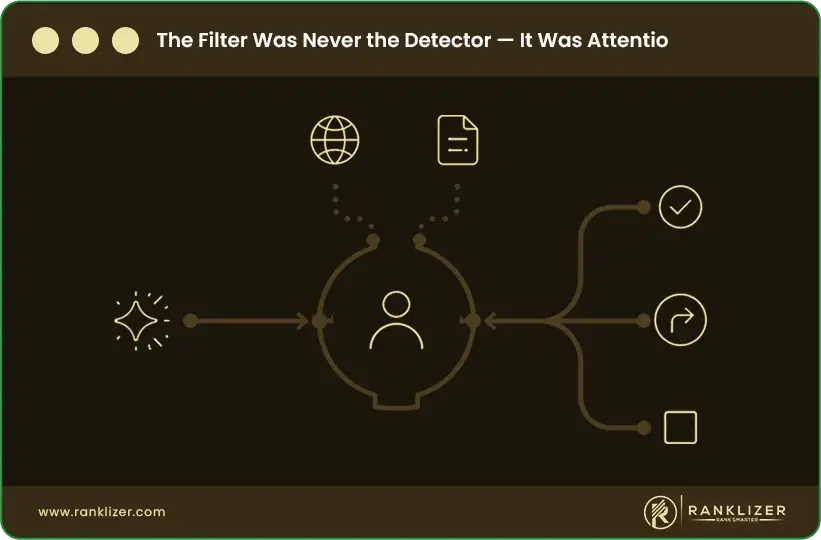
Before we get to the fixes, here’s the part worth sitting with: none of this is really about beating a detector. If you’re just trying to get around a checker, you’re not solving the right problem, since the checker wasn’t really the gatekeeper.
The editor’s attention span was. And the editor’s attention span is triggered by only one thing that a language model structurally can’t fake: a specific person’s specific experience of a specific problem.
That is not a “workaround”. That’s what a guest post should be.
The 10 fixes that work
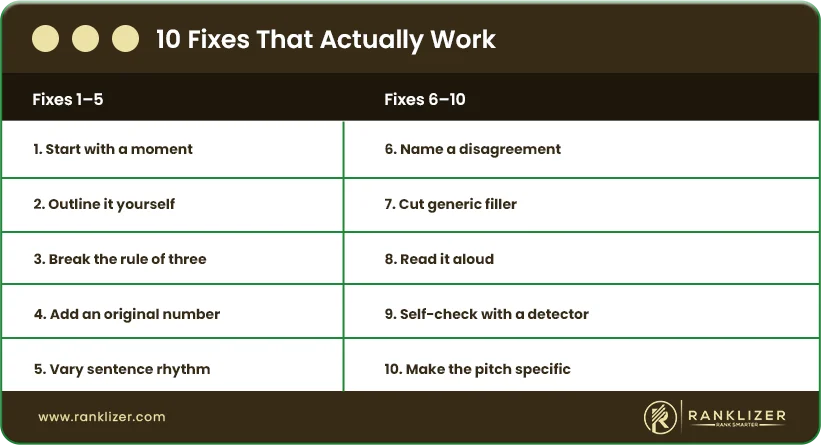
- Start with a moment, not a claim. Avoid using the opening “In today’s landscape, X is changing rapidly.” Begin with something that went wrong: a client call that went wrong, a number you didn’t expect, a mistake you made. The specificity in the first two sentences does more to indicate that this was written by a human than anything you’ll do in the other 1,500 words.
- Create the outline first without AI. If desired, use AI to research, summarize, or format at a faster pace. Plenty of working writers do. However, the argument, the structure and the point of view must be from your perspective. If the model is doing the thinking and you’re just editing the output, then that’s the space that editors are trained to feel.
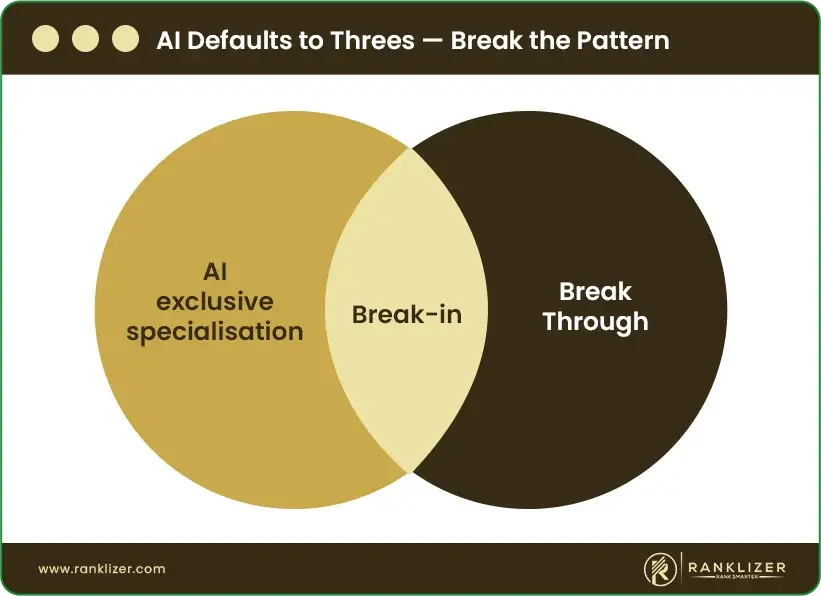
- Break the rule of three. AI output is always in threes. Three benefits, three reasons, three tips. Make a deliberate break in the pattern. Sometimes, give two, sometimes five, sometimes just make the point in a sentence and move on.
- Add one number that no one else has added. Your own data, your own client work, your own testing. Not a recycled “studies show” line. A real person, whose name you can provide. This one move is more for credibility and detectability than for any rewording.
- Keep one sentence short. Then let the next one run long, unpacking it properly. That rhythm change is one of the three technical signals that detectors look for, and it’s also the same rhythm that natural writing sounds like.
- Name a disagreement. Choose one place where you disagree with the prevailing opinion in your industry. AI-generated drafts will be somewhat conservative, as that’s the statistically safe result. One of the more difficult things to fake convincingly is a sincere opinion, clearly expressed.
- Delete all sentences that might apply to any company in any industry. If a sentence could still be written with your brand name replaced with another competitor’s, it’s filler. Editors are more likely to pick up on generic filler than anything else because it is a sign that the writer didn’t really need to write it.
- Read it out loud before you send it. If you get stuck on a sentence, or it doesn’t sound like something you would say to a colleague, rewrite it. This is the one habit that will trap more AI-flatness than any tool will.
- Run your own draft through a detector before the editor does. Not to game the score, but to see what it flags, and ask honestly, if that section reads generic, is it? Don’t aim to avoid a high score, but rather use it as a diagnostic.
- Make the pitch as difficult as the piece. Cite an article published in the newspaper. Offer an angle that is appropriate for their audience. A generic pitch receives a generic review, and editors read the pitch as their first clue as to whether the draft that follows will be worth their time.
The bottom line
The editors did not become more adept at identifying AI, the tools did not become smarter. They improved because they’ve been trained, albeit unwittingly, by a pile of confident, well-structured, forgettable prose in their inboxes.
The solution was never to outwit a checker. It’s about providing them with what a model can’t provide on its own: a person who has something to say.