

- Combine organic marketing (SEO, social, email, content) with paid ads (Google, Meta) for balanced growth
- Prioritize local visibility through Google Business Profile, citations, and reviews
- Focus on one or two channels done well, rather than spreading thin
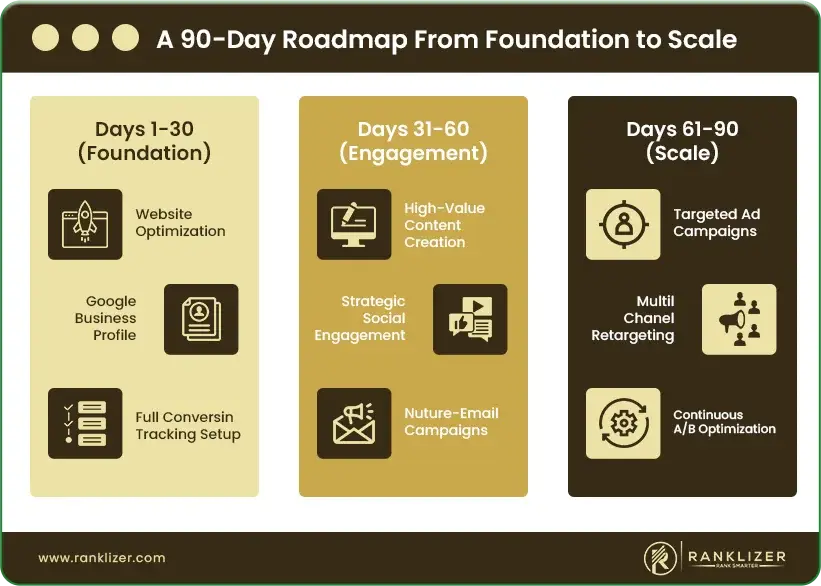
- Follow the 30-60-90 day roadmap: foundation, then publish/nurture, then test/scale ads
Small businesses can compete with big businesses to get their share of the market with the right marketing channels, a clear message, and proper execution.
A lean team can attract, build trust with, and convert customers if they use the right resources and marketing channels.
Deciding where to market your business is the hardest part. Many marketing avenues exist, but which ones are the best? We provide a comprehensive analysis of the small business online marketing landscape in this guide.
From visibility in search to social media marketing, email marketing, content marketing, and paid advertising. This guide also provides a practical toolkit, useful metrics, and a straightforward 30-60-90-day marketing roadmap.
Unveiling the needs of your potential customers and meeting them where they are searching is the foundation of every successful marketing plan.
Whether you’re starting a local business, an online business, or promoting a business to generate more leads, the same rules apply.
Digital Marketing Strategies for Small Business
Digital marketing strategies for small businesses use online means versus print ads, direct mail, radio, or television. For example, digital marketing strategies may encompass search engines, social networks, email, websites, online directories, video, and digital advertising.
The primary advantage is flexibility. A small business can kick off a digital marketing campaign with a limited approach and measure the response.
Adjustments can be made to the digital marketing campaign without incurring the commitment of a large traditional advertising campaign.
Organic and Paid Marketing
In general, digital marketing falls into two categories, organic and paid marketing.
- Organic marketing: Marketing that does not include the expense of each impression or click and is earned. This includes SEO, blogging, social media, emails, online reviews, and even referrals.
- Paid marketing: In exchange for a target audience, this type of marketing places a business before an audience. This may include Google Ads, Meta Ads, and even paid partnerships with influencers.
Organic marketing takes time to show results, but has the ability to create visibility that is sustainable. Paid marketing brings traffic to a website but has to be balanced.
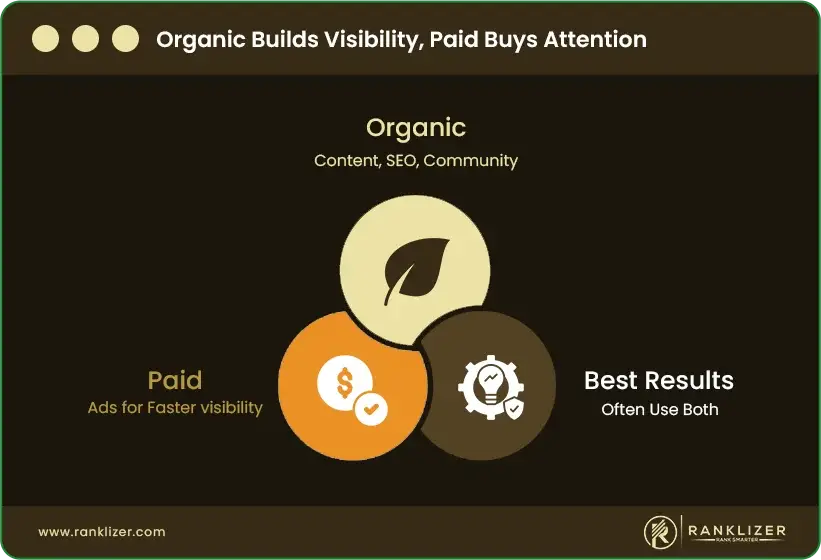
Being flexible is usually the best way to be successful when integrating a marketing solution. Paid search can be a strong player when utilized to capture time-sensitive demand. While SEO creates visibility that is sustainable, email nurtures contacts that are already generated and known.
Reasons Small Businesses Should Use Digital Marketing
Digital Marketing is excellent for small businesses as it focuses on specific demographics and is measurable.
Instead of targeting a large area and casting a wide promotion net, a business can target customers based on location, search intent, interests, professional role, previous visits to their page, and as a customer.
Digital Marketing also has a lot of options and functionality for small businesses. A local retail business can run social media posts several times a week. The posts can become services pages with email subscription for a consultant.
A local restaurant can create a better profile, improve reviews, and advertise special offers targeted toward local customers.
The goal is not to be everywhere, but to be reliable in the channels your customers use.
Google Business Profile and Local Marketing Tips
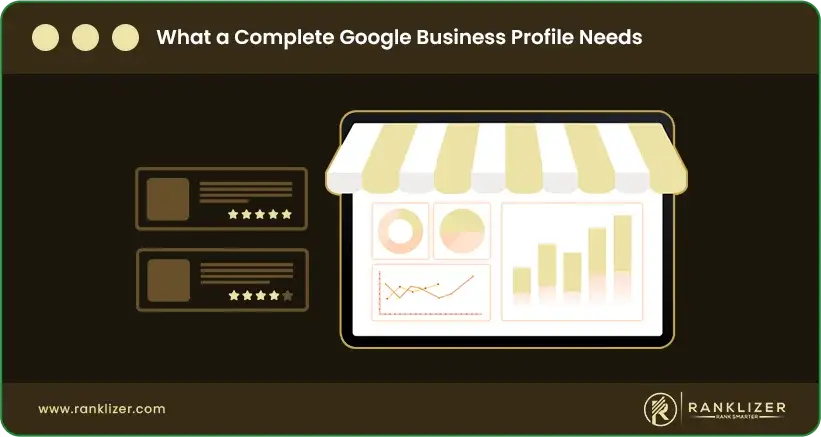
For businesses dedicated to serving a specific town, city, or area, local search visibility is one of the best routes in marketing. An up to date Google Business Profile is how new customers find your business.
Although many people still refer to this as Google My Business optimization, Google actually calls it Google Business Profile. The goal is the same: provide useful, accurate, complete, and compelling information about your business.
Claiming Your Listing And Polishing
To get started, you need to claim your listing and provide the requested information to verify your listing. Once claimed, go through as if you were a potential customer and determine if you would reach out to you.
Given the following points, please provide feedback:
- Business name
- Address
- Contact info (including website)
- Primary and secondary business categories
- Opening hours
- Holiday hours and available appointments
- Service areas for businesses that go to the client
- Products, services, menus, price ranges, and links for booking
- Quality pictures of your premises, employees, products, and work done
- Concise description of your business highlighting what makes it different and who you serve
Rather than using your business name plus a bunch of keywords, just use the actual business name.
Including the phrase “Best Affordable Plumber in Lahore” in your name field a couple of times is pretty spammy and could potentially get your listing taken down.
Pictures should be current. To show visitors the location, include frontal images of your business. Also, include images of the work done and of the products to show quality.
Managing Reviews
Reviews affect trust, customer choices, and visibility of a business. Customers are more likely to select one business over another if one business has better reviews, regardless of the similarity of the services offered by the two businesses.
It is important to time the review request to the appropriate moment. A service provider can request a review after completing a successful service, while an online shop can request a review after successful delivery.
You can easily facilitate the review process by sending a direct review link. There is no need to offer a discount to influence positive reviews, as this can compromise your listing.
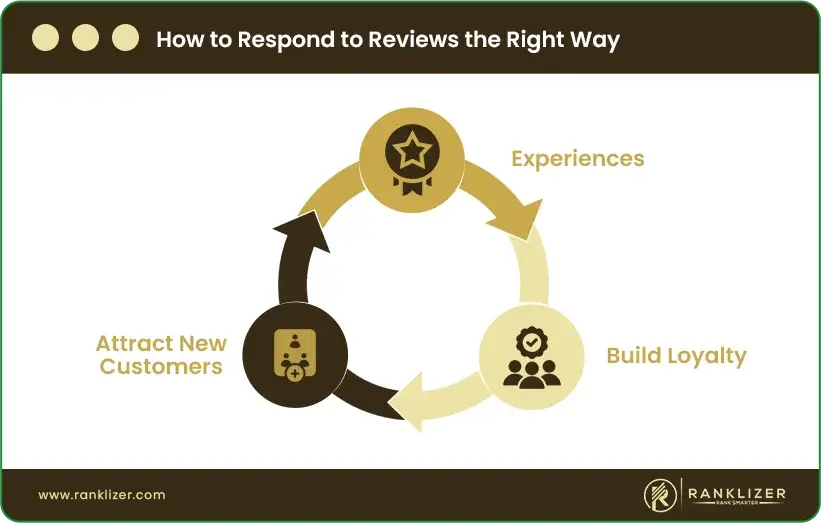
Respond to reviews thoughtfully:
- Acknowledge positive feedback
- If possible, refer to a specific detail
- Do not defend against negative feedback
Complaints should be directed towards private communication while keeping the public responses polite.
Analyse what was said for patterns in the feedback to determine if it indicates concerns with an established process within the operation of the business.
A negative review can serve as an opportunity to improve the reputation of your business by demonstrating responsibility toward your customers and addressing problems instead of displaying ignorance as if every customer interaction in your business is perfect.
Local Citations and Directories
Local citations are references to your business in an online format that includes the business name, address, and phone number.
These can be found in online directories, chamber of commerce websites, professional association sites, review websites, or other regional business listing pages.
Be consistent. Customers may become confused, and it may be difficult for search engines to connect listings if your business address is entered differently across different directories or your business phone number is not the same across different directories.
It is better to list your business in a few high-quality local directories than to list it in hundreds of low-quality directories.
Search Engine Optimization Fundamentals
SEO for small business is the practice of enhancing website quality and visibility so search engines can easily access it and users can find it for relevant queries.
It is important to know that SEO is a long-term marketing strategy; however, once a website receives visibility for relevant queries, users may begin to return and increase the value of the website.
Small businesses should avoid broad ranking in competitive phrases for their industry. A more realistic and effective strategy is to adopt a variety of precise ranking positions for key phrases that are valuable to your target customers for your business.
Deep Keyword Research
Keyword research starts with how your customers would describe their problem and how they refer to a solution. Understand the questions they ask when they’re about to buy, the problems they describe, and how they label their own search.
Robust starting places include:
- Google’s autocomplete suggestions and related search options at the bottom of search results pages
- Questions customers ask sales reps
- Questions customers ask support staff
- Search Console for queries that generate impressions
- Competitor service pages and article topics
- Keyword research tools that are free or freemium (such as Ubersuggest)
- Phrases like “near me,” a city name, or a neighbourhood
Keywords with search intent fall into these categories:
- Informational (provide instruction): “How to fix a leaking roof”
- Comparison (Considering an action): “Best roofing material for a small house”
- Buying (comprehension): “Roof repair service in Lahore”
- Guiding (navigation): When someone searches for a business or brand
Generally, a service page should incorporate a relevant commercial or transactional keyword, whereas a blog article should answer an informational keyword and funnel the reader toward a service.
keyword Phrasing
Stuffing phrases into each paragraph that relate exactly to the keyword doesn’t work. Search engines are completely unimpressed, as are readers.
Optimizing Your Pages
The visible and hidden elements of each page and their optimization come together to form on-page SEO. Start with the reason a page exists. The visitor must understand this reason within a few seconds.
Review the following elements:
- Title tag: Concisely describe the page and include the main topic.
- Meta description: Describe the benefit of visiting the page and increase relevant clicks.
- H1 heading: Used once to describe the main topic of the page.
- H2 and H3 headings: Used to describe topics in a clear and on target manner to the search engines and site visitors.
- Body copy: Describe the offer, address objections, naturally use related terminology.
- Images: Reduce image size, use a filename that describes the image, and add relevant alternative text.
- Internal links: Link to relevant related pages: service pages, articles, case studies, contact pages.
- Calls to Action: Encourage visitors to perform the desired action like filling out a form for a quote, arranging a consultation or call a business.
Extract from an article on choosing a commercial cleaning service. It could include a link to a page on commercial cleaning services, a pricing page, and a contact form.
This article creates a helpful user journey from the informative stage to the conversion stage.
Technical Essentials
The technical aspects impact the overall user experience as well as performance in search results.
A simple design without moving parts and a website that functions as expected will surpass more complex designs that do not perform as expected.
Prioritize:
- Optimizing page load speed, especially for mobile users
- Design with varying screen sizes in mind
- Security of your site with HTTPS
- Designing with navigation and font legibility in mind
- Creating contact forms with click-to-call phone numbers
- URL naming conventions
- XML sitemaps and managing indexation settings
- Having useful error pages and optimizing images
- Regularly updating and securing all software and plugins
Test important pages from your mobile device; otherwise you will only be reviewing them on your desktop.
Keep in mind that commuters, customers searching for your services, and/or customers comparing you to competition are likely to find your business.
Social Media Marketing for Small Business
Small business social media marketing is most effective when used to achieve a clear business goal. That goal can be to increase brand awareness or to improve customer loyalty, perhaps even drive traffic to a local store.
Social media marketing should not be an area a business owner avoids. Posts should be targeted in nature and be relevant to the business, to help the business achieve its goals.
Choosing the Right Platform for Your Audience
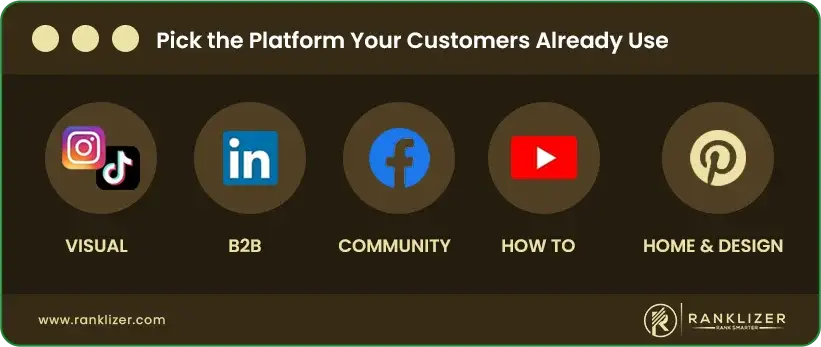
Which social media platforms your business decides to use are often dependent on your customer type, the type of industry you serve and your available resources. It is important to consider your available resources.
- Instagram and TikTok are suitable for products and services with a lot of visual appeal, including food, fashion, fitness, and creative services.
- LinkedIn more closely aligns with the needs of B2B products, services, and professional consultants and tech companies.
- Facebook still serves a critical function for community organizations, customer groups, and businesses with offerings for customers across a range of ages.
- YouTube supports a variety of how-to and demonstration style video content.
- Pinterest complements businesses in the home improvement, fashion, food, design, and other visually based services.
Starting with just one or two networks is ideal to build a following. Your team should select a highly frequented network and continue to publish quality content.
A Content Rhythm
Getting into a routine of consistency is better than posting 20 times a day with no structure or quality. Repetitive content does not produce business.
- Start a content calendar with recurring themes to build structure.
- Consider educational posts.
- Include some behind-the-scenes.
- Share customer posts.
- Demo your offerings.
- Address common questions.
- Meet the team.
- Integrate community activities.
An achievable schedule may include 3 weekly posts, a short handful of stories, and one longer post per month.
Revise the content rhythm if there is an improvement in business or an internal constraint.
Batching posts becomes a time saver. Take all the photos for the month’s posts in one day. Write all the captions in a single session.
Turn your single question customer email into a post, email, and a video all at the same time.
Focused Engagement
Conversational content building through engagement strengthens a following. Take the time to respond to each comment, direct message, and customer shout out. Join conversations that pertain to your business.
To get answers, ask multiple choice or other easily answered questions. Encourage people to share their preferences, identify challenges, or vote on options. Responses to these types of questions can provide insight into developing products, content, and offers.
Being social doesn’t mean responding to every comment or message at every moment of the day. It is responding as you normally would if you were having a face to face conversation instead of posting to a wall.
Email Marketing for Small Business
Email marketing for small business means that you can communicate with people who are interested, when they are interested, rather than relying on social media where your audience reach can become unpredictable.
The email list also makes it easier to build trusting relationships and customer loyalty.
It is better to have a small list, that is actively engaged then to have a large list with people who don’t engage with your content.
Growing a Subscriber List Organically
Clear, ethical opt-in options are usually positioned along the customer journey with common examples such as:
- Offers
- Resources
- Access to new products/exclusive events
- A lecture series
- An excellent advice newsletter
It is important to inform potential subscribers of the frequency of contact with the list as well as what they can expect to receive after signing up.
Pre-checked opt-in consent boxes should never be used and buying a list is always a bad idea.
Purchased lists will likely not give you any engagement and with potential legal, reputational, and deliverability issues, you should never buy a list.
Place forms where the context matters like with your site’s header, blog posts, service pages, an online checkout, and a booking confirmation form. Use basic forms if additional input isn’t required for segmentation.
Crafting Messages That Convert
An effective email is straightforward. It has an audience, a relevant email subject, a message, and a clear next step.
Improve performance by:
- Writing unambiguous subject lines
- Personalizing email content by customer interest and previous customer activities (or inactivity)
- Segmenting subscribers by location, interest in different products, customer status, or engagement
- Use simple paragraphs
- Include one clear call to action
- A/B test email sends at different times
- Evaluate clicks and conversions, not just opens, for email effectiveness
Your newsletter and other emails should be consistent but not overly frequent. A good small business practice would be to send one newsletter each week, or two emails per month, with automation of emails triggered by sign-ups, purchases, or customer inquiries.
Automation Without Complexity
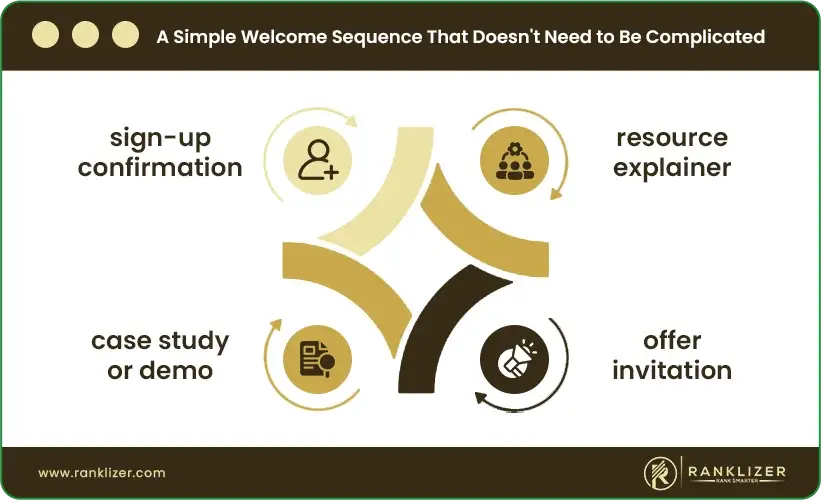
Marketing automation doesn’t have to be complicated. The first sequence could include the following:
- Confirming subscription email with expectations
- A resource or explanation
- A case study, customer video testimonial, or product demo
- An offer or invitation to a scheduled call
Content Marketing for Small Business
Content marketing for small businesses focuses on developing and distributing useful content to attract, engage, and assist customers in their purchasing decision. Content marketing can include blog posts, videos, how-to guides, case studies, checklists, podcasts, etc.
Creating content solely to make a publishing deadline never results in productive content. Effective content marketing naturally connects real customer concerns with products or services.
Blogging for Trust-Building
Starting a blog can help a small business gain visibility by addressing the questions potential customers might have before contacting a supplier. Additionally, it can satisfy the demand for and remove doubt about a product or service.
Clear article topics are usually borne from:
- The most frequent customer questions from the sales or support team
- Mistakes that customers make
- Comparison of products
- Factors that affect pricing
- Product preparation and use instructions
- Seasonal and local concerns
- Technical definitions explained
Articles should be specific to provide real value. Publish “Seven Tips to Help Find the Best Commercial Painters”, instead of “Everything You Ever Wanted to Know About Renovating Your Home.”
A blog post should not regurgitate content from other websites. Instead, post original information, observations, and an explanation provided in a logical format with clear next steps.
Digital Guest Posts and Backlinks
Publishing guest posts can help a business reach related audiences and market with reputable websites. Quality audiences can be found at industry publications, local organizations, and related businesses.
Instead of offering an advertisement in disguise, pitch an article that serves your audience. An example of an article submission in this vein could be from a web design company about how small business sites might prepare for mobile visitors.
Don’t use massive link schemes or pointless guest-post networks. A handful of that complement the content and are editorially appropriate are better than a bulk of weak links.
Repurposing Content Across Channels
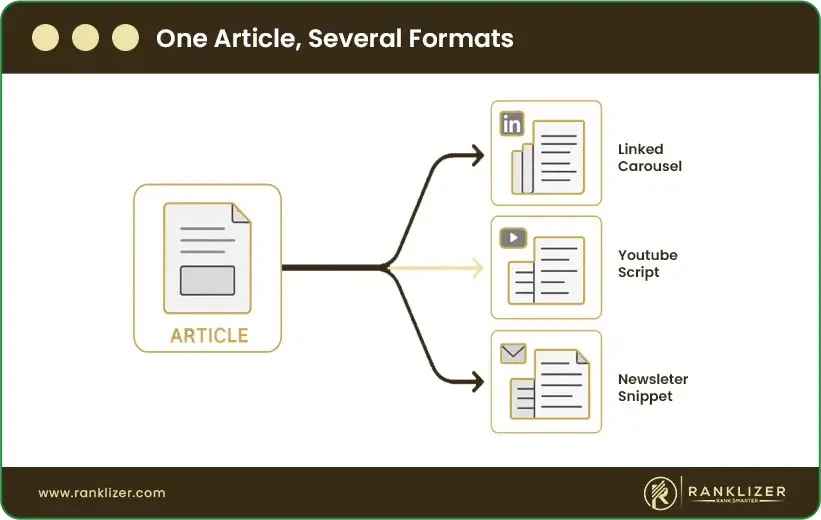
Thoroughly researched articles are often able to generate multiple small content pieces:
- A couple of social media posts
- A short newsletter
- An infographic or carousel
- A short, explainer video
- Answers to customer FAQs
- A short video or resource to help sell
- A list to aid in selling and customer follow-up
When repurposing content, do not just copy and paste to different mediums. Adjust your content to the format and expectations of the new channel.
A blog example may become a quick social tip with a few steps, and a case study may become a short video outlining a problem, a process, and a result.
Online Advertising for Small Business
Online advertising for small businesses can increase visibility immediately, but effective, ROI-driven campaigns require focus, strong creative, and accurate conversion tracking. Advertising should not be about just getting clicks, it should be aligned with a purpose and objective.
Before launching, determine the ideal conversion outcome. This may be a phone call, a form submission, a purchase, a booking, a store visit, or a newsletter sign-up.
Google Ads vs Meta Ads: Which Will Best Serve Your Advertising Goals?
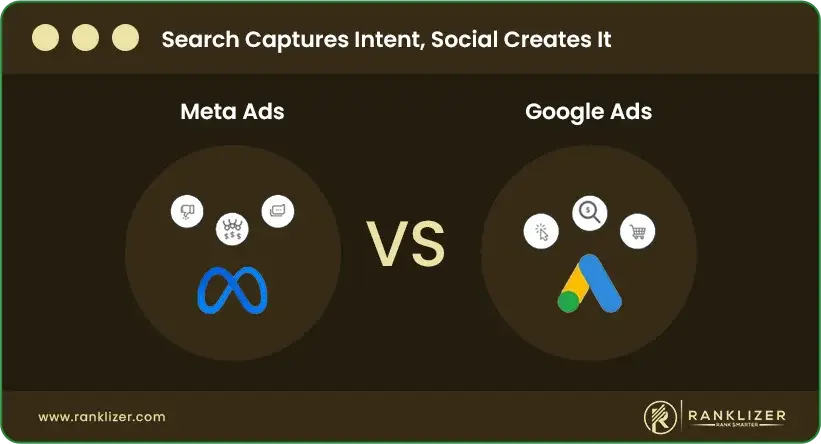
These advertising channels offer a variety of advertising options, which means you can choose the one best suited to your objective. Google Ads are often the best choice when users are actively searching for a service like yours.
For example, the search query “emergency electrician near me” has a strong intent, whereas someone browsing the social media feeds has, at best, a weak intent.
The driving force of Meta Ads is audience targeting. This form of advertising is typically used to appeal to an audience and create a demand for a product or service that the users may not actively be searching for.
Meta Ads are best used in concert with Display ads because, although there is less intent to convert with Display ads, they expand your audience reach and provide an opportunity for retargeting.
If you’re working on a limited budget, the daily spend limit for your ads should be tied to how much you are able to sustain over the long term, relative to click cost and conversion value.
Advertisers who operate in a less competitive geographical location may be able to spend more.
- One clearly defined audience
- A limited geographic area
- One primary conversion goal
- A small group of closely related keywords or creatives
- A dedicated landing page
- A realistic testing period
Don’t base your judgment of a campaign on impressions or clicks; see how many quality conversions it has. Look at the qualifying opportunities and customers that result from the generated inquiries.
Where possible, test one significant variable at a time. This can be a headline, offer, landing page, audience, keyword theme, or imagery.
When a good pattern is observed, do not make an uncontrolled, rapid huge expansion; rather, increase the amount spent in a more controlled way.
Smart Retargeting
Smart retargeting involves showing potential customers who’ve engaged with your business or visited your site (even in the past) relevant, targeted ads. Many of these customers are interested, but potentially not ready to make a purchase.
Good candidates for retargeting include:
- Viewers of a service page
- Potential customers with a product in their cart
- People who viewed a product video
- Prospective customers who partially filled out a form
- People who bought a service in the time since the last visit
Set creative and frequency limits to avoid being overly aggressive. A retargeting message can address a common objection, show a customer result, answer a common question, or remind visitors about an offer that expires.
Low Budget Marketing Options for Small Businesses
Creativity replaces cash for low budget marketing campaigns. Budgetary constraints also work to your advantage because it means prioritization is key. The best small business low-budget marketing strategies are as follows: customer advocacy, existing relationships, good content, and local networks.
Here are some marketing activities to try:
- Event sponsorships: Sponsor local community events for brand exposure
- Expert answers: Participate in local community forums and groups without pushing your marketing services
- Customer testimonials: Ask satisfied customers to provide testimonials
- Referral program: Create an incentive for brand advocacy through a referral program
- Community partnerships: Form community partnerships to host local collaborative events and workshops
- Local events: Participate in local community events to capture audience leads
- Free workshops: Teach a practical related service, collect contact information
- User-generated content: Encourage customers to post about your product or service
- Reviews: Create a system to capture product reviews
- Marketing tools: Use the free versions of marketing tools such as Google Search Console, Google Analytics, Canva, and basic scheduling and email tools
One common thing about all marketing tools is that they require time, so consider your time as a cost and build sustainable marketing strategies.
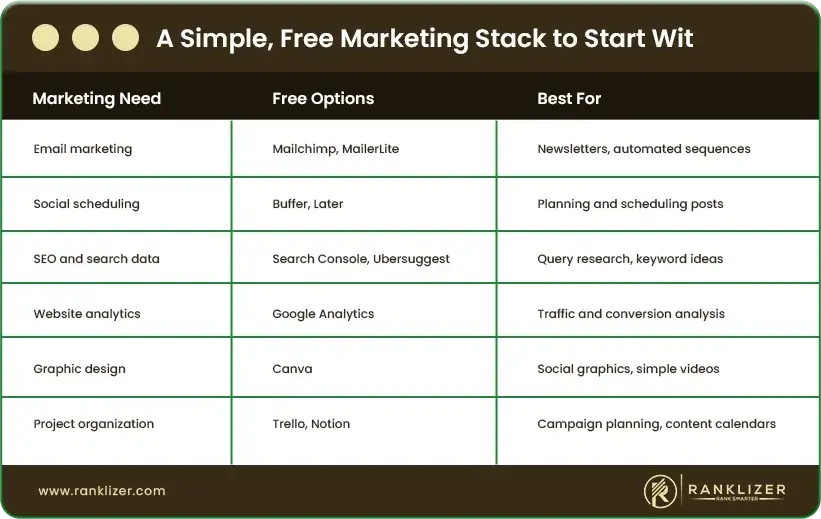
The top marketing tools for small businesses don’t need to break the bank. A good tool solves an operational pain, fits your team’s skills, and provides data to support better decisions.
| Marketing Need | Free Options | Best For |
|---|---|---|
| Email marketing | Mailchimp, MailerLite | Newsletters, automated sequences, subscriber management |
| Social scheduling | Buffer, Later | Planning, scheduling posts, reviewing social posts |
| SEO and search data | Google Search Console, Ubersuggest | Query research, website visibility, keyword ideas |
| Website analytics | Google Analytics or a privacy-friendly alternative | Traffic, events, conversion analysis |
| Graphic design | Canva | Social Graphics, Lead Magnets, Presentations, Simple Videos |
| Landing pages and forms | Website CMS, Form builders, landing page platforms | Lead capture, campaign-focused pages |
| Project Organization | Trello, Notion, or a shared spreadsheet | Campaign planning, task management, content calendars |
A basic stack to help you get started is:
- One email marketing platform
- One social scheduling or content planning tool
- One design Tool
- Local visibility
- Analytics and conversions
- Organic search insights
Review your subscriptions every once in a while. If a tool doesn’t fit your team, doesn’t help you be more efficient, or doesn’t support progress, it doesn’t deserve to be in your business budget.
How to Market a Small Business Online: Bringing It All Together
Learning how to market a business online is easier when you organize your workflow. With SEO, social, email, and advertising campaigns all happening at once, this can quickly become overwhelming for a team, big or small.
A better approach is to set up your credibility, create a path for conversion, and then increase your reach.
Days 1 – 30: Lay the Foundation
You have to set up the assets that will be influencing the different channels you are about to introduce.
- Define: Clarify the problem your business solves and describe your ideal customer.
- Position: Describe your offer, position yourself, and state your main call to action.
- Website: Create or enhance your website’s main pages.
- GBP: Claim and develop your Google Business Profile.
- Tracking: Setup analytics and conversion tracking.
- Directories: Collect your business details for all relevant directories.
- Research: Conduct customer keyword research and consider one social network to approach your customer on.
When your customer is able to discover your business, understand your offer, trust your standing, and contact you with minimum barriers, you have completed this step.
31st Day – 60th Day: Publish and Nurture
Next, set up a publishing and nurturing system that you can repeat.
- Publish Helpful Content Around Customer Questions
- Optimize Important Service/Product Pages
- Start A Simple Social Publishing Schedule
- Add Email Opt-in With A Clear Offer
- Create And Send A Welcome Email Sequence
- Reach Out To Those Who Have Purchased And Asked Them To Leave A Review
- Create One Lead Magnet, Study, Or Resource
- Establish Local Partnership Business Relationships
Don’t mistake follower quantity for quality or genuine interest. Real interest and engagement can be measured by inquiries, responses, downloads, bookings, and visits to your website.
61st Day To 90th Day: Test And Scale
Now that the basics are in place, test introducing some promotion.
- Start A Small Google Ads Campaign For High-Intent Keywords
- Experiment With Meta Ads If Visual Discovery Or Audience Targeted Advertising Works For Your Business
- Set Up Retargeting Audiences
- Check The Performance Of Your Landing Pages
- Evaluate Conversion Rate By Channel
- Improve Content Based On Search Console Data
- Format Successful Content In Different Ways
- Put More Funds Into Channels That Produce Results
Possible conversions include:
- Requests for quotes
- Phone calls
- Scheduled calls
- Purchases
- Contact form submissions
- Files that are downloaded
- Sign ups to receive emails
Analyze how your leads and customers found your website (source). Also consider the page that the leads and customers found (landing page).
The location, device, and the user’s intent are other factors to consider. A small number of high converting visitors may be more valuable than a high number of low converting visitors.
Email Open and Click-Through Rates
While email opens are a good indicator of progress for a campaign, it should not be the only measure of a successful campaign. Clicking an email, completing a form, or making a purchase are better measures of a successful campaign.
Check the list growth rate, unsubscribe rate, bounce rate, click-through rate, and conversion rate. Measure the effectiveness of different types of emails. Also test different segmentation and calls to action.
Social Engagement and Follower Growth
Follower growth can be a good metric of growth, but it should not be the main goal. Additional metrics to evaluate include, comments, saves, profile visits, clicks to your website, calls to action, direct messages, and leads.
Quality of engagement is more important than quantity. A customer that asks relevant, thoughtful questions is more valuable than a customer that engages superficially.
Cost Per Acquisition on Paid Campaigns
The cost per acquisition (CPA) determines how much it costs to obtain a customer or achieve another predetermined conversion. Analyze CPA with average order value, profit margin, and the lifetime value of a customer.
A paid campaign that has a high CPA is justified if the visitors that are acquired purchase numerous times. Conversely, a low cost lead source may be ineffective if the leads acquire customers infrequently.
Frequently Asked Questions
What is the most effective online marketing strategy for small businesses?
With limited resources and no shopping platform, the ideal approach couples a local or service-specific website with Google Business Profile, targeted SEO, and one or two platforms your clientele uses.
You can engage in email marketing and pay for ads when you have a clear offer, reliable ways to track leads, and the available time to follow up with them.
How much should a small business allocate to online marketing?
One answer does not apply because different businesses have diverse costs related to location and competition. Begin with a sustainable budget, load one or two platforms, and use qualified conversions to justify an increase in spending.
Can small businesses employ online marketing strategies without allocating funds?
Yes. Principles of online marketing like a Google Business Profile, local SEO, social media, email marketing, user-generated content, and referral marketing employ low to no-cost practices that take effort for small businesses.
These practices require active maintenance but do not rely on a marketing budget.
What is the most effective social media platform for small businesses?
The most effective platform for any small business is the one the target audience uses and the one the team can manage regularly.
Some small businesses do well with Instagram or TikTok. B2B small businesses do well with LinkedIn, and local businesses do well with Facebook.
How long until SEO becomes visible for local businesses?
The smallest businesses should know that results from SEO will need patience, at least 6 months for results to be seen, depending on the competition and the quality of the site.
Local algorithms respond to improvements, fixes, and service-specific pages. Curating content targeting higher competition keywords will take longer.
Closing Thoughts
Successful online marketing for small businesses is not promoting your services on every social media platform. It’s a customer-centric approach to marketing, with continuous progress and improvement.
Focus on the basics by improving your local visibility, making your website more informative, customer focused, and creating multiple communication channels. Once those aims line up with your goals and resources, you can add content, social media, email, and paid marketing.
It’s better to manage and actively improve two channels than to use ten poorly. Prioritize your data and customer feedback, and revise your marketing strategies in relation to the goals that cause the most measurable results.