

- An AI search monitoring platform shows where your brand appears, or doesn’t, in AI-generated answers, so you can spot content gaps and competitor advantages.
- Key metrics to track include mention rate, citation rate, share of voice, and how accurately AI describes your brand.
- Strong SEO fundamentals like crawlable pages, schema markup, answer-first writing, and trust signals still drive AI visibility.
- Start small with a list of real buyer questions, record your baseline, fix the clearest gaps, and recheck monthly.
An AI search monitoring platform improves your SEO strategy by showing where your brand appears, or fails to appear, inside answers from AI search tools.
It also reveals data to create better content, clarifies why competitors outrank you, and suggests ways to optimize your existing content.
Now, web searching has shifted, and people use AI search tools to find answers. If your brand is included in an AI overview, your analytics will likely show an increase in sessions.
If a competitor’s brand appears instead, your analytics won’t show anything at all. You simply won’t know you lost the customer.
That’s why it’s important to understand your competitors’ edge, and AI search monitoring platforms help you with this.
That silent gap is what monitoring platforms are designed to expose.
This blog explains what they track, how the data sharpens your SEO plan, which foundations still matter, and how to choose between doing the work yourself, buying software, or hiring a specialist team.
What Does an AI Search Monitoring Platform Track?
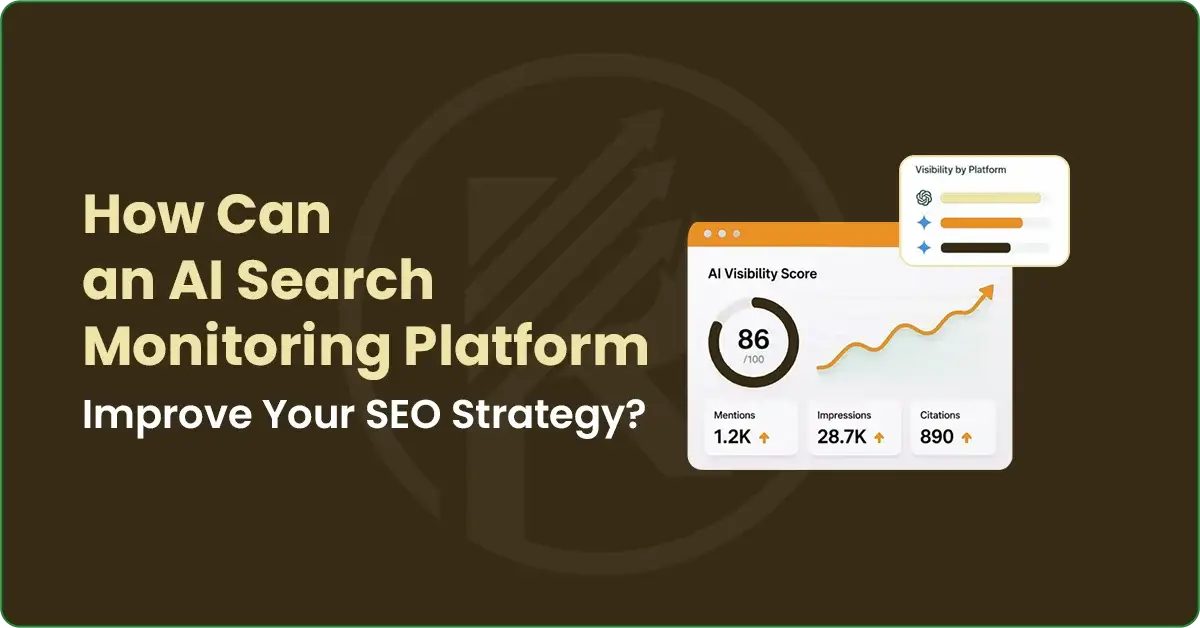
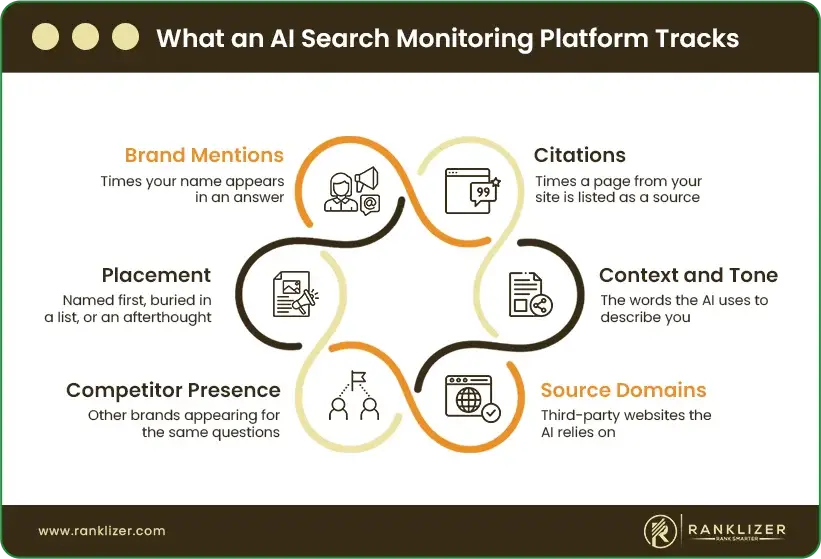
An AI search monitoring platform runs a saved list of questions through several AI tools on a schedule, then records what comes back. Examples of data points include:
- Brand mentions: the number of times your name appears in an answer
- Citations: the number of times a page from your site is listed as a source
- Placement: whether you are named first, buried in a list, or mentioned as an afterthought
- Context and tone: the words the AI uses to describe you
- Competitor presence: which other brands appear for the same questions
- Source domains: the third party websites the AI relies on to form its answer
Other data points include the words and phrases the AI uses, the domains it references, and the tone of the response.
Two types of tools are commonly confused with AI monitoring: rank trackers and general SEO tools. Rank trackers measure the position a webpage ranks for a given keyword and have nothing to do with AI responses.
General SEO tools use automation and machine learning to optimize processes, but they don’t measure AI responses either. As explained above, AI monitoring tools measure your performance in AI-generated answers.
Why Use AI Search Optimization Tools for Your Business
AI monitoring gives businesses insight into customer interactions that are impossible to track by conventional means.
For example, a customer may ask an AI tool for the best option in a given category. If your business appears prominently in that answer, you may win the customer even though they never visited your website.
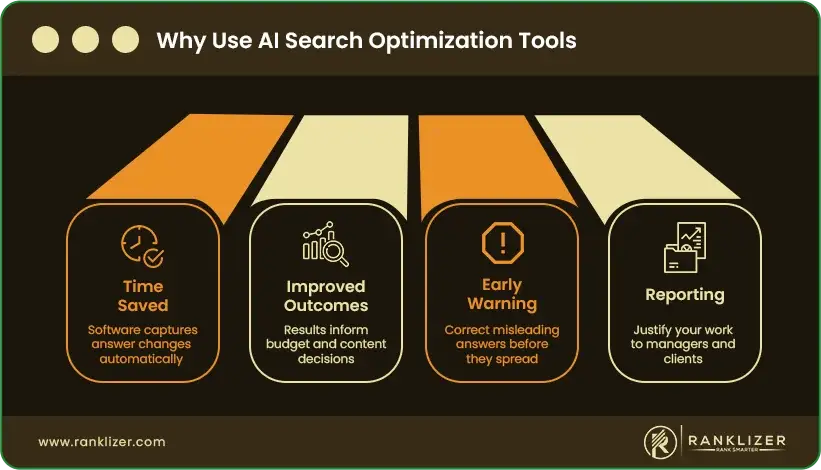
- Time saved: Manually checking numerous prompts is slow and tedious, and the answers can change each time you check. Software captures these changes, including misleading information, automatically.
- Improved outcomes: Monitoring results can inform decisions about budget and content.
- Early warning: If a misleading answer is captured, you can correct it before it spreads.
- Reporting: Reports document your optimization work and justify it to managers and clients.
Smaller businesses can often rely on manual checks for some time before a paid subscription becomes necessary.
How Monitoring Data Improves Your SEO Strategy
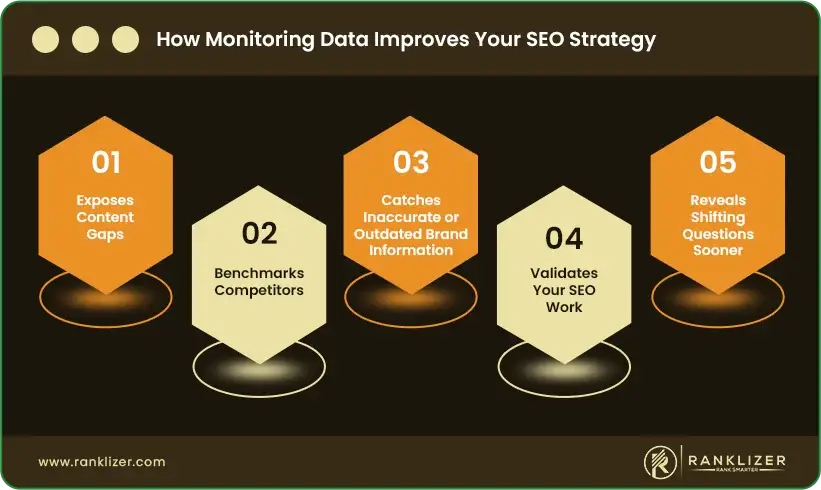
It exposes content gaps
Monitoring is also helpful for identifying content gaps. When an AI tool answers a question by naming a competitor but not you, it’s a sign that your site has only a thin page on that subject, or none at all.
It can also reveal what kind of content a question requires, and the best way to answer it to earn the top position.
It benchmarks competitors
To validate your SEO work, you need to see how your competitors appear in AI answers. Keyword data gives you little insight into how competitor pages are structured.
You may discover that competitor pages less than half the length of yours outrank you for a question because they contain a clear, concise answer, while your answer is buried in a long, detail-heavy paragraph.
It catches inaccurate or outdated brand information
AI tools sometimes present inaccurate or outdated information about your business. Monitoring gives you a way to identify and correct it.
It validates your SEO work
You can use monitoring to verify whether your pages’ visibility improved after you made changes to your site. For example, if you implemented Schema.org structured data, you can check whether your citations increased.
It reveals shifting questions sooner
Monitoring shows you the questions customers are starting to ask so you can answer them before your competitors do. These tools often surface questions before search volume for them rises.
What Elements Are Foundational for SEO With AI
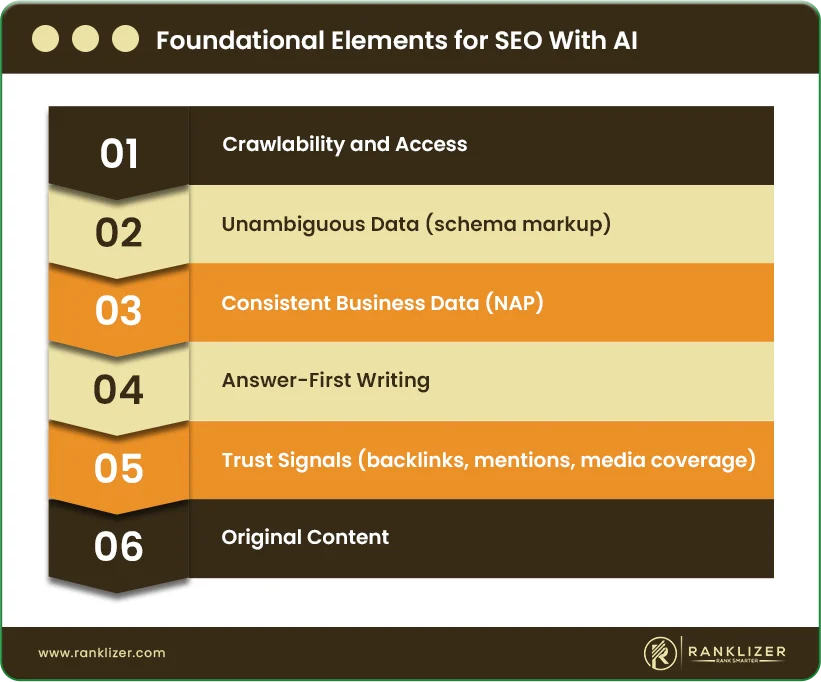
AI systems evaluate your pages against certain threshold factors, including:
- Crawlability and access. Whether AI systems can crawl and access your pages depends on factors such as your server health and the entity extraction rules the AI systems use.
- Unambiguous data. With schema markup, sites can communicate the answers to the five Ws (who, what, when, where, why) to search engines.
- Consistent business data. Consistency is key for machines to recognize your business. Your NAP (business name, address, and phone number) and business description should match across all channels, including your website, social media, and business directories.
- Answer-first writing. Lead with a clear, direct answer, then expand on it in paragraph or list format. For more information, see our article on content structure.
- Trust signals. Backlinks, positive mentions of your business, and media coverage help establish your business as trustworthy and authoritative.
- Original content. AI systems favour content that adds new information. If your content only repeats what’s already available, it’s unlikely to be surfaced.
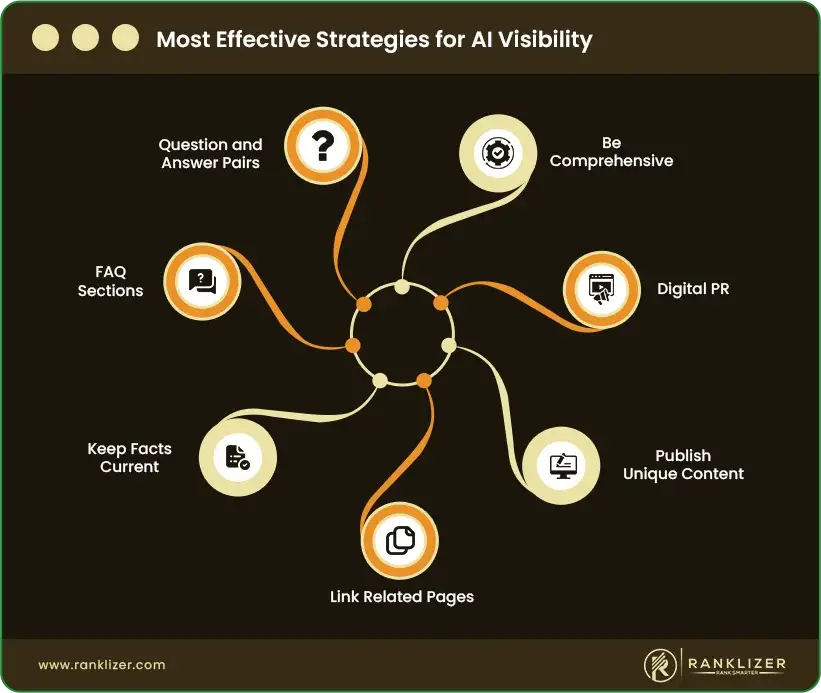
Most Effective Strategies for AI Visibility Enhancement
Monitoring measures results, but it does not create them. The underlying work still decides whether AI systems can find, understand, and trust your content. These foundations matter most:
- Use question-and-answer pairs. Write headings that match the way people actually phrase questions, and follow each with a detailed answer.
- Be comprehensive. Cover a topic in enough depth to address all relevant information.
- Use FAQ sections. Provide common questions and their answers.
- Do PR. Digital PR helps you build your business and establish your name in the industry.
- Keep facts current. Facts change, and outdated information gets repeated and spread.
- Publish unique content. Material specific to your business, such as the results of your own surveys or studies, is difficult for others to replicate and gives you a competitive edge.
- Link related pages. Create a path through related pages to help users and search engines understand your important information.
These strategies increase your site’s authority and reduce ambiguity. They complement traditional SEO rather than replace it; the same efforts improve both.
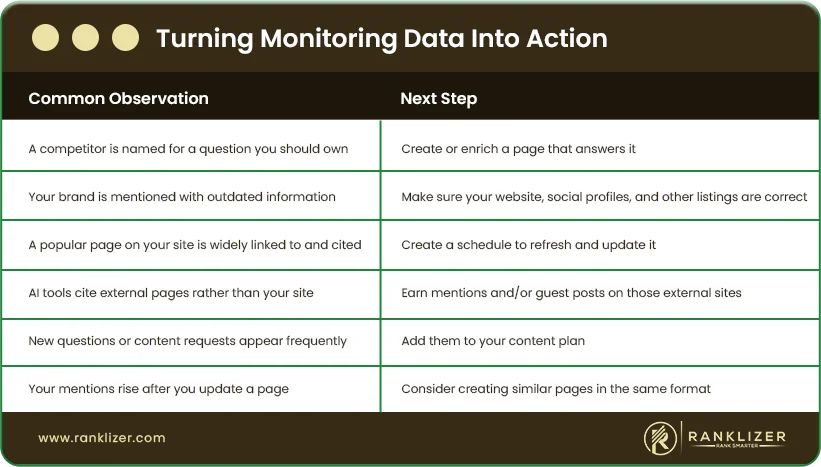
Turning Monitoring Data Into Action
Data is only useful when you interpret it and act on it. The process involves the following steps:
- Prepare a question list. Brainstorm 20–50 questions your buyers (potential customers) might ask, including questions comparing providers and asking for the best ones.
- Record your baseline. Note your position and your competitors’ positions, what is said about each, and any other important information.
- Classify the data. Sort the information into three categories: what is said about you (positive, negative, or neutral), what is not said about you, and what is said about your competitors.
- Take action. This may include changes to your site, new content, or outreach.
- Repeat. Run this process regularly to assess and improve your position.
The following table describes common observations and suggested next steps.
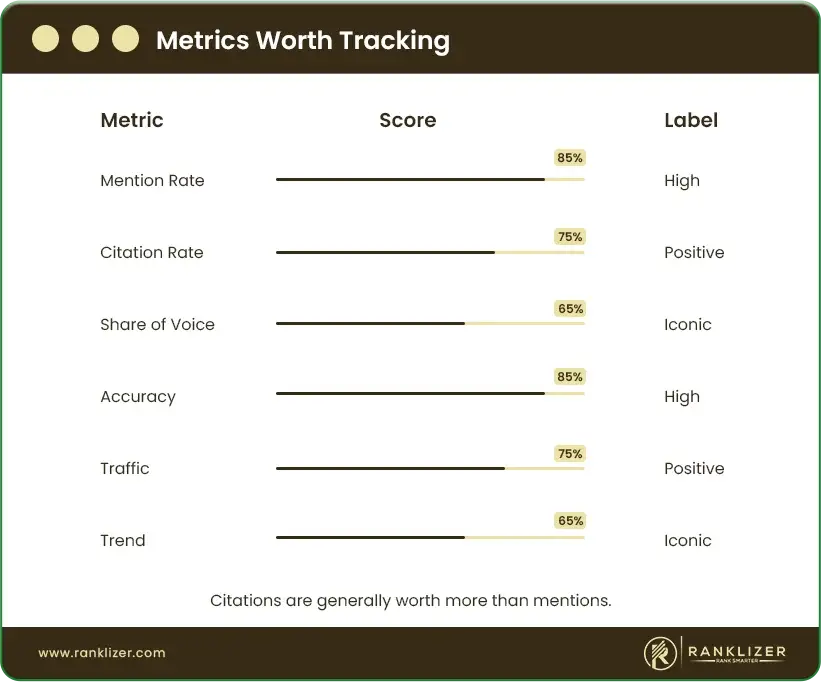
Metrics Worth Tracking
It’s best practice to define terminology in a report. Use the following definitions:
- Mention rate: What percentage of prompts named your brand?
- Citation rate: What percentage of prompts cited your page?
- Share of voice: What share of all brand mentions went to your brand?
- Accuracy: How accurately did the AI describe your brand?
- Traffic: How many visits came from AI tools?
- Trend: How are these metrics changing over time?
Citations are generally worth more than mentions because they link to your site and can drive traffic. However, mentions still build positive public perception.
Don’t judge your strategy on a single day’s results. Assess it over a longer period, such as a month.
Building an AI-First SEO Strategy
An AI-first strategy integrates two search channels that have traditionally been treated separately: search engines and AI tools.
An effective strategy includes:
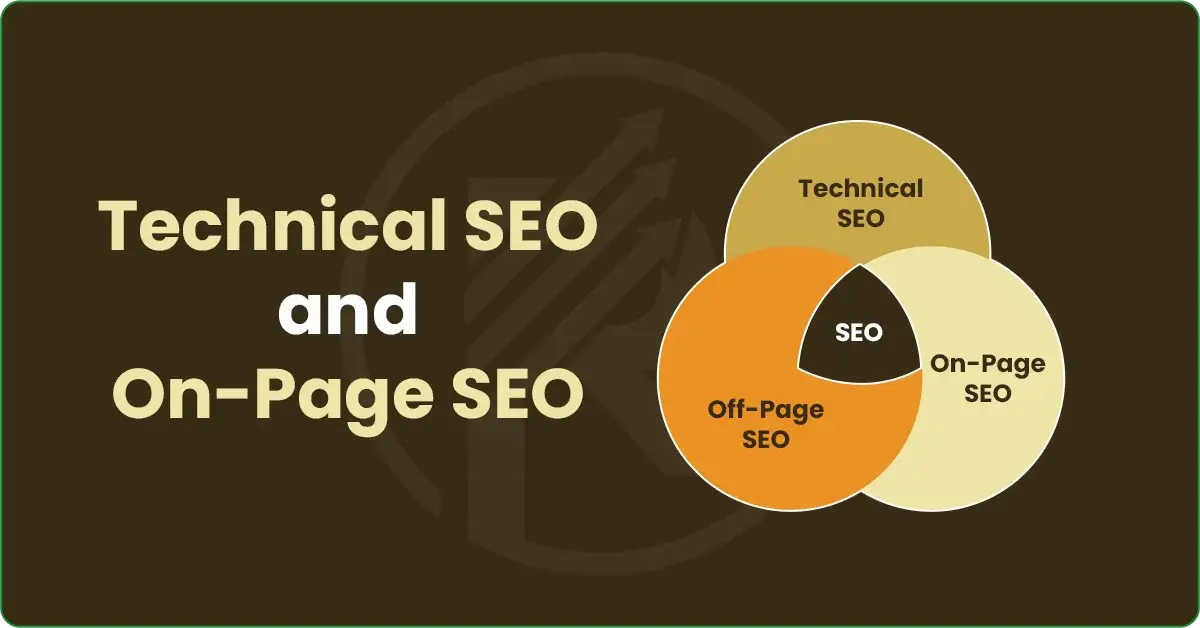
- Continue practicing on-page, technical, and off-site SEO.
- Frame your target questions the way customers actually ask them. Sales calls and support emails are good sources for this phrasing.
- Once your questions are framed, designate areas on each page that give direct answers.
- Keep an eye on both scoreboards.
- Optimize for AI visibility and adjust your approach based on the data rather than chasing every trend.
- Add an AI visibility section to your existing SEO report.
AI Search Optimization for Consultants
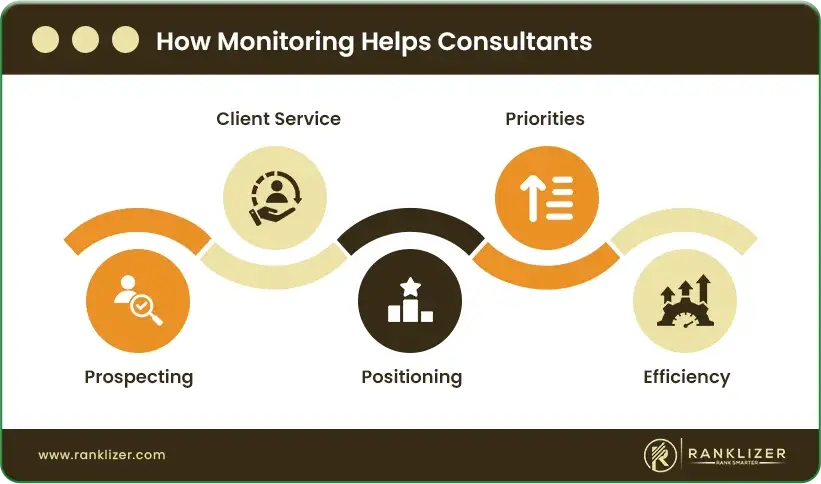
Reputation management is critical for consultants and independent advisers, because AI can now answer questions like “Who is the best adviser for X?” Questions like these threaten to disrupt the consulting marketplace. Monitoring platforms help with:
- Prospecting. A report summarizing how AI depicts a prospective client is useful input when pitching your services.
- Client service. Monthly AI visibility reports show clients the progress of ongoing work.
- Positioning. Reports reveal which fields AI associates you with as a subject-matter expert.
- Priorities. Reports can show when AI presents you as a specialist in a field even though you work as a generalist, or vice versa, so you can decide where to focus.
- Efficiency. Compiling AI reports manually is time-consuming. Monitoring tools automate the work and suggest next steps, making service delivery easier.
A consistent focus on reporting helps consultants build their brands and reputations and gives clients confidence that the engagement is being well managed.
Why Choose AI Search Optimization Services
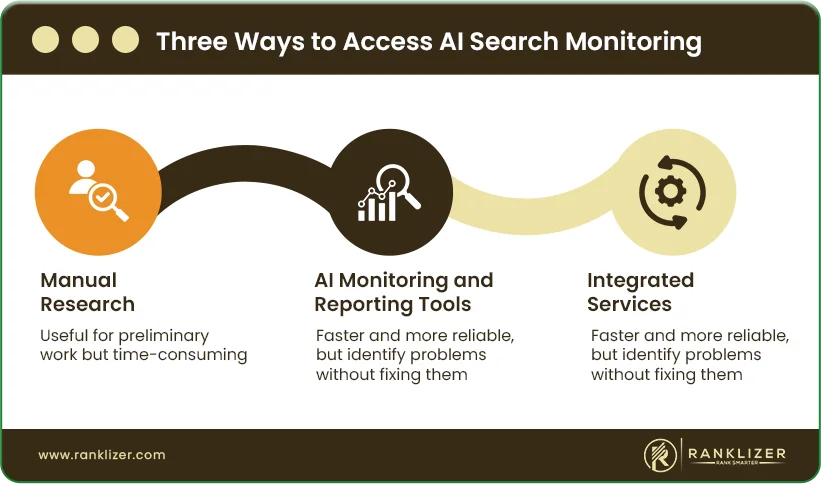
AI monitoring is a valuable research aid, but fully integrating it takes time and money. There are three ways to access it:
- Manual research. Useful for preliminary work but time-consuming.
- AI monitoring and reporting tools. Faster and more reliable than manual work, but they identify problems without fixing them.
- Integrated services. End-to-end solutions that include the technology, the optimization work, and integration with your existing processes.
Hiring an outside service makes sense mainly when your company lacks the time or expertise to do the work itself, or when problems span multiple areas of the business (for example, content, technical SEO, and PR).
A monitoring tool can help identify the gaps; closing them takes the right combination of tools and expertise.
A good approach is to monitor gaps continuously and bring in experts when the situation warrants it. Our company offers an AI search monitoring service to help identify and close these gaps.
Limits to Keep in Mind
AI tools are useful but should be used judiciously. Keep the following in mind:
- AI tools don’t always give accurate answers.
- Answers can vary from user to user based on location, history, or settings.
- Different AI tools often give different answers to the same question.
- Results are often subjective and depend on how the question is phrased.
- Gaps identified by a monitoring tool should be confirmed by a person, and the tool should be treated as one signal among many.
- Use the data to help diagnose the cause of a situation, not as the final word.
Frequently Asked Questions
How can an AI search monitoring platform improve SEO strategy?
A business’s competitiveness depends on understanding what is and isn’t working in its SEO strategy. An AI search platform shows where a business is mentioned in AI answers, which of its pages are cited, and which competitors appear for a given query.
What is the difference between AI search monitoring and rank tracking?
Traditional rank tracking shows where a website ranks on search engine results pages (SERPs) for a particular query. AI search monitoring shows how an AI model mentions and describes a business.
Do small businesses need an AI search monitoring platform?
Manually reviewing a sample of around 15 questions can help a small business spot major gaps. An AI search platform becomes worthwhile as the number of questions, competitors, or reports grows.
How long does it take to improve AI visibility?
It takes time for websites to gain visibility in AI search results. Be patient, check progress monthly, and look for trends over time.
Does traditional SEO still matter for AI search?
Yes. Solid SEO fundamentals help AI systems understand and present your information.
Closing Thoughts
AI search monitoring tools are not a replacement for traditional SEO tools or a magic fix for every SEO problem. Their main value is showing what AI tools say about your business in response to real queries.
With that information, you can refine your content strategy and compete for queries your competitors currently dominate.
Treat AI monitoring as one more means to an end. For example, you can document the questions your buyers typically ask and use them to fill gaps in your content.