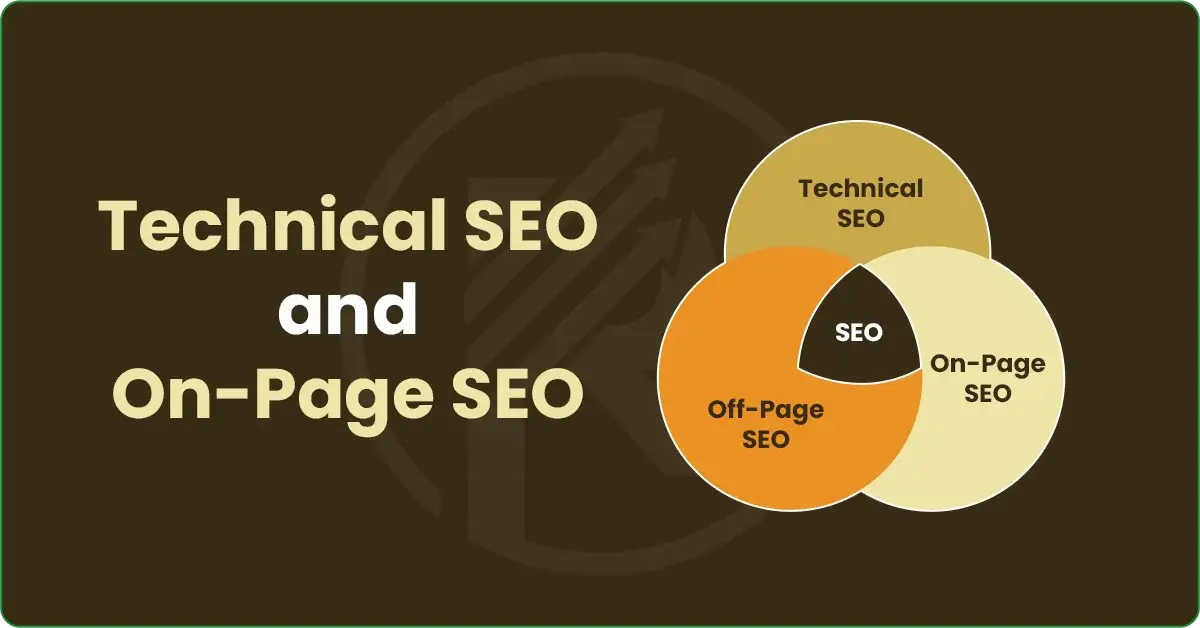


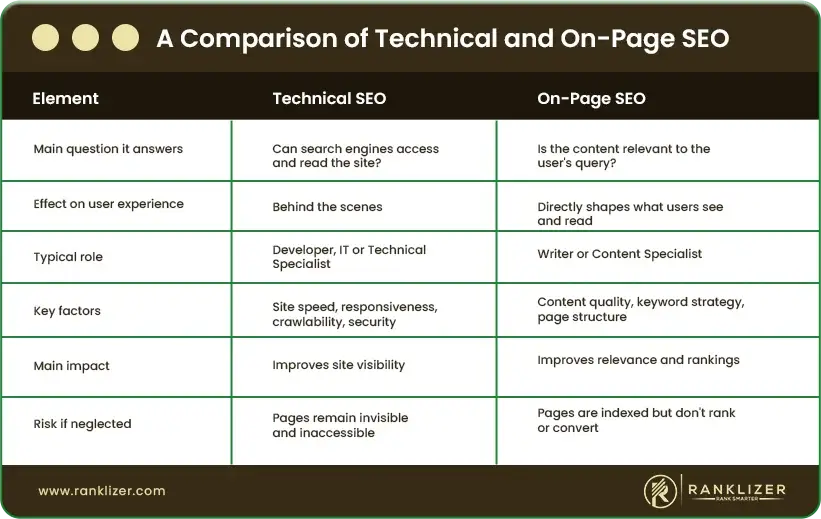
- Technical SEO makes your site crawlable, fast, secure, and indexable, while on-page SEO makes each page’s content relevant to what searchers want.
- Fix technical issues first: if Search Console shows indexing errors or slow Core Web Vitals, content improvements won’t help until those are resolved.
- Small businesses can handle on-page SEO themselves with free tools like Google Search Console and PageSpeed Insights, and bring in a developer for complex technical fixes.
- Both matter for AI Overviews, since AI systems can only cite pages they can access and easily extract clear answers from.
Search engine optimization is often treated as a single skill, but it actually splits into distinct disciplines that require different expertise. Two elements that confuse many people are technical SEO and on-page SEO.
Knowing the boundaries between them can help you decide what to address first on a website that isn’t ranking well.
In simple words, technical SEO builds the structural foundation that allows search engines to find, crawl, and trust your website.
On-page SEO shapes the content and elements within individual pages so they satisfy what a searcher actually wants. Neither discipline works well without the other, yet many site owners pour resources into one while neglecting the other entirely.
This article covers both elements of SEO. It provides a way to determine which term is more critical for a given website and explains the importance of each, particularly now that search engines use Artificial Intelligence (AI) to provide summaries of search results.
What is Technical SEO?
Technical SEO covers all of the website’s “invisible” elements that affect how successfully a search engine can find, understand and index the web pages of a website.
If a search engine bot can’t reach all the pages of your site, or hits a roadblock such as a broken link or a blocked page, those pages may never be indexed or shown in search results.
Because of this, it is important to fix broken links, keep an up-to-date XML sitemap, and make sure your robots.txt file isn’t blocking pages you want found.
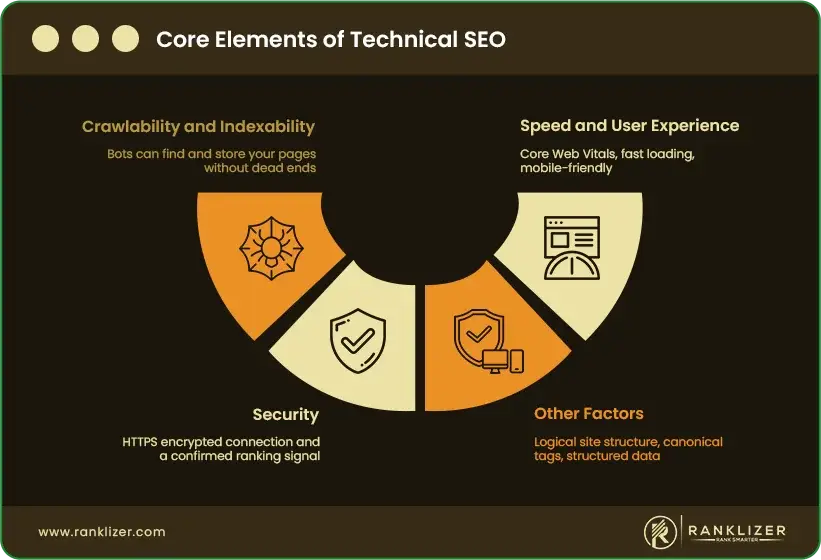
Core Elements of Technical SEO
- Crawlability and Indexability: Ensuring search engine bots can discover and store your pages without hitting dead ends or blocked paths, so pages that are orphaned, noindexed by mistake, or buried too deep in the site hierarchy never get the chance to compete in search results.
- Speed and User Experience: How quickly your site loads and how well it responds to user interactions affect both your rankings and how long users are willing to wait. Google measures these through its Core Web Vitals. Additionally, most users now access sites from a mobile device, so it is important that your site can be easily read and used on mobile.
- Security: Using HTTPS, which creates an encrypted connection between your site and your visitors’ devices, lets your visitors know that your site is trustworthy and safe to use. It is also a confirmed ranking signal.
- Other Factors: Having your pages organized in a clear and logical manner helps search engines better understand your site. Logical organization, along with canonical tags, also helps reduce duplicate content on your site. Structured data (schema markup) is another technical part that helps search engines understand what your pages are about.
While a site’s underlying framework may not always be visible to the average user, it is just as important as the site’s design and affects how crawlers and users interact with the site.
What Is On-Page SEO?
On-page SEO covers the visible, content-driven components that you control directly on a given page, including structure and formatting designed to satisfy both a reader’s intent and a search engine’s relevance criteria.
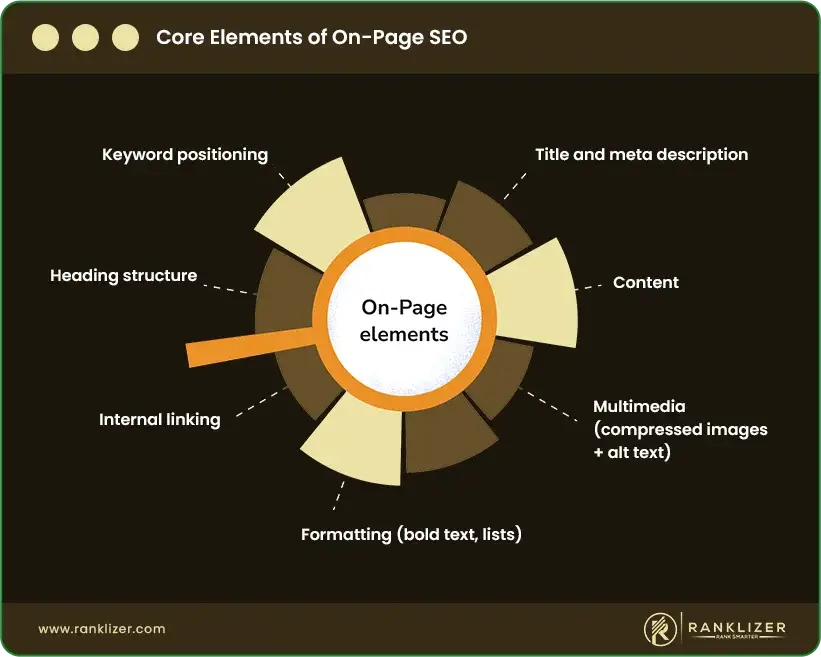
Core Elements of On-Page SEO
- Keyword positioning: Keywords are added naturally throughout web pages, including headings and page copy.
- Title and meta description: Summaries displayed in search results that help improve click-through rates.
- Heading structure: Headings format page content and signal to search engines which points are most important.
- Content: Original and detailed content that answers the user’s search intent.
- Internal linking: Links between pages of the same site that help users navigate and pass link authority to other pages.
- Multimedia: Compressed images improve page loading time, and descriptive alt text explains images to search engines and to users who can’t see them.
- Formatting: Bold text, lists and other formats emphasize key content and improve the user experience.
Relevant, well-formatted content that thoroughly covers the topic captures the user’s attention and answers the search query.
A Comparison of Technical and On-Page SEO
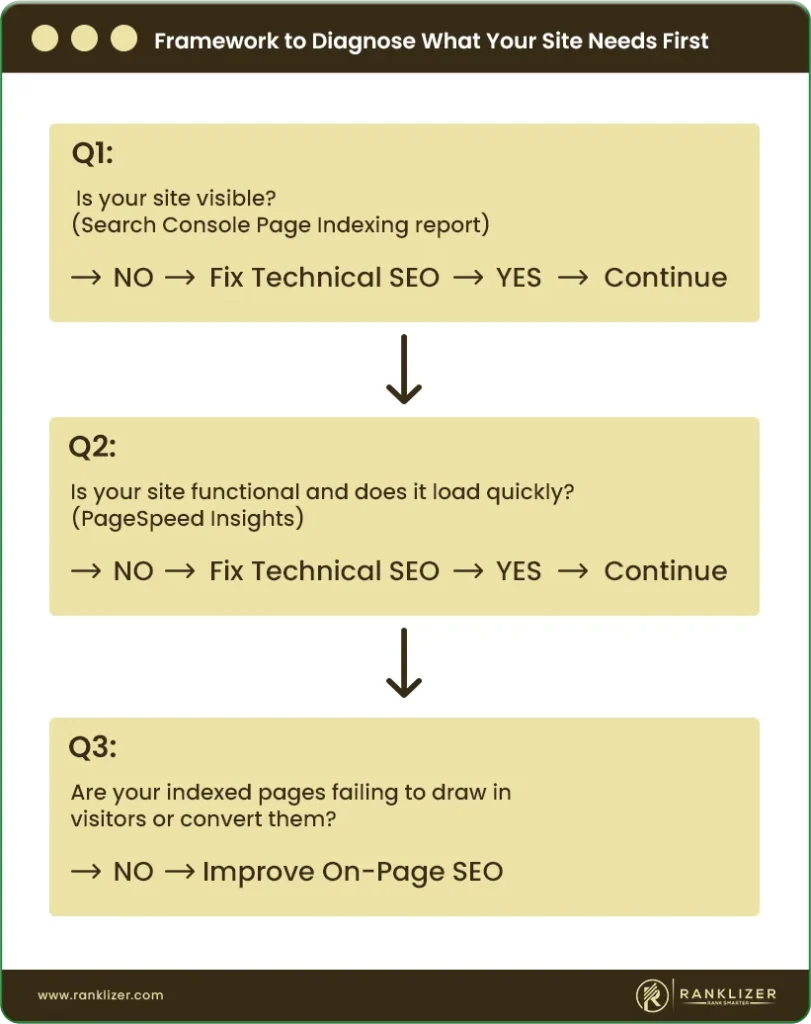
Framework to Diagnose What Your Site Needs First
Rather than guessing where your site needs the most improvement, answer these questions.
Is your site visible?
In Google Search Console, check the Page Indexing report. If your pages are not visible due to crawl or indexing issues, working on content quality won’t help until those issues are fixed.
Is your site functional and does it load quickly?
Test your home page and other key pages with Google’s PageSpeed Insights. If functionality and load time are the issues, then site structure and performance become the greatest concern.
Are your indexed pages failing to draw in visitors or convert them?
Generally, if results aren’t satisfactory, it’s often due to lacking expertise on the topic and/or poor structure and organization of the information. In these cases, it’s best to work on improving the content of the pages.
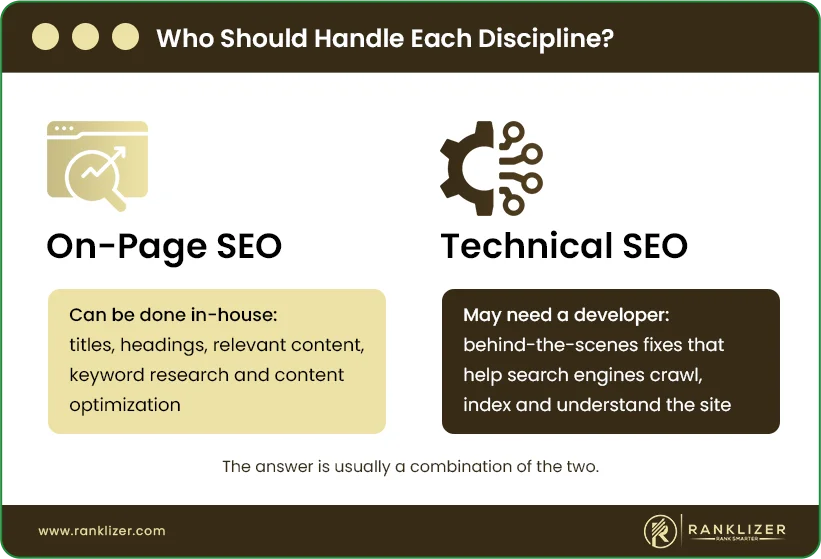
Who Should Handle Each Discipline in a Small Business?
In a small business, the main question is usually whether they can do the work themselves, or if they need to hire someone, and if so, how quickly?
The answer is usually a combination of the two.
On-page SEO is on-site factors of a website. A person does not need a background in web development to optimize title and heading elements.
Additionally, someone does not need a background in coding to identify and include relevant and useful information. This work can be done by almost any employee, especially if they have a good understanding of keyword research and content optimization.
Technical SEO is the name given to handling the behind-the-scenes elements of a website that help search engines crawl, index, and understand it properly. Fixing many of these may require a developer or web programmer.
In the end, the decision on when to engage a developer usually comes down to cost and time. It makes sense to first investigate problems and possible solutions, using resources which are often free or inexpensive.
Why This Distinction Matters for AI Overviews
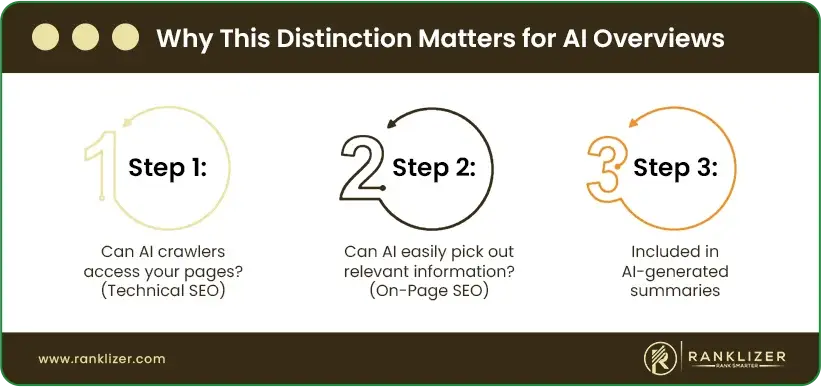
The way users search has changed, and so has the way search engines present results. Many search engines now show AI-generated summaries above the traditional “blue links,” built from information the AI finds on various web pages.
The same principles that apply to traditional search also apply to AI. If AI crawlers can’t access your pages, they can’t use your content in their summaries, no matter how helpful it is.
Your pages also need to be organised so that relevant information is easy to pick out. If a page is cluttered with unrelated text, an AI may be unable to extract what it needs.
In the end, if your content is not accessible to AI systems or not optimized in a way they can use, it won’t appear in these summaries, however useful it may be to human readers.
Common Misconceptions Worth Clearing Up
“Technical SEO only needs to be done once.” Incorrect. Technical issues can appear at any time, so technical SEO needs ongoing attention.
Most small and medium businesses should do a basic technical check at least once a quarter.
“Great content alone guarantees rankings.” Incorrect. Many things beyond content affect a site’s rankings.
A site can contain the best content in the world, but if the site is technically broken, that content will never be found.
“Expensive tools are necessary for technical SEO.” Also incorrect. Google offers free tools to analyze a site and provide recommendations, including Google Search Console and PageSpeed Insights.
Other tools provide similar information, but for a small business, Google’s free tools are ideal.
“Keywords need to be repeated throughout a page for SEO to work.” Incorrect. Search engines have become more sophisticated and now understand topic depth, so repeating keywords doesn’t matter now. Pages are ranked on how well they cover a topic.
What is Off-Page SEO?
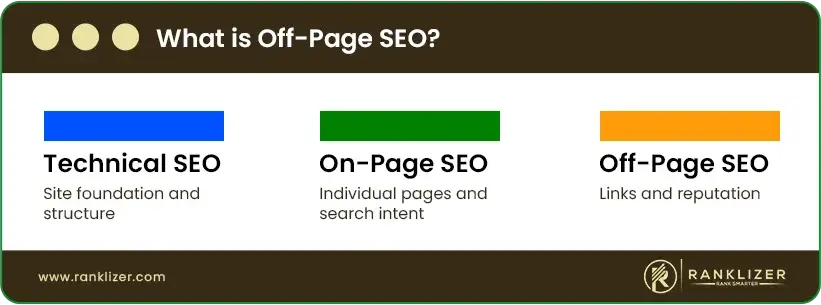
Off-page SEO is usually thought of as link building or backlinking, but it’s more than that. It focuses on external factors that influence a site’s position in search results.
It most commonly refers to links from other sites pointing to yours. Other off-page factors include a site’s reputation (trust, prestige, and so on) and how people talk about the site or company elsewhere online.
Frequently Asked Questions
What is the difference between technical SEO, on-page SEO, and off-page SEO?
Technical SEO focuses on a site’s foundation and structure. On-page SEO focuses on individual web pages and how well they satisfy a search query. Off-page SEO focuses on signals from outside the site, such as links to the site and the site’s reputation.
When should I prioritize technical or on-page SEO?
Prioritize technical SEO if Search Console shows indexing errors, poor Core Web Vitals, or other page experience problems. Technical SEO lays the foundation for everything else, and sites with many technical issues will see little improvement from on-page changes.
Can a small business owner do SEO?
Yes. On-page SEO requires minimal financial investment, and small business owners can use their time and free resources to improve it.
More advanced technical SEO may require a developer, but basic site management and routine checks are within a small business owner’s reach.
Can technical SEO affect AI Overviews?
Yes. Technical factors such as crawlability, page speed and structured data affect whether AI systems can access and understand your pages. This can influence whether your site is included in AI-generated summaries and how accurately it is represented.
How often should I check technical SEO?
A basic technical check, such as reviewing Search Console for errors and testing page speed, should be done regularly, at least once a quarter.
A full, in-depth technical audit is needed less often, typically after a major change such as a redesign or a switch to new website software.
Most problems will be caught during your regular checks. Some issues, however, only show up in an in-depth audit, which is why a full review after significant changes is important.
Closing Thoughts
A sound technical structure and good content work together to make sure your site can meet the needs of your target audience. You can optimize for search engines and for your audience at the same time, but you can’t ignore either one for long.
First, establish a sound technical structure and fix any major errors. Free online tools can help you do this. Once your structure is in place, work on your content so your message is clear and aligned with your target audience.
Ongoing work in both areas gives you the best long-term chance of reaching your business goals.