

- An AI visibility audit shows whether AI assistants mention your brand, where you appear in their answers, how accurately they describe you, and which sources they rely on.
- Run a focused set of buyer prompts several times each, with memory turned off, and record mentions, position, sentiment, accuracy, and cited sources.
- Trace every citation to its source, make sure AI crawlers can access your key pages, and compare your results against your competitors.
- Fix the highest-impact issues first by correcting inaccurate information, creating citable content, and earning third-party coverage, then repeat the audit every quarter.
An AI visibility audit is the process of running a set of buyer questions on several AI platforms and recording the responses.
For each response, note whether your brand is mentioned, where it appears in the answer, how it is described, and which sources the AI relies on. Then identify the gaps and errors that have the greatest impact on your business, and fix them.
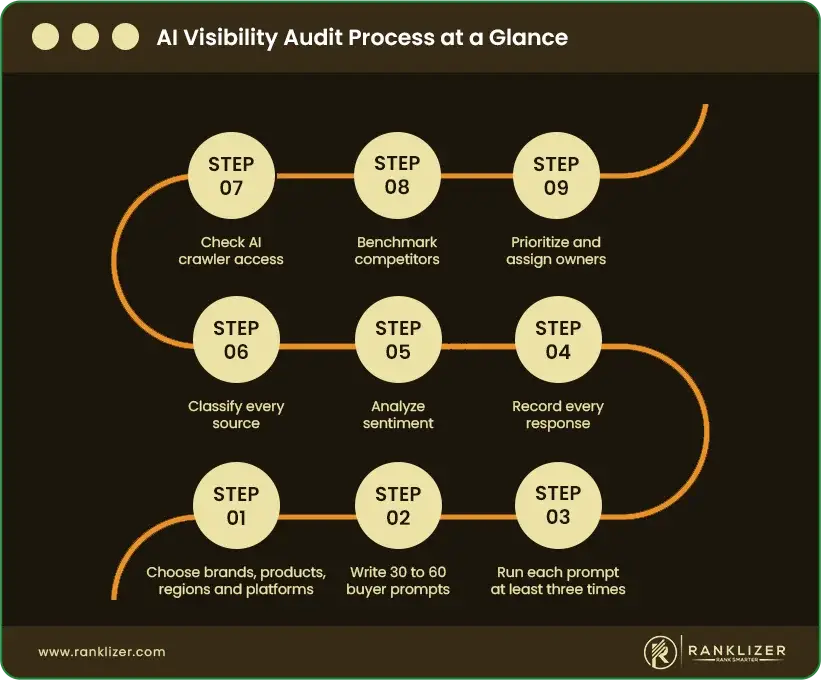
AI seo audit and content optimization services process at a glance:
- Choose the brands, products, regions, and AI platforms you will evaluate.
- Write a set of 30 to 60 buyer questions (prompts).
- Run each prompt at least three times.
- Record the results of every response.
- Analyze whether each response is favourable, neutral, or unfavourable to your brand.
- Identify and classify every source the AI cites.
- Make sure AI crawlers can access the pages that represent your brand best.
- Benchmark your competitors and find where you fall furthest behind.
- Prioritize the issues and assign owners to fix them.
What Is an AI Visibility Audit?
An AI visibility audit is similar to a brand visibility audit, but it examines how AI assistants describe your brand, if they mention it at all. A traditional brand visibility audit focuses on how and where customers can find your brand.
The difference matters. Unlike search engines, AI assistants don’t return a ranked page of links. They narrow the options down for the buyer and explain their choice.
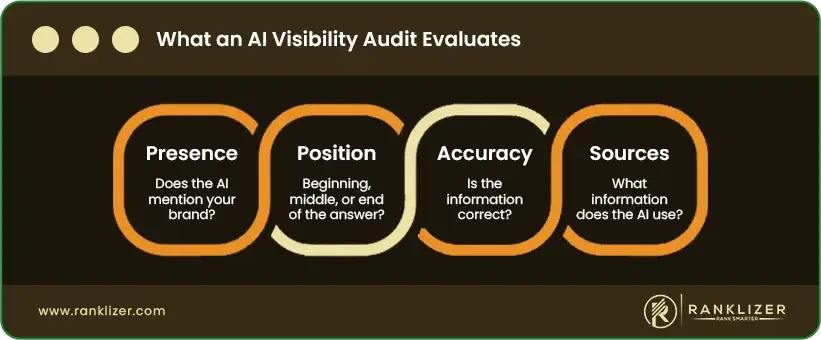
An AI visibility audit evaluates four aspects of how AI represents your brand:
- Presence: Does the AI mention your brand when prompted?
- Position: If your brand is mentioned, does it appear at the beginning, middle, or end of the answer?
- Accuracy: Is the information about your brand correct?
- Sources: What information does the AI use to reach its conclusion?
An SEO audit alone is not enough to show how your brand appears to buyers who use AI.
A search engine results page (SERP) is one of several sources an AI assistant may combine to answer a question.
However, AI assistants draw on only a small number of sources for each answer. As a result, a page that ranks highly in search may never be mentioned in an AI-generated answer.
Before You Start: Scope, Entities, and Platforms
Before your first LLM visibility audit, decide which brands and products you want to track, which AI platforms and regions you will test, and whether web search will be on or off.
Web search is usually on by default, and you can change it for individual prompts.
Entities
A map of your brand entities helps you predict which prompts buyers will use and highlight your key differentiators. Include:
- Common misspellings and variations of your brand name
- Product lines, products, and services
- Executives and subject-matter experts
- Proprietary frameworks, methods, and metrics
- Merged or acquired brands
Platforms, Localization, and Settings
Pick three to five AI platforms that your audience actually uses. Ask your sales and customer teams which tools buyers mention most often.
Language and locale affect results. A prompt run in American English may return different results than the same prompt in British English, so record the language, locale, and region for each result.
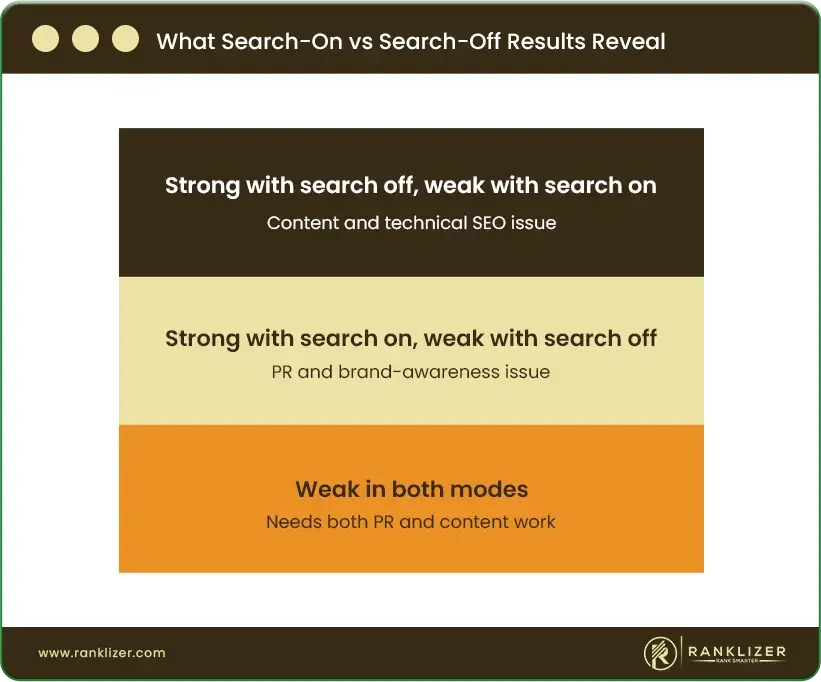
For some prompts, turn web search off to test what the AI knows about your brand from its training. For others, turn it on to test what it finds through live search. Compare the two:
- Strong with search off, weak with search on: The AI knows your brand but can’t find or cite your pages live. This is a content and technical SEO issue.
- Strong with search on, weak with search off: Live search finds you, but the AI has little built-in knowledge of your brand. This is a PR and brand-awareness issue.
- Weak in both modes: Your brand isn’t discoverable. You need both PR and content work.
If you can’t switch search on or off on a platform, simply record which mode you tested in.
How to audit brand visibility on LLMs
Build a set of buyer prompts
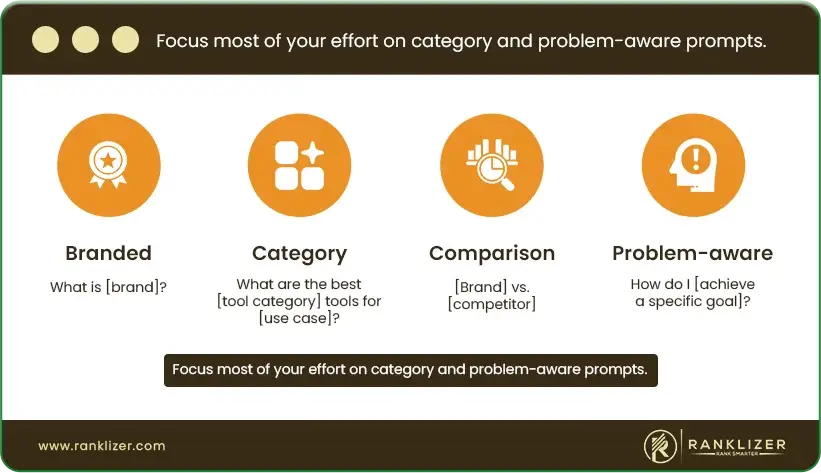
Use your branded and unbranded keywords to write questions that reflect what real buyers ask. There are four general prompt types:
- Branded: “What is [brand]?” or “Is [brand] a good choice for small businesses?”
- Category: “What are the best [tool category] tools for [use case]?”
- Comparison: “[Brand] vs. [competitor]” or “[Competitor] alternatives”
- Problem-aware: “How do I [achieve a specific goal]?”
Good sources of prompts include sales call notes, support tickets, your website’s internal search logs, and question-based queries in Google Search Console. Write 30 to 60 prompts for your first audit and review them manually.
Branded prompts are easy wins. Focus most of your effort on category and problem-aware prompts, where buyers don’t know your brand yet.
Run prompts with statistical discipline.
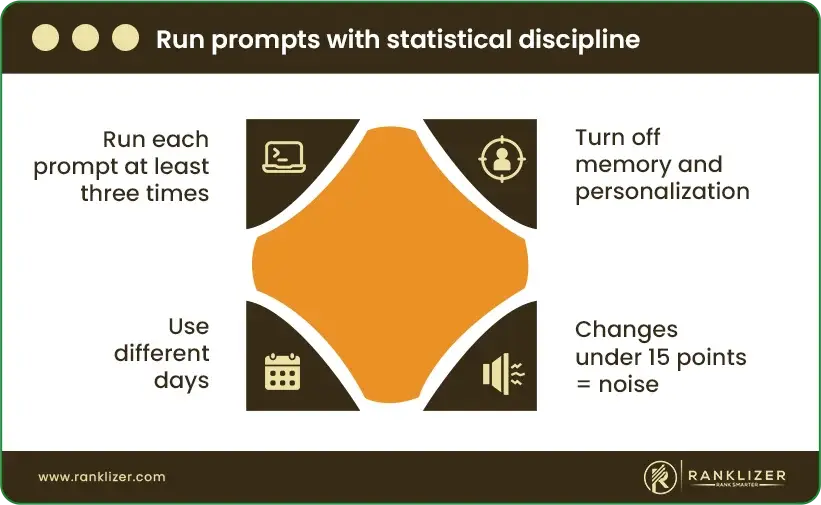
AI answers are not consistent, so a single run can’t be relied on. Follow these rules:
- Run each prompt at least three times, preferably on different days.
- Measure a mention rate instead of a simple yes or no: Mention rate = (M ÷ R) × 100, where M is the number of runs that mention your brand, and R is the total number of runs.
- Use a fresh browser session with memory and personalization turned off.
- Treat changes of less than 15 percentage points from a previous audit as noise, unless the audit used a large number of prompts.
This rule prevents false alarms caused by normal variation in AI answers.
Record mentions, position, sentiment, and accuracy
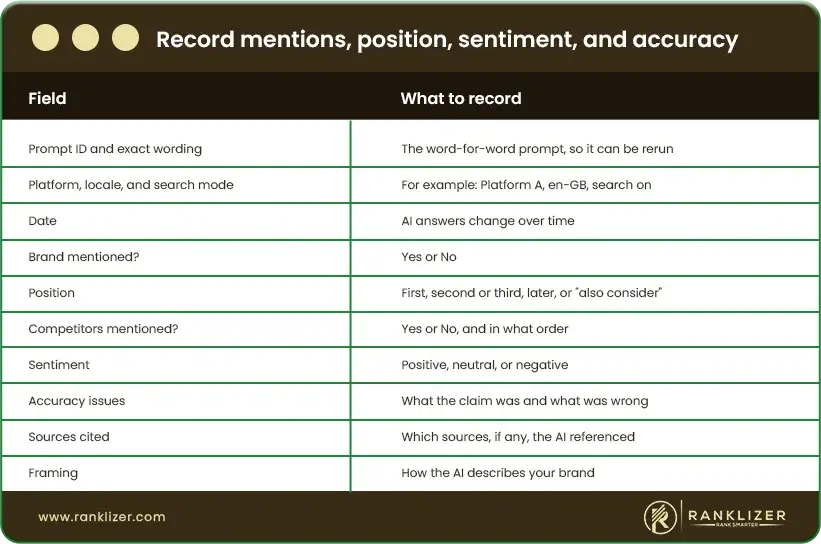
For larger AI engine optimisation audits, a shared spreadsheet works well. Record the following for each response:
Tacmind offers a rule of thumb: your results are healthy if at least 70% of your brand mentions are neutral or positive. If negative mentions exceed 10%, investigate further.
Trace citations to their sources
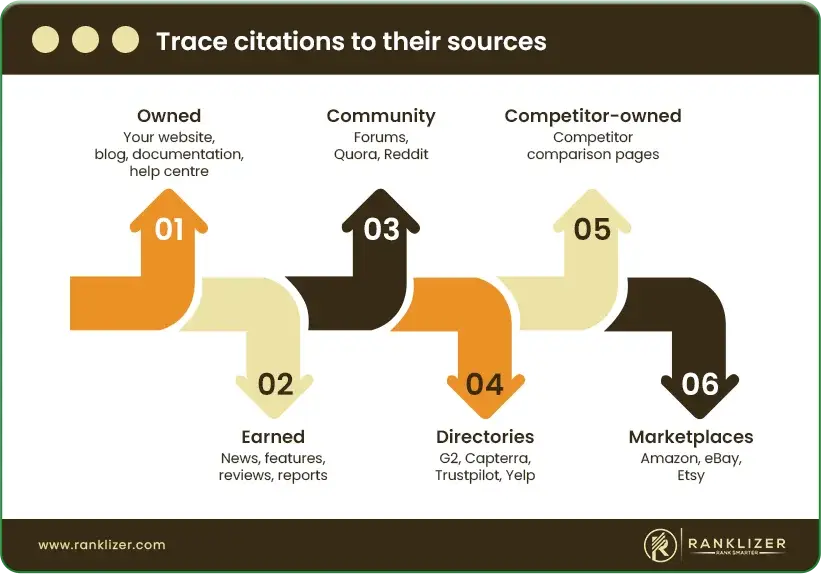
Sort every cited URL into one of these groups:
- Owned: Your website, blog, documentation, or help centre
- Earned: News articles, magazine features, reviews, and reports about your company
- Community: Forums, Quora, and Reddit
- Directories: G2, Capterra, Trustpilot, and Yelp
- Competitor-owned: Comparison pages published by your competitors
- Marketplaces: Amazon, eBay, and Etsy
This classification is usually the most valuable output of the citation analysis, because it shows which sources shape how AI describes your brand, and which ones you need to update or influence.
According to a report by Wellows, some AI platforms cite brands more often than others, and each tends to draw on a different search index. Your citation sources may therefore vary from one platform to another.
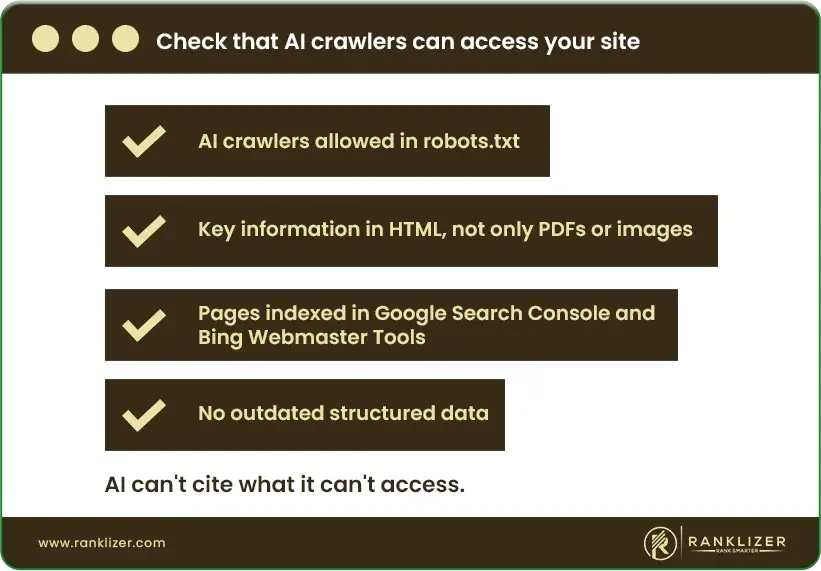
Check that AI crawlers can access your site
AI can’t cite what it can’t access. Check that:
- AI crawlers and search engine bots are allowed in your robots.txt file.
- Important information is in your pages’ HTML, not only in PDFs or images.
- Your pages are indexed in Google Search Console and Bing Webmaster Tools.
- There is no outdated structured data (e.g., schema markup) on your site.
Next, analyze your server logs. Robots.txt shows what you allow; server logs show what crawlers actually do. Filter by user agent to see whether and how AI crawlers visit your site.
Check whether they spend time on low-value pages (such as tag archives or URLs with tracking parameters) instead of your key product and pricing pages.
Note that Google-Extended is a robots.txt token, not a separate crawler, so it won’t appear in your logs. It controls whether your content is used for Google’s AI models, not whether you rank in Google Search.
Analyze competitors
Add three to five known competitors, plus any others the AI names that you didn’t expect. AI sometimes lists companies outside your space, which can be revealing.
Compare your average position and mention rate with your competitors’. Review the prompts where competitors are mentioned and you are not, and use them to build a list of content topics and outreach targets.
Prioritize and assign
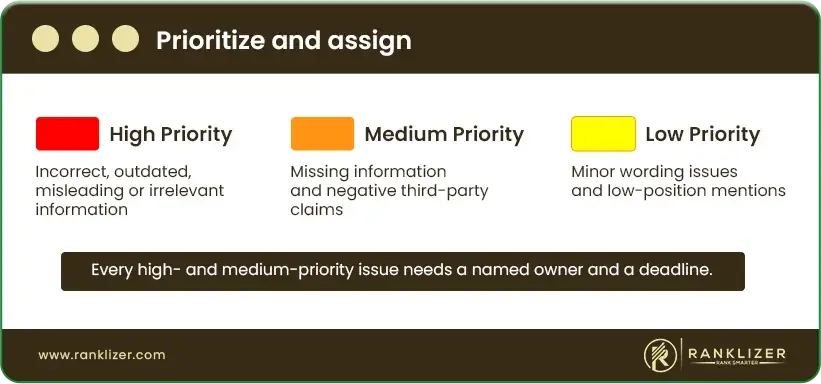
Rank issues by business impact:
- High priority: Incorrect, outdated, misleading, or irrelevant information about your brand.
- Medium priority: Missing information, especially where competitors dominate the prompt, and negative claims attributed to third-party sources.
- Low priority: Minor wording issues and low-position mentions on low-intent prompts.
Every high- and medium-priority issue should have a named owner (SEO, content, PR, product marketing, or legal) and a deadline.
Integrating SEO and AI Visibility
Traditional share of voice measures your visibility across a set of keywords, based on rankings, impressions, and clicks.
AI share of voice measures your brand’s mentions across a set of prompts as a percentage of all brand mentions in those answers.
A combined scorecard might look like this:
| Metric | Classic search | AI answers |
|---|---|---|
| Share of voice | Visibility across target keywords | Brand mentions across target prompts |
| Key pages | Pages that rank | Pages that get cited |
| Trend | Ranking changes over time | Mention-rate changes over time |
The most important part of the scorecard is tracking which pages rank and get cited, and whether that is improving. Search and AI are two of the most important discovery channels for buyers, so tracking both gives you a well-rounded picture.
The scorecard will show whether your brand has an authority problem, a content gap, or both.
Your AI Visibility Roadmap
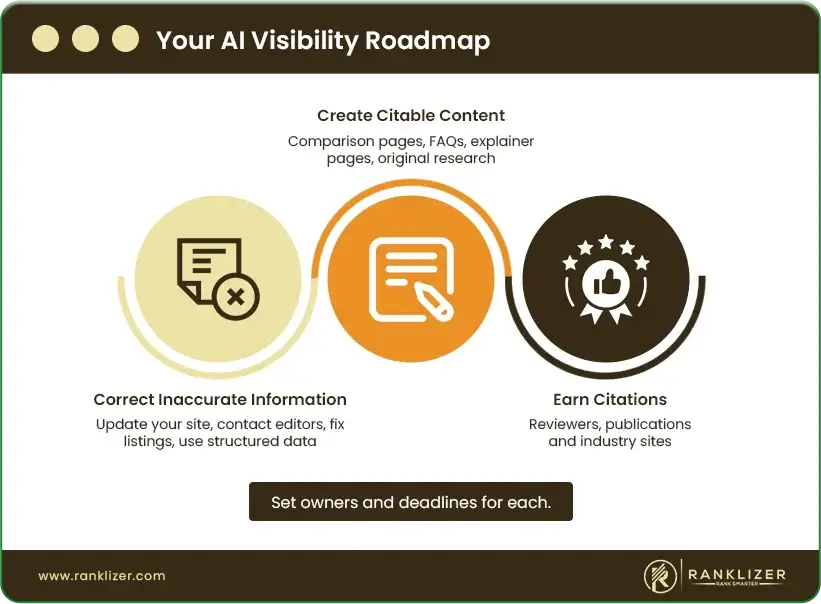
Organize your audit findings into three groups, and set owners and deadlines for each:
- Correct inaccurate information. Update your own site, contact publication editors, fix directory and listing profiles, and use structured data to state key facts clearly.
- Create citable content. Publish comparison pages, FAQs, explainer pages, and original research that AI platforms are likely to cite.
- Earn citations. Reach out to third parties such as reviewers, publications, and industry sites to generate independent coverage.
Some errors come from the AI itself and won’t change quickly. However, you can improve the web sources that AI relies on, and those improvements tend to flow into AI answers over time.
If you operate in several countries, assign owners and deadlines for each market.
AI Visibility Audits for E-commerce Businesses
Shopping questions differ from B2B research, so e-commerce audits need a few extra steps:
- Product-specific prompts: For example, “What are the best waterproof hiking boots under $150?” or “What office chair is best for people with back pain?”
- Purchase details: Check whether AI answers correctly state stock availability, price, shipping details, and return policies.
- Product accuracy: Compare AI shopping results with your product pages and correct any mismatches at the source.
- Reviews: Respond to negative reviews and fix the underlying problems.
- Timing: Run an audit before your busiest shopping seasons.
AI Visibility Audits Services for Large Brands
Large e-commerce businesses face extra challenges:
- Scale: You may need to audit many sub-brands and products across many markets.
- Governance: Clearly define who makes the final decision on changes to product descriptions, pricing, or selling restrictions.
- Quality assurance: When you run thousands of prompts, manually review a random sample of the outputs.
- Reporting: Leadership usually wants trend data. Build a dashboard showing a few key metrics, such as mention rates, types of AI errors, and the traffic driven by AI referrals.
How Should You Allocate Resources?
Manual review works well for up to about 50 prompts across three AI platforms. Beyond that, a tracking tool or an agency can help you find where content, PR, and SEO improvements are needed.
Either way, a person must still review how AI frames your brand and what it gets wrong.
Consider an agency when several teams need to coordinate or your team doesn’t have capacity. Before hiring one, ask:
- How do you handle variation between runs, and how many runs do you use per prompt?
- How do you separate what the AI knows from training versus live search?
- Will we have access to the underlying prompts and responses?
- What is your methodology beyond the final report?
- How do you connect your work to changes in traffic and revenue?
The answers to the first two questions are the best indicators of an agency’s quality.
How Often Should You Run an AI Visibility Audit?
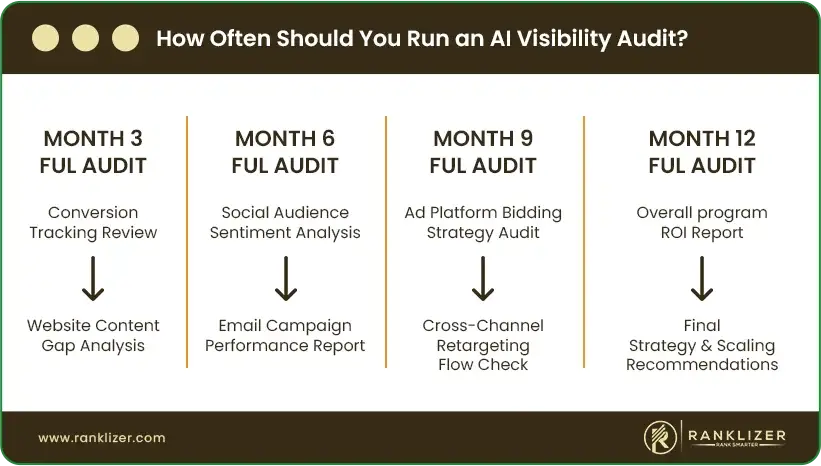
Run a full audit every quarter, and check your 20 most important prompts every month. Run an additional full audit after major AI updates or if your company receives negative attention.
Events that call for an immediate check:
- Launches of major AI models
- Changes to your company name or pricing, and product launches or updates
- Negative PR incidents or leadership changes
- Competitor product launches
- Unexpected changes in AI-referred traffic to your website
FAQ
What is an AI citation audit?
An AI citation audit is an analysis in which prompts are run to see how AI assistants mention and describe a brand or topic.
It evaluates four things: whether the brand appears in the answer, where it appears, whether the description is accurate, and which sources the AI relies on.
How long does an AI visibility audit take?
A first audit usually takes one to two weeks, and most of that time goes into analyzing the results.
Automation tools can cut data collection down to a few hours, but interpreting and acting on the results takes just as long.
How many prompts should an audit include?
Start with 30 to 60 prompts, with most of them unbranded. Run each prompt on every platform you selected. Large brands often use automated tools to track thousands of prompts.
What is the difference between an AI citing and mentioning a brand?
A mention is when the AI names your brand. A citation is when the AI references or links to a source, such as your website or a review page.
Final Thoughts
AI answers are becoming the new shortlist, and they get the buyer’s attention. An AI visibility audit replaces data with evidence: where you appear, how you’re described, and which sources shape those descriptions.
Start small. Pick 30 prompts, three engines, and one spreadsheet. Run them properly, trace the citations, and fix the P1 errors first.
Then repeat every quarter, because what you’re really tracking is the trend over time, not a single snapshot.